
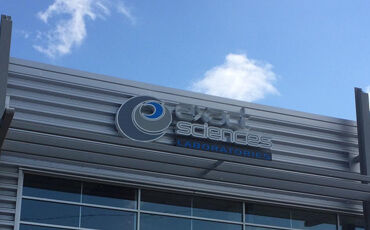

The dream of a bustling new downtown headquarters for Madison biotech Exact Sciences Corp. is dead, but Exact’s plans for a new facility are still alive and well.
In a surprise announcement Monday, Exact Sciences Chairman and CEO Kevin Conroy, flanked by Madison Mayor Paul Soglin and University Research Park Managing Director Aaron Olver, said the company is withdrawing its plans to build at the Judge Doyle Square site and will instead expand at University Research Park on the city’s west side.
Established in 1984, University Research Park is an internationally recognized research and technology park that supports early-stage and growth-oriented businesses in a range of sectors, including engineering, computer, and life sciences. The park is home to more than 125 companies employing more than 3,800 workers.
While Conroy noted the opportunity to locate downtown was appealing, consolidating its operations at University Research Park, where it already has three buildings, was “a prudent decision for our company and our community.”
Since the Exact Sciences proposal for Judge Doyle Square first received preliminary approval from city leaders in July, it’s been beset by criticism. First, opponents said the city was moving too fast in approving the Exact Sciences headquarters plans from JDS Development in an effort to meet an aggressive deadline set by Exact and JDS to begin the project.
Then, critics questioned the long-term viability of Exact Sciences. Those fears appeared to become reality on Oct. 6 when the U.S. Preventive Services Task Force (USPSTF) did not classify Cologuard, the company’s non-invasive test for colorectal cancer, as one of the main recommended screening tests. Instead, the task force named Cologuard as an alternative test that’s useful in select clinical circumstances as it issued a draft report updating its guidelines for colorectal cancer screening.
At the time, Conroy defended Exact’s flagship product and said the company was resolute in its plans to still build downtown. However, amid increasing pressure, including from Soglin — an early champion of the project — Exact appears to have reversed course.
“While it would have been a game-changing addition to the downtown landscape, ultimately we should all be excited that an innovative company, like Exact Sciences, is able to scale their operations here in greater Madison and at one of the world’s leading research parks,” Zach Brandon, president of the Greater Madison Chamber of Commerce, told IB.
“It was a disappointment to hear they weren’t going to be a part of the Judge Doyle Square project, but these things happen,” Susan Schmitz, president of Downtown Madison Inc. added. “Sometimes these things are just out of our control.
“The good news is the process that took place to get the approval at the council level was probably the best process I’ve seen since I came to DMI for a large project,” Schmitz said. “It was open, it was very thoughtful, people were trying to make things work, people asked good questions, and people wanted to understand because it was a very complex project proposal. I think we’ll get some really good new proposals, but we’ve already had a lot of the really tough questions answered, especially having to do with the financial aspects of a project like this.”
The original JDS Development proposal for Judge Doyle Square was for a $186.4 million to $203.2 million development that would provide 357,000 square feet of space for a new Exact Sciences headquarters that could have brought as many as 600 employees to the downtown area. It also included as many as 250 hotel rooms, plus restaurant and retail, but no housing. Other elements would have included a food hall, wellness center, conference center, broadcast/digital media center, and up to 1,540 parking spaces. Public funding was expected to cover about a third of the project’s cost.
(Continued)
“This is an opportunity to work with the city, build on our current footprint in Madison, and partner with the university to continue grooming its aspiring talent,” said Conroy in a written statement. “We’re grateful for the mayor and the city council’s efforts to help efficiently bring our teams together. While the chance to build a headquarters downtown was incredibly appealing, an opportunity to develop a campus allows us to bring our team together and make a prudent investment that benefits the company and community for the long term.”
Exact Sciences and its more than 425 Madison-based employees are currently stretched across three buildings in the University Research Park and the 35,000 square foot Exact Sciences Laboratories. More than 60% of Exact Sciences research and development staff are graduates of the UW System.
“The city understands and respects the reasons that Exact Sciences will not be moving its corporate headquarters to the downtown,” Soglin said. “I am encouraged that the company plans to focus its future facility planning in the City of Madison at University Research Park. We will now proceed to review other development plans for parking, a new hotel, and other commercial development on the downtown site. City staff as well as those from Exact Sciences and the Hammes Corporation have invested hundreds of hours of work into this project and I am grateful for the commitment.”
The other three Judge Doyle Square plans originally submitted to the city included:
- A $112.8 million plan from Beitler Real Estate Services of Chicago to build two 150-room mid-priced hotels, 200 apartments, 45,000 square feet of government office space, public outdoor space, and 973 parking spaces. No public assistance would be required.
- A plan from Doyle Square Development (Urban Land Interests of Madison and North Central Group of Middleton) to bring two Marriott-branded hotels offering 257 rooms to downtown, 108 apartments, 197,000 square feet of office space, 12,645 square feet of retail, and 1,302 underground parking spaces. No price was given, but the public would be asked for about $48 million to cover parking.
- A plan from Vermilion Development of Chicago for a 282-room Marriott-brand hotel with a restaurant, 93 apartments, 94,000 square feet of office space, 18,000 square feet of meeting space, 13,500 square feet of retail space, and 1,055 parking spaces. The cost would be $189.5 million, with $52.2 million in public support for parking.
Soglin indicated the city will revisit those earlier proposals and encourage the developers to resubmit their plans. He also didn’t rule out the possibility of JDS Development coming back with an alternate proposal of its own.
“A solid proposal is what you ultimately want,” noted Schmitz, “but if there was another large biotech, or maybe a couple smaller high tech or biotech-type businesses that were looking to locate in the center of the city for all the right reasons — because of all the downtown has to offer in terms of its amenities for folks who work in downtown offices — that would be the best case of all. If that could happen … I don’t know, we’ll see. Obviously we’re looking for a solid project and project that takes into consideration the challenges with parking and traffic.”
University of Wisconsin–Madison Chancellor Rebecca Blank stated she is “pleased that through University Research Park, UW–Madison is able to help the city and Exact Sciences find a solution that keeps the company in Madison. We look forward to continuing to partner with Exact Sciences on workforce development and lifesaving research.”
“University Research Park is one of the most concentrated communities of life sciences companies in the Midwest,” noted Olver. “We’re proud to be called home by Exact Sciences and look forward to the opportunity to support their continued growth.”
Click here to sign up for the free IB ezine – your twice-weekly resource for local business news, analysis, voices, and the names you need to know. If you are not already a subscriber to In Business magazine, be sure to sign up for our monthly print edition here.

