
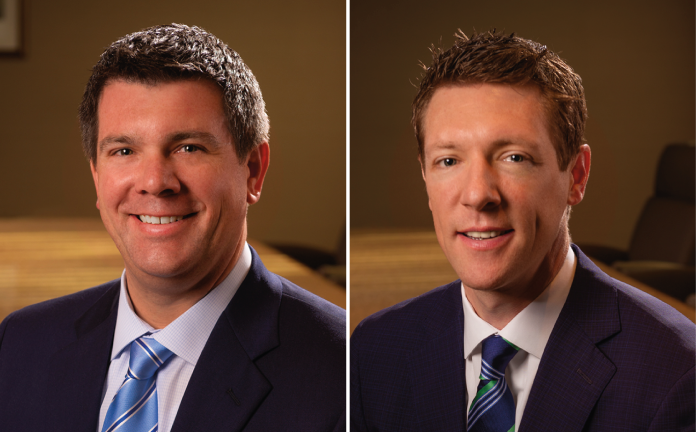
When Patrick Flesch and brother Mark Flesch collected their degrees from Miami University of Ohio, the brothers weren’t immediately ticketed for the family business — the Gordon Flesch Co. There wasn’t much doubt they would both end up there, however, and they were well prepared for the company’s recent leadership transition thanks to the vision of the company founder.
GFC, a 2016 Wisconsin Family Business of the Year award winner, recently named Patrick Flesch as president and Mark Flesch as COO as they prepare to take the reins from their father, CEO Tom Flesch, and uncles John and Bill. This is something Patrick and Mark both have wanted to do for a long time, but company bylaws demanded they first demonstrate their business-development chops elsewhere.
Founding principle
Company bylaws include a provision that required any member of the family to get a college degree and spend three years working somewhere else before joining GFC. The provision now has helped prepare two “next-generations” of the Flesch family to run the business, and they were an expectation of Gordon Flesch, who founded the office-technology company in 1956.
That’s fine with Patrick Flesch, who always wanted to work for the family business and was well aware of the rules. “That was always the goal, but I also wanted to know that I could be successful on my own,” he states. “We’re lucky that Gordon Flesch [Patrick’s grandfather] put those bylaws in place.”
Patrick and brother Mark both earned marketing degrees from Miami University. Patrick spent his first three professional years in Chicago, selling for the technology products and services provider CDW, while Mark also was off to Chicago to develop business for C.H. Robinson, a large freight-brokerage firm based in Minneapolis. Both brothers consider those years critical to their professional development and both are thankful for the experience, so if it sounds a bit visionary for the company founder to make family members prove their worth, neither Patrick nor Mark would disagree with you.
“When Mark and I were asked to join the business, we were ready and we had some sales experience, and that was sort of the proving ground for us,” Patrick says. “Could you cut your teeth in sales for a sales-centric organization?”
Actually, Patrick wasn’t entirely sure he wanted to join the family business after three years at CDW. He was living and working in downtown Chicago, he had developed a nice book of clients, and he had a pretty good setup. But that’s when his father, Tom Flesch, called him to inform him that a sales territory had opened up in Chicago’s western suburbs.
“He said, ‘Tomorrow, the branch manager will be down in The Loop and you guys can meet for lunch, and he’s going to tell you a few things, and we’ll go from there,’” Patrick recalls. He knew this day was coming, but he wanted to make sure he had the same entry-level package as everyone else.
Once back with the Gordon Flesch Co., Patrick’s primary focus was to “make trip,” a sales benchmark that provides some extra incentive for meeting one’s annual quota. Those who make trip get an attractive rewards trip, but it took a while for Patrick to build a sufficient book of business in a geographic area that had not been a “trip-winning” territory since 2001.
“It wasn’t like I walked into a gravy situation,” he says. “It took a lot of hard work, a lot of prospecting, a lot of phone calls, and a lot of knocking on doors to build up a solid sales funnel, which took some time,” he explains. “Once I got that rolling, it was a really nice place to sell.”
Given what’s required in company bylaws, COO Mark Flesch notes that succession planning “began with the beginning of our professional careers.” His early experiences in sales at both C.H. Robinson and Gordon Flesch, where he sold in the Columbus, Ohio market, were the most important of his career. At C.H. Robinson, he had to prove to himself and to his family that he was capable of succeeding outside the family business. “My time at C.H. gave me the confidence that sales are a good path for me,” Mark states. “Once I entered a sales role at GFC, it was my opportunity to again prove that I could succeed in sales but, more specifically, sales in our industry.
“Once we started at GFC, we took on entry-level sales positions,” Mark adds. “This allowed us to learn the business from the ground up and prove our abilities to work hard and be trusted to advance our roles within the organization.”
After their sales tenure, both managed sales teams in different branches and then led GFC’s east and west regions at the vice president level, their first taste of leadership. Mark believes the COO role is a good fit for him because even though he has a sales background, he’s always been intrigued by the operations side. “Since I’ve spent my entire career in sales, taking on an operations role has been an exciting challenge,” Mark states. “I’ve really enjoyed learning more about all of the other departments within our organization, and I’m working hard to have a positive influence on those departments with a unique sales perspective.”
Raising the bar
Gordon Flesch Co.’s proving-ground tradition started with the second generation to operate the business. Tom Flesch graduated in December 1974 from the University of Wisconsin–Eau Claire with business degrees in economics and administration. After college, he migrated to Milwaukee, where he eventually took a sales job at Liberty Mutual Insurance.
Tom had the additional barrier of entering the job market during a severe recession, and even a double degree didn’t guarantee him a job when they were hard to come by. He actually began his work life by tending bar in Beer Town, something he had done to earn extra income during his college days, before he was able to secure a job selling business insurance.
From Tom’s vantage point, he knew working at another company would benefit Patrick and Mark, and he wasn’t surprised when both of them built a strong book of business with many repeat customers. “They very successful on the sales side of it,” Tom says, noting they could have had good careers at CDW and C.H. Robinson, respectively. “By going there and learning from somebody else [outside the family], you get instruction from people who are not afraid to tell you what to do or when to show up. That was a great experience for both of them and a good training ground for both of them.”
When it was time for a leadership transition to begin, Tom asked the brothers what they thought, and the funny thing was they came to the same conclusion about who should handle what. Given the example of their father and uncles, who avoided a top-down command structure in favor of consensus, he wasn’t worried about sibling rivalry or clashing egos. “They are thoughtful guys. They know their roles and what they are good at.”
(Continued)
Bylaws aside, the nitty-gritty succession planning that led to the recent leadership change started several years ago but it wasn’t until 2017 that Patrick and Mark knew what their father was thinking. Tom’s only counsel recommended they focus on their roles as vice presidents. “That was always his advice and something I learned very early in my career,” Patrick says. “Just focus on exactly what you’re supposed to be doing now and everything else will take care of itself. If you do a really good job with your current role, your upward mobility and those opportunities should come.”
By October 2018, the torch had been passed, and so Patrick and Mark had a full year to absorb the forthcoming changes. Patrick notes he had a pretty good idea that he would be president and Mark would be COO because Tom mentioned those exact titles in an initial meeting. With siblings, there can be natural rivalries, especially with two brothers who could otherwise fight over who is going to be the top dog, but their distinct operational interests help prevent infighting.
“Mark and I always had a natural division when it came to our passion for the business,” Patrick notes. “Mark is much more interested in service and process and operations, where I’m still much more passionate and geared toward the sales side of the business and our emerging revenue streams like IT services and document management. I’m still living in that sales arena, so it’s a nice, natural divide of our focuses.”
Technically, Mark reports to Patrick, but it’s a collaborative management relationship and very similar to that of Tom and his brothers. “While we do have titles here, we’re a pretty lean organization,” Patrick explains. “There is not a lot of red tape, and I think there is a lot of trust among the leadership team. We challenge each other. We have conflict, but I think it’s healthy to have that conflict. That means you feel comfortable when you have strong opinion to voice.
“We try to collectively come to a decision,” he adds. “Sometimes, not everyone agrees on a certain direction, but when we walk out of that room, we’re all going forward in the same direction.”
Operational optics
Patrick and Mark have already helped the Gordon Flesch Co. become one of the largest independent office technology companies in the country, and they have gained some notoriety. Patrick is part of In Business magazine’s 40 Under 40 class, and both recently were named to Cannata Report’s prestigious 2019 Young Influencer list.
As they take command, their biggest business challenge is to keep the growth train going. GFC’s core business, the print industry, has plateaued over the past decade, and so it’s become somewhat of a commodity. Most of the top office equipment manufacturers make very similar products that run very well, so differentiating has become more difficult.
On Sept. 30, the last day of the quarter and fiscal year, orders of plastic wrapped boxes containing Cannons and Sharps were being shipped out of the company’s Technology and Logistics Center, also known as the TLC in Monona. Workers unbox the machines in what GFC calls the set-up shop, where technicians can stage the equipment, attach the accessories ordered by the customer, and get the machines ready for delivery.
Elsewhere in the TLC, call center technicians use modern communications technology to helping existing customers trouble shoot, guiding them step-by-step on how to deal with issues that arise with equipment. GFC offers prospective customers a tour of the facility, especially this customer-service function, to reinforce the comprehensive nature of after-the-sale servicing.
“That’s where our whole logistics piece takes place, and some neat technology that we utilize to take care of our customers,” Patrick says. “We made a big investment there in 2015 to completely renovate that facility and make it a state-of-the-art display.”
Even with this investment, finding other ways to grow revenue is their biggest focus. Developing the IT services — the managed services piece of its business — and growing its enterprise content management software business are two keys to differentiation. One of the things GFC is looking to do more of is help clients manage the exploding volume of digital data.
A third key to growth is developing emerging geographic markets, which include its Appleton branch in the Fox River Valley, its new Indianapolis location, and the recent acquisition of Advanced Systems Inc., an independent office-technology dealer with offices in Iowa, Minnesota, and South Dakota.
“Our products and services are constantly evolving, so our ability to remain cutting-edge with our go-to market strategies, and our willingness to invest in new technologies and services will continue to set us apart in our industry,” Mark predicts. “I’m also very motivated by our recent acquisition in Iowa. This was a strategic move for our company that will have long-term effects on our future. The team at ASI has been great to work with so far and we’re very optimistic about our ability to grow together.”
Gordon Flesch Co. is constantly evaluating merger-and-acquisition opportunities, but it’s more selective than most because of the necessity of finding a cultural fit. “We’re in full expansion mode,” says Patrick. “Our industry has seen a lot of consolidation. Smaller dealers are getting bought almost daily by larger private equity groups, or what I would call mega dealers, which are dealers of $100 million and up, such as ourselves. It seems like there is a lot of generational turnover, so the dealer-owners who want to get out of the business, if they don’t have family involved, they are looking to exit.”
If the right match can be found, it’s one way to address the labor shortage, as well. “That’s one of the key things right away when these partnerships come to fruition,” Patrick states. “What’s the talent like? Let’s get in there and meet their people to see if we have future leaders. Do we have all-star salespeople? Do we have really talented administrative folks? Those are all things that when the ink is dry on the paper, that’s step one for us. Let’s find out who their people are and how we can leverage their talent because the labor shortage is difficult, and we talk about recruiting a lot because it’s just getting harder and harder these days to find good people.”
Click here to sign up for the free IB ezine — your twice-weekly resource for local business news, analysis, voices, and the names you need to know. If you are not already a subscriber to In Business magazine, be sure to sign up for our monthly print edition here.

