
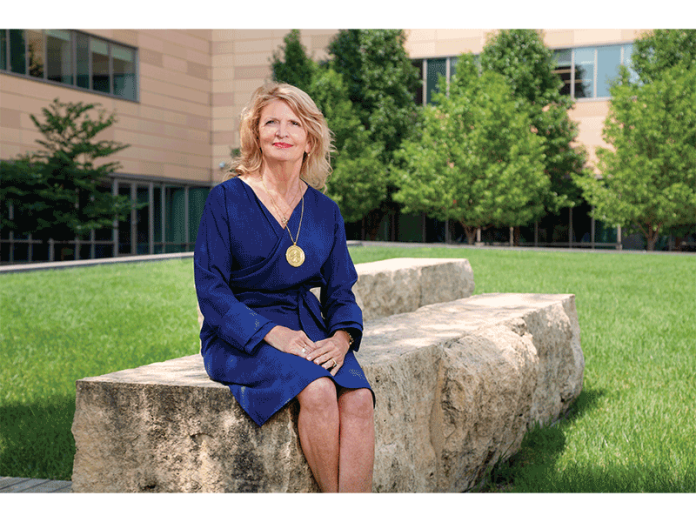
After three decades building an organization that has served tens of thousands of entrepreneurs and aspiring founders, for Wendy Baumann, the work wasn’t over.
When the former president of the Wisconsin Women’s Business Initiative was tapped late last year for the top spot at the Wisconsin Department of Financial Institutions, she jumped at what she saw as a once-in-a-lifetime chance.
A career focused on financially empowering women, people of color and individuals with lower incomes — and a long history of working with a variety of types of financial institutions — has armed Baumann to address pressing statewide issues affecting the financial sphere, from AI to cryptocurrency, fraud and more.
She is also among Gov. Tony Evers’ appointees still awaiting the approval of the Republican-controlled state Senate.
IB Madison spoke with Baumann about her career transition, the trials and triumphs that preceded her role as DFI secretary-designee and the next steps toward statewide financial security.
What pivotal personal and professional experiences have prepared you for this role?
For 31 years, I led the Wisconsin Women’s Business Initiative, better known as WWBIC. It’s really about providing hope and opportunity to individuals who want to start or grow a business, or really get themselves centered around their own personal financial household.
WWBIC partnered with financial institutions, both banks and credit unions, statewide. We worked with megabanks, major international banks, regional banks and then, of course, the Department of Financial Institutions leads Wisconsin-chartered banks.
I was appointed to the first Governor’s Council (on Financial Literacy, under Gov. Jim Doyle), and then I was reappointed with the administration change under Gov. Scott Walker and reappointed again under Gov. Tony Evers. In the past 10-15 years, I served as the Governor’s Council’s chair. The Governor’s Council on Financial Literacy is led by and through the Department of Financial Institutions.
The personal piece … was really my mother. My mother, Dr. Carol Edler Baumann, was a professor of political science.
She was born 1932 and she was way ahead … related to women. Almost all women at that time went to grade school, almost all went to high school, but not all — I bet less than half — went on to college at that time. She went on to college at the University of Wisconsin-Madison, scholarship and all, and never came back with anything less than an A, or straight As.
If I even got an A-, it would be, “Well, that’s an A-, Wendy.”
She went right from undergrad to a Ph.D. program. She ended up with a Marshall Scholarship and went to the University of London School of Economics — a huge academic career.
Right after that, she moved back to Madison. I was born in Madison, and she became a professor of political science at UW-Madison. Then, we moved to Whitefish Bay, where I basically grew up. She was a professor of political science (at UW-Milwaukee) but also ran the Institute of World Affairs, really bringing the international world to the people via the university.
When Jimmy Carter was elected president and Cy (Cyrus) Vance, who she went to China with on a delegation, became secretary of state, he tapped her on the shoulder and said, “Would you consider being assistant deputy secretary of state?”
She wasn’t really planning on leaving the UW system, wasn’t planning on moving to Washington, D.C., but she said, “I have to take this opportunity. This is a once-in-a-lifetime opportunity.”
Seeing my mom at an impressionable time, high school, early college, sort of disrupting everything … (she) was never running away from anything, nor was I running away from WWBIC after 31 years, but having that thought, “I need and want to take on this opportunity,” that was significant in my life.
What are some of your most meaningful achievements so far?
The basic piece, of course, was leading WWBIC from a literally $250,000 organization and an office in, I called it the lower level, but, it was the basement, to running an organization that ended up with six regional offices, a staff of over 60, a loan portfolio … really having made a thumbprint in Wisconsin.
And it’s not so much about being known, it’s about being known with a positive reputation — a good place to go if you want to start a business.
Also, sticking very true to our mission. Continuing to focus on women, people of color and lower wealth is very, very important. It’s an unlevel playing field. There isn’t equity yet. (It was important to) have an organization that understood that.
I was also one of the founders of the Milwaukee Public Market. That’s something that I’m still really proud of. This year, 2025, the Milwaukee Public Market — now 20 years old — was named the top market in the country and hosted the International Public Market Conference in Milwaukee.
Sometimes people have ideas and they talk about things, and that’s great, but I’m a little more action-oriented. I talked about it but then decided, we’re going to do this. I worked on it as a private citizen for a good five years, to put together a business plan, raise the money. We raised $11.5 million … and we had a public-private partnership.
It’s something I’m so proud of every single time I drive past.
What roadblocks did you encounter during those earlier points in your career?
In (WWBIC’s) beginning, 31 years ago, the world was a bit of a different place, and people a little bit tossed us to the side. Who really cares about a micro-business? Who really cares about the butcher, the baker, the candlestick-maker?
It was all, “High-tech businesses, that’s what we have to focus on. Venture capital, that’s what we have to focus on.”
My comment was, yes, to all of that, but also yes to you, who want to start a part-time writing business, or want to start a part-time bakery in addition to working as an accountant, or want to advance something else that is their passion.
A lot of the power at the time was negative toward what we were doing. They didn’t give us a seat at the table. So the challenge was getting a seat at the table, and we did. We had to fight for it.
How about more recently?
A challenge in this work and industry, for many others and for us — as it relates to financial, to banks, credit unions, securities and related — is just that train coming down the path, AI.
Cryptocurrency as well — to understand it, to stay up with it. How do we regulate it? How do we provide guidance and rules around that to keep consumers safe and sound, to allow companies to grow?
And then, fraud is still rampant. It’s still rampant at banks and credit unions and in securities, so the challenge is, how do we stay on top of that?
Before I came into the role more in government, it’s not like I was anti-regulation, but … coming in here, oh my goodness, do we need regulation. Because unfortunately, the few can take advantage of things, can take elderly and young people’s savings, and we must stay on top of that. That is part of the regulation, to make sure that we’re putting out, as much as possible, those safe and sound practices and procedures.
What do you hope to accomplish within the department?
I promised myself that for six months, I would use my eyes and my ears and not as much my mouth.
There’s nothing that needs fixing, nothing that needs addressing. However, there are always things we need to do collectively to continue on. So we (convened) a strategy session in August that (was) a futuristic look at our strategic plan, with the entire leadership team of the Department of Financial Institutions.
Because the world has changed so much — not only on the federal side but just on many, many things — we needed to really look at it, brush it off a little bit, see the parts that still really ring true, and see what we needed to augment.

