
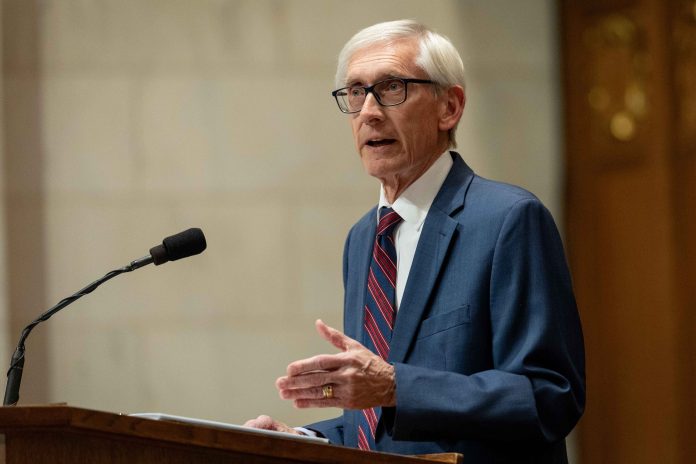
Declaring 2025 the “Year of the Kid,” Gov. Tony Evers called for $500 million more in state funding for early child care and nearly $300 million for mental health and behavioral health care in his “State of the State” address before the Legislature Wednesday night.
Those are among the highlights of Evers’ policy priorities for the 2005-27 budget biennium, and he is expected to follow up with more specific details when he delivers his budget message on Feb. 18.
The speech provided an early glimpse of elements of his forthcoming spending plan. With a projected budget surplus of $4.6 billion, he told lawmakers that $500 million more is needed for child care expansion and nearly $300 million to provide comprehensive mental health services in schools statewide, including support for peer-to-peer suicide prevention programs and expanded mental health training.
Evers said child care still is “too darn expensive” and the state must make it more affordable and accessible for children, parents in the workforce, and for the economy. He touted his signing of a bill last year to expand the child and dependent care tax credit but also said more is needed in the form of direct state investment.
On the subject of the tax credit, he noted the bill goes into effect this year, and parents and families should consider that when they file their taxes.
“Over 110,000 Wisconsin taxpayers will see an average benefit of over $650 per filer, totaling nearly $73 million this year alone,” he said. “That’s great news for Wisconsin’s working families.”
Touting his $500 million proposal for the next state budget, Evers also said Wisconsin must do more to lower out-of-pocket costs because working families are paying more for child care. He cited a 2023 report showing that child care costs in Wisconsin can consume 18% to 36% of a family’s household income.
“If those parents are under 25 and have two kids in child care, it’s closer to 70%,” he said. “The cost of putting two young kids in child care costs more than the average rent or mortgage in Wisconsin and exceeds the annual cost of tuition to send two students to the University of Wisconsin–Madison.”
According to Evers, even if people can find and afford care, families may be waitlisted for months. Child care providers across Wisconsin have 48,000 kids on waitlists, with nearly 60% of providers having unutilized capacity, often because they need more workers. Providers are therefore stuck increasing costs while keeping classrooms closed and serving fewer children. Getting private providers up to full capacity would mean serving another 33,000 kids.
Noting that he repeatedly has proposed plans to lower the cost of child care, which Republican lawmakers rejected, Evers directed $170 million in emergency funding in late 2023 to keep the child care industry afloat, but that was 16 months ago.
“We must do better than nothing when it comes to making child care more affordable,” he said. “Our next state budget will once again include sustainable, ongoing funding to make sure our Child Care Counts program is permanent, including investing over $500 million aimed at lowering child care costs, supporting this critical industry, and investing in employer sponsored child care.”
Ruth Schmidt, executive director of the Wisconsin Early Childhood Association (WECA), has said free market economics don’t work in child care and that it’s a broken business model because centers cannot charge parents enough to cover their real operating expenses and pay their staff a decent wage. In her view, that’s why state investment is needed.
Following the governor’s speech, she gave her full support to what she calls “such a rich investment into child care.”
Of the governor’s $500 million proposal, Schmidt said $480 million is for the Child Care Counts program and the rest would support coursework for early childhood educators and several other investments.
“WECA strongly supports Child Care Counts as the foundational piece helping to provide sustainability to programs and working to ensure vacant seats due to staffing shortages are open to families with more teachers working in child care,” she said.
Evers’ mental health plan is aimed at supporting children during the 80% of their lives when they aren’t in school. After securing $30 million in the last state budget for school-based mental health services, he reminded lawmakers that it was just a fraction of what he asked the Legislature to approve.
Evers called on lawmakers to start treating Wisconsin’s mental health crisis with the urgency it requires — for every one of every age but especially for children.
“The state of our kids’ mental health continues to be concerning for me, both as a governor and as a grandfather,” he said. “A kid in crisis may be distracted or disengaged and may not be able to focus on their studies, if they are able to get to school at all.”
Touting taxes
Evers also took time to note achievements of his administration and the Legislature, including an improvement in Wisconsin’s tax burden relative to other states, and the record number of people now employed in the state.
Citing a new Wisconsin Policy Forum report that says state and local tax burden dropped to a record low in 2024, he said Wisconsinites are keeping more of their hard-earned income today than at any point in the last 50 years. Through the income tax cuts he has signed into law, most Wisconsinites have seen a 15% income tax cut or more, and they will see $1.5 billion in tax relief each year, primarily targeted to the middle class.
“The state and local taxes Wisconsinites pay as a share of your income is the lowest it has been in over half a century,” said Evers, who has proposed middle-class tax cuts in every budget he has introduced as governor. “Just two decades ago, Wisconsin was in the top five states for our tax burden and the taxes Wisconsinites paid as a share of their income. Today, Wisconsin is in the bottom 16 states in the country. We have seen the largest drop in our tax burden of any state over the last 20 years.”
At the same time, Evers said the state has been able to provide “real, responsible relief” while still paying down its debt, saving where it can, and working across the aisle to be good stewards of taxpayer dollars.
“After 30 consecutive years of our state’s checking account running a deficit, we have ended all five fiscal years that I have been governor with a positive balance,” he said.
A big factor in the state’s improving fiscal situation is that more people are working and paying taxes into the state’s coffers than ever before. Wisconsin’s unemployment rate is just 2.9%, Dane County enjoys a jobless rate of 2.1%, and in September 2024, nine other Wisconsin counties reported their lowest rates of unemployment on record.
“Wisconsin ended last year with seven consecutive months of record-high employment,” Evers said. “Wisconsinites are hard workers by nature, and more Wisconsinites are working than ever before.”
In contrast to Evers, Republicans support returning more of the surplus directly to taxpayers. Wisconsin Republican Party Chairman Brian Schimming saidEvers has previously said he would deliver tax cuts for Wisconsinites, but his record proves otherwise. Last year, he said Evers vetoed three Republican proposals that would have brought $3.5 billion in tax cuts to Wisconsinites.
“This fall, Wisconsin voted to maintain a Republican majority in the Legislature to keep a check on tax-and-spend Tony Evers,” Schimming said. “Tony Evers’ address will not distract Wisconsinites from his failures as governor.”
Budget blueprint ahead
Evers’ 2025-27 biennial budget message, which kicks off deliberations that will result in a new, two-year state budget by mid-summer, will take place Tuesday, Feb. 18, at 7 p.m., in the Assembly Chambers of the Wisconsin State Capitol.

