
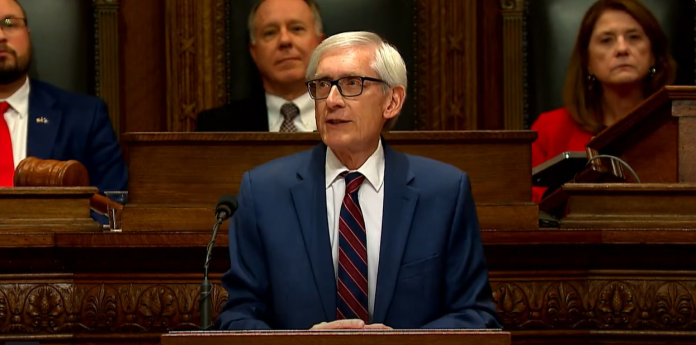

Observers of recent state budget battles would be forgiven if they have seen this play before: In Act I, Gov. Tony Evers proposes a new biennial budget with what critics call massive new spending. Legislative Republicans declare it dead on arrival and vow to rewrite it in Act II (the current phase). Then the real wrangling begins in Act III, leading to a climactic scene with the passage of a new budget in late June.
Evers’ 2025–27 budget proposal, outlined in his Feb. 18 budget address, is a new $119 billion spending plan, an increase of 20% over the previous budget. The spending plan calls for a significant investment in children — Evers has declared 2025 “the Year of the Kid” — from early childhood to higher education. It was quickly dismissed by Assembly Speaker Robin Vos, R-Rochester, and his GOP leadership group, who referenced the “Back to the Future” nature of this budget scenario. While their legislative majority is slimmer after redistricting, Republicans vowed to build their own budget, starting with programs the state is obligated to fund, and branch out from there — just like they did two years ago.
“We are not going to let Wisconsin become Tim Waltz’s Minnesota,” Vos said, a reference to the governor of Minnesota who was Kamala Harris’ vice presidential running mate. “We saw over the course of the last year as Gov. Evers continued to campaign for bigger increases in taxes, larger increases in spending like our neighbors in Minnesota, and we also know the effect that that’s had on their economy and the economy of America. We do not want that for us.”
Budget blueprint
Evers’ budget would increase K–12 education spending by $3.15 billion, which is still less than what was proposed by State Superintendent Jill Underly. It also would grow Universities of Wisconsin spending by more than $850 million and, perhaps even more important for working parents of preschool children, allocate $480 million in state funds for the Child Care Counts program, a child care subsidy previously supported by pandemic stimulus money from the federal government.
The governor, who this week has traveled across the state to rally support for his budget plan, also would expand BadgerCare and Medicaid access for new moms, devote $400 million more to expand broadband access, and allocate $145 million to abate PFAS contamination.
Evers also proposes $2 billion in tax cuts, which would include the elimination of a sales tax on electricity and natural gas for homes and cutting state income taxes on tips. However, he also wants to increase taxes on upper-income Wisconsinites by creating a new, top tax bracket to generate $1.3 billion in revenue. While Evers favors more targeted tax cuts for the middle class, Republicans reiterated their support for broad-based tax cuts.
The governor’s budget would also ban health insurance companies from requiring pre-approval for inpatient mental health services and require a grace period of six months between a person not paying a medical bill and that bill going to a collections bureau.
“Our budget includes my comprehensive plan to lower costs from child care to medication to help working families, seniors, and students,” Evers said during his budget address. “I’m providing nearly $2 billion in tax relief, including eliminating income tax on tips. And my plan invests in public education at every level while holding the line on property taxes to make sure the average homeowner will not see a property tax increase.”
During his budget address, Evers frequently criticized federal budget cuts from President Donald Trump’s newly established Department of Government Efficiency (DOGE), led by technology executive Elon Musk. Evers also took aim at Trump’s imposition of a 25% tariff on Wisconsin’s largest trading partners — Canada, Mexico, and China — saying they would harm Wisconsin’s $116 billion agricultural industry by sparking a trade war that drives up the cost of gasoline and groceries.
Evers touted a new plan designed to help protect Wisconsin’s agriculture industry and bolster its supply chain. The plan creates a new ag economist position in state government that can help farmers navigate market disruptions and volatility caused by higher tariffs.
“I’m also proposing to double our investments in the Wisconsin Initiative for Ag Exports to help increase exports for our dairy, meat, and crops, and help farmers and producers expand into new markets,” he said. “And we’re going to build upon our support for meat and dairy processors to help keep our supply chains strong.”
The response
Reactions to the budget were mixed among Wisconsin business groups. Kurt Bauer, president and CEO of Wisconsin Manufacturers & Commerce (WMC), the statewide chamber of commerce, took aim at Evers’ proposed tax increase on manufacturers. The budget proposal would limit the amount of income that can be claimed as a manufacturing tax credit to $300,000, which would result in a tax increase of $792 million for Wisconsin manufacturers.
“I find it to be incomprehensible that Evers continues to target manufacturing for tax increases, given its role in creating high-paying, middle-class supporting jobs, not just in factories but throughout the supply chain and beyond,” Bauer said. “It’s a simple economic axiom — tax something and you get less of it. Apparently, Evers wants less manufacturing and less of all the economic activity it creates.”
Bauer also criticized the governor’s proposal to create a new “millionaire tax bracket” at 9.8%. He said more than 90% of businesses in Wisconsin are pass-through entities, meaning they pay taxes at the personal rate. “As it is, Wisconsin has a wealth drain, meaning high-net-worth individuals decide to domicile in states like Florida or Arizona after retirement because of the favorable tax environment,” he said. “When that happens, Wisconsin loses tax revenue. Instead of adding a new bracket, Evers should support repealing the current highest personal income bracket of 7.65%.”
Rachel Ver Velde, WMC’s associate vice president of government relations and senior political adviser, criticized the governor’s health care proposal. Ver Velde said Evers’ proposed budget inserts costly, top-down government mandates for coverage, limits the ability of payers to prevent unnecessary or harmful care, and weakens health care consumerism. “These changes will drive costs even higher, making Wisconsin’s already expensive health care system even more unaffordable,” she said. “Wisconsin employers support meaningful reforms that promote pricing transparency and empower patients to make informed choices — without government mandates that increase costs.”
One business group that supports the governor’s budget is the Main Street Alliance, which called on lawmakers to back Evers’ proposed funding for Child Care Counts. The organization believes that Wisconsin’s child care crisis has reached the point where an industry collapse is a real possibility without state funding beyond July 1, when the new budget biennium begins. The alliance called for state funding to ensure that prices are stable for working parents and compensation for early childhood educators is attractive enough to maintain staff.
“That means folks won’t be able to afford the child care and so when parents quit, that’s going to withdraw all these people from the workforce,” said Shawn Phetteplace, national campaign director for the Main Street Alliance and its top staff member in Wisconsin. “That will cause those businesses, both family child care facilities and other child care centers, to potentially close down.”

