
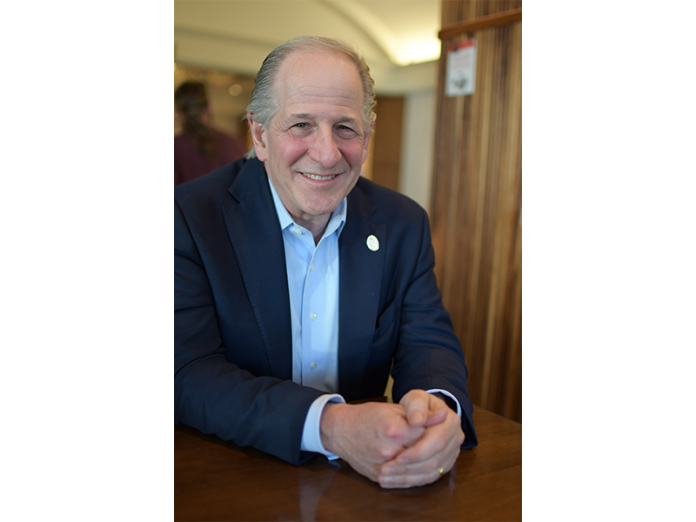
Many Wisconsin moviegoers may recognize Greg Marcus as the friendly face from the comedic previews that run before films shown at Marcus Theatres locations.
In the lead role at his family’s business, Marcus has had a front row seat to decades of growth and change at Milwaukee-based Marcus Corp. But for him, the company’s greatest value is providing opportunities for people to gather together.
The 90-year-old business has expanded its reach in recent years, both in hospitality and entertainment. In fact, last year Gov. Tony Evers proclaimed Nov. 1, 2025, as Marcus Corporation Day to honor the company’s founding and statewide importance.
Marcus Hotels and Resorts’ portfolio includes 17 hotels — like the Hilton Madison Monona Terrace, Lake Geneva’s Grand Geneva Resort and Spa, and Milwaukee’s Pfister Hotel — 24 restaurants, 19 bars and lounges, two golf courses, two spas and even a ski hill.
On the entertainment side, meanwhile, Marcus Theatres’ movie theaters now stretch across 17 states.
Marcus represents the third generation of family leadership at Marcus Corp., and while he doesn’t know if the company will remain in family hands — he noted “nobody else is here but me at this point” apart from Stephen Marcus, his father and company chairman emeritus — he’s focused on continuing its legacy of investing in its businesses and the people it employs, and creating spaces that encourage people to get out of the house and spend time with one another.
Was it always your plan to follow in your family’s footsteps?
No. I always knew it was an option, but it was not always the plan. I had what I call “the lost decade.” I went away to college in Indiana, I went to law school in Boston, I went to join a film school in California for a while after I was already a lawyer and an accountant, and then I worked for a producer. Then I ultimately came back to the Midwest and worked for a real estate developer, and then came home.
I wanted to make sure I had a good foundation to do whatever I wanted to do. Getting an accounting degree and a law degree sort of set me up to say, “OK, I can do whatever I want with those degrees and we’ll see where it goes.”
At the end of the day, I think it was a good move because it gave me a lot of flexibility.
There are always challenges, no matter what it is. I think about law school, and I’m more of a quantitative than a qualitative (person), so I’m a better bean counter than I am a writer, and law school’s about writing, so I can think of that as a challenge.
Coming into the company, coming into the family business, I didn’t come in as the CEO or the president. I was a real estate manager. It was a very entry level-ish kind of job, but still I had great opportunity.
And yet, everyone says, “Well, the reason you got this opportunity is because you’re Steve’s son and Ben’s grandson.” And that’s true, but… I was already a lawyer. You have to deal with the perception, and you just work hard and try to do your best, and you see what happens.
What did the pathway toward your executive role at the company look like?
I started there (as a real estate manager), and then I was buying our restaurant real estate because we had restaurants. We were doing Applebee’s. We don’t even have restaurants now in the public company anymore. We do have them in the full-service hotels. We’re actually still probably one of the largest food service companies in the state, but not standalone restaurants.
Then we were working on our theaters, and then they wanted me to get some operational experience, so I was the assistant to the guy who was running our Woodfield Suites operation, which was our limited service suite concept, part of Budgetel Baymont.
I was in operations there and then I temporarily took over running (the hotel brand) Baymont when the president of Baymont left after we had converted Budgetel (an earlier Marcus brand) l to Baymont. Ultimately, we sold that business. … They brought in a new leader there … and then I started working in corporate development, looking for new things for us to do and grow our businesses and ultimately became the president and then CEO.
What significant moments stand out in your tenure so far?
It’s been a whole bunch of different things. It was running a business the size of Budgetel as an operator, running that and Baymont was pretty important, and learning how that works.
Selling a business that large, and figuring out how to redeploy that capital — we sold it and then we did a big dividend and put up a significant, not our regular dividend, but what we call a liquidating dividend so it was return of capital to shareholders — and then redeploying that capital.
Getting through some of the challenges — that happened before the great financial crisis — and then getting through the financial crisis, and then growing our theater business to the fourth-largest in the country.
And then dealing with the pandemic. The pandemic was probably the most unbelievable thing to go through and the most challenging — it was just unreal.
Are you still navigating post-pandemic challenges, especially in the movie theater business? What about on the hospitality side?
I mean, it’s difficult. It’s smaller than it was but it’s still a $9 billion a year industry in the United States and $35 billion across the world, so it’s still a pretty good-size business. But it’s smaller, so that makes it harder, and that’s challenging.
Hollywood is very challenged. There’s a lot of change in the people who make the product, which makes it challenging for us.
(Our goal is) just to keep growing, looking for new things to do. The hospitality side continues to grow with properties that come into and go out of the portfolio. We manage the portfolio.
We put about $150 million into the lodging side of the business in the last few years because, with the pandemic … we had to stop. Everything was frozen. Everything was closed, so our capital projects tend to follow relative cycles, and those cycles got pushed back a little bit.
So the Grand Geneva, our resort in Lake Geneva, had a huge capital infusion over the last couple of years — the rooms redone and the bathrooms redone, the hotel was redone, we added a new 11-hole short golf course, the spa’s about to be redone. So there we’ve had a lot of capital.
The Pfister got a lot of capital. The Hilton here in Milwaukee, our convention center hotel, got $40 million of investment.
So we’ve had a lot of internal investment in the hotel business. That’s finally slowing down, but that’s been taking a whole lot of effort these last few years.
Businesses have to grow — they say “grow or die” — so businesses have to keep growing.
What are your most valuable takeaways from your career with Marcus. Corp?
Surround yourself with good people. There’s nothing more important than that. You’re never going to do it alone, and it’s proven itself over and over again just in the basics of growing our businesses and seeing the great people that have been with us.
When I think about the pandemic, had I not been surrounded by an incredible team of people, who knows what would have happened? But the good news is I was.
We’re places where people gather. We’re places where people spend time together, which is so important in today’s world, where people are hiding in their house too often — especially older people!
Younger people are out. It’s really interesting. Young people want to go out. They’re back at the movies. We see the demo(graphic)s, and our young people are back in much bigger numbers than the older people.
The older people are like, “Oh, I’ll just sit home and watch it on TV.”
Or whether it’s our hotels where people are gathering for events, life cycle events — weddings and parties and birthdays and all those things — being able to provide that is wonderful.
To continue to be able to do that, and expand that, to provide an investment for people to make a return on is important, and to provide a living for people — we employ thousands of people — and in a lot of cases it’s their first jobs, and so to continue down that path is what we want to do.
Editor’s note: A previous version of this story has been corrected to reflect that Stephen Marcus is chairman emeritus of Marcus Corp.

