
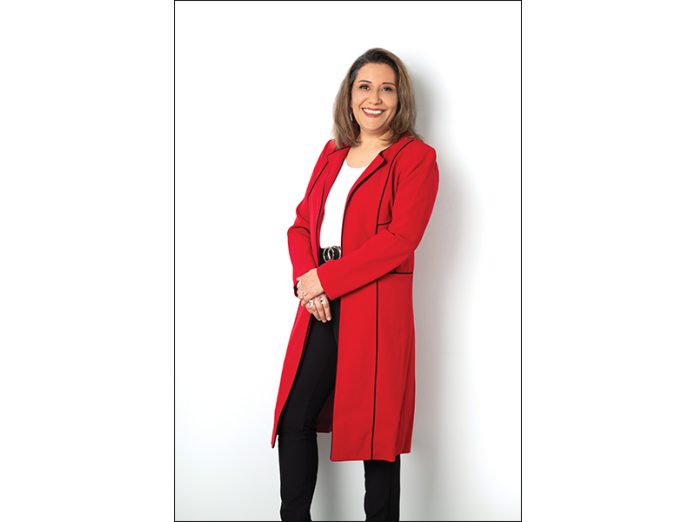
Finding economic pathways for others has been the life’s work of Nydia Martinez, the new executive director of the Latino Academy of Workforce Development.
Martinez came to Madison in 2024 from Spokane, Washington, where she was a dean at Eastern Washington University and led career-readiness programs for migrant and first-generation students. She holds a doctorate in history from the University of New Mexico and earned bachelor’s degrees in philosophy and American studies and a master’s degree in history from the University of Texas at San Antonio. She also completed a postdoctoral fellowship at Earlham College in Richmond, Indiana.
Originally from Mexico, Martinez’s immigrant experience is what drives her to help others pursue opportunities in the labor market. In her new post, she leads an organization dedicated to strengthening the Latino workforce through linguistically and culturally responsive education, skills training, and career development. We talked to her about what she hopes to accomplish.
Before joining the Latino Academy of Workforce Development, you were a university dean, which sounds like a pretty good job. What was it about the Academy that lured you to Madison?
I have always been connected to nonprofit work, and right now, one of the things that attracted me to this job is precisely the direct impact with the communities and with families and parents. One of my experiences in higher education is that I was working in rural communities. Many times, the reason that students, especially first-generation rural students from low-income families, would drop out of the university was not because they were incapable, but because they needed to go back and help their families.
In most of my work while I was a dean, and even before that when I was director of the Chicano studies program as a faculty member, and also in other institutions, it was a similar situation. I was always helping and working with the family too, and you don’t just support a student, you support the entire family, the whole community. So, in this case, with this job… the impact we’re having is not just for the individual that we’re serving, but it has an impact on their family.
Many of these individuals are supporting families in other countries, so our impact is not only at the local level, it’s at the regional and national levels, and you can even say the international level because of the impact it has across multiple generations and locations.
The Academy already has programs for computer literacy, English as a second language, a commercial drivers’ license program, and a business and contractor accelerator. Are there any programming or service gaps you want to address?
Well, currently, while we do have digital literacy, that is an area we need to build and strengthen because the needs in our communities are huge. So, it’s not just about linguistic access rights — much of the technology expertise is in English and the linguistic aspect is one part — but also the access, the financial access to new technology. Some of our families and community members, their access to their computer would be their phone and that’s all they have. At times, when there is a low-income family, they might only have one computer that they need to share with everybody, and they have one email that the whole family shares because that’s kind of how they work. So, there is a huge need in the area of digital literacy, and all organizations need to link arms and support this need across the community.
What would you like prospective donors to know about the Academy in terms of its effectiveness in transforming people’s lives?
Our organization is dedicated to serving Latino adults and, in reality, anyone who walks through our doors. We serve anybody who has a need in Madison, Wisconsin, and the region with the tools to succeed, especially in the diverse industries in the state.
We focus on construction, CDL, and hospitality… and we provide bilingual education and cultural support with industry-specific training and personalized support. It is these wrap-around services that create opportunities for individuals to develop those essential skills that meet the demands of local employers. So, with our programs, we not only prepare participants for meaningful careers, but we’re also improving their economic mobility and supporting the communities right here in this area.
What I really would like our donors to know is that we need strong partnerships with businesses, with other community organizations, and with educational institutions so that we can ensure that every learner can access those resources to try and contribute to Wisconsin’s needs in the workforce.
At Eastern Washington University, you led career-readiness programs for migrant students, among others. What concerns you about President Trump’s plans for mass deportation?
Well, I think there is a lot of uncertainty, but I’m going to keep it very broad. As a nonprofit, we have to be careful with that, but I think because there is uncertainty, we don’t really know what is going to happen. There are a lot of proposals on the table and some of them seem very drastic, but there’s uncertainty that can cause confusion and misinformation, and individuals who have the right to access resources might choose not to access those resources because of fear.

