

The United States is in a race with other countries to lead biotech research — and Wisconsin is at the forefront of that competition.
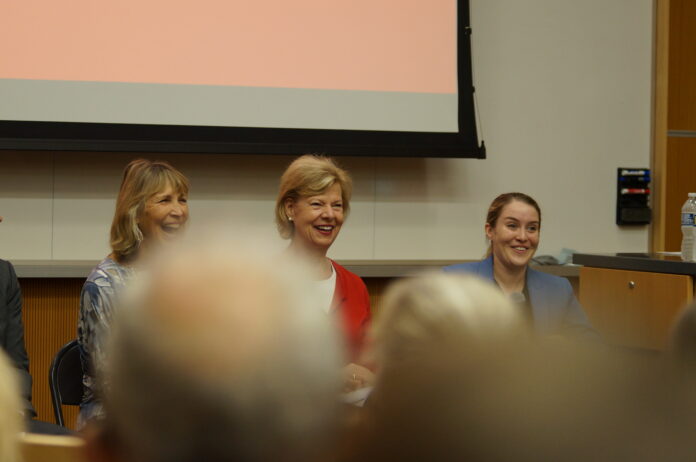
That was the contention of U.S. Senator Tammy Baldwin on Friday morning, when she was joined by a contingent of education, government and private business leaders on the University of Wisconsin-Madison campus to discuss the state’s status as a biotech hub, and where it goes from here.
Biotech is big business in Wisconsin. Wisconsin was federally designated as a Biohealth Tech Hub in 2023, with the state positioned as “a global leader in personalized medicine and biohealth technology, (that is) building a world-class center that merges advanced medical research with practical healthcare applications,” according to the Wisconsin Biohealth Tech Hub’s website. The state received about $49 million in federal grant money to advance personalized medicine, workforce development and commercialization.
“Our state’s bio health industry supports nearly 139,000 jobs and generates more than $38 billion in economic activity every single year, and we’re here today to talk about how we ensure that America remains competitive for generations to come,” Baldwin said.
Congress created the Biotech Commission in 2022 before the work began in earnest in 2023, and it will sunset in December. The point of the Biohealth Tech Hub designation was to get private and public entities in Wisconsin to contribute “to this grand national strategy that we really believe we need,” said Alina Meltaus, chief of staff of the National Security Commission on Emerging Biotechnology, at the Friday panel discussion event, held at the DeLuca Biochemistry Building.
Now, with the groundwork laid, it’s time for Wisconsin to keep moving forward, she said. As a general-purpose technology that affects not just health security, but food security and economic security, biohealth and biotech are important to people and national security.
An action plan was published in 2025 based on two years of research and analysis, Meltaus said, “and it won’t surprise folks in this room to hear that while the United States has enjoyed decades of biotechnology leadership — not just because of our outstanding innovation, but our ability to scale that and bring products to market and bring cures to patients — that lead is slipping, and it’s not guaranteed.”
She said there are other countries that have focused on biotech as a strategic national priority for decades.
As a Biohealth Tech Hub, Wisconsin is helping to scale regional leadership into national strategy to close the gap. Meltaus said there is much to do, though much has been accomplished.
“It’s a tapestry all the way from basic research and innovation to the talented folks we need to make those things possible, to the infrastructure to scale it, to the regulatory reforms to meet the technology of today, let alone five or 10 years from now, and the grand scientific endeavors we’ve all got to take on,” she said.
She said the National Security Commission on Emerging Biotechnology provided 49 recommendations to Congress and the U.S. administration to move the industry forward. About half of those have been completed.
Why Wisconsin?
Baldwin, whose grandfather was a biochemist at the UW-Madison, said Wisconsin has been successful in its pursuit of a bolstered biotech industry.
She was one of the senators to write the legislation that created the federal tech hub program, and pushed for Wisconsin to be a hub.
“This investment is more than just about growing our economy, it’s really about pioneering new technologies that can better diagnose and treat patients, improve access to care and truly save lives,” Baldwin said of the money provided by the federal government.
“That’s something we should all be incredibly proud of here, but we can’t stop there. We need to keep investing in the groundbreaking research, innovation and skilled workforce that have put Wisconsin at the forefront of biotechnology.”
Baldwin said a challenge to the hub is President Donald Trump’s administration threatening the investments that have been made in the sector.
“I’ve been fighting back, working to hold this administration to account and protect critical investments in medical research on cancer, Alzheimer’s, ALS and other devastating diseases,” Baldwin said. “We cannot expect America to lead in the next generation of medical breakthroughs if we’re cutting off the investments that make those innovations possible.”
Baldwin is proud of what has been accomplished, but she said it’s just a starting point.
“I’ll keep fighting to make sure Wisconsin has the resources and the support it needs to build on this progress, because I want the next big breakthrough in biotechnology to happen right here in Wisconsin, powered by Wisconsin workers leading the way,” she said.
According to the National Security Commission on Emerging Biotechnology, to remain competitive, the U.S. must take swift action in the next three years, or even faster, to stay competitive in the biotech sector.
That includes UW-Madison.
Michael Falk, chief intellectual property and licensing officer at the Wisconsin Alumni Research Foundation, said UW-Madison has all the pieces to keep moving forward: a university system that can bridge the gap between early-stage research and the ability to move it through the steps needed for something to become a commercial product.
“Both to bring revenue back (and) to create jobs,” Falk said. “More importantly, to solve the problems we have as humans right now: how to have better, more nutritious food, how to protect ourselves from diseases. And we have all the tools for that: medical school, vet school, of course, biochemistry, agriculture, to put all of that together to move some of these products and hit those real security issues we have as a country.”
Nita Ahuja, dean of the School of Medicine and Public Health at UW–Madison, said more partnerships with industry will be crucial moving forward.
“We need to do that more intentionally with states such as ours,” Ahuja said. “Wisconsin is known for manufacturing. It’s known for its grit, but we need all of us together to start to do that faster, so that the young people continue to see the promise of what we’re doing.”
She pointed to the groundbreaking of the $62 million expansion of the Cyclotron Lab at the UW-Madison as an example of a win.
Lisa Johnson, CEO of BioForward Wisconsin, said education working with industry has not always happened historically, but it is changing for the better.
“We have to have more collaboration, ongoing collaboration between industry and our academic research institutions, and that is starting to happen,” Johnson said. “But if we don’t do that, we can’t advance the state.”
David Borhani, senior director at Ginkgo Bioworks in Boston, said another element of moving forward is the use of autonomous laboratories to drive forward American sciences.
“We need to generate data faster. We need the AI models to be driving the experiments, driving those laboratories,” he said.
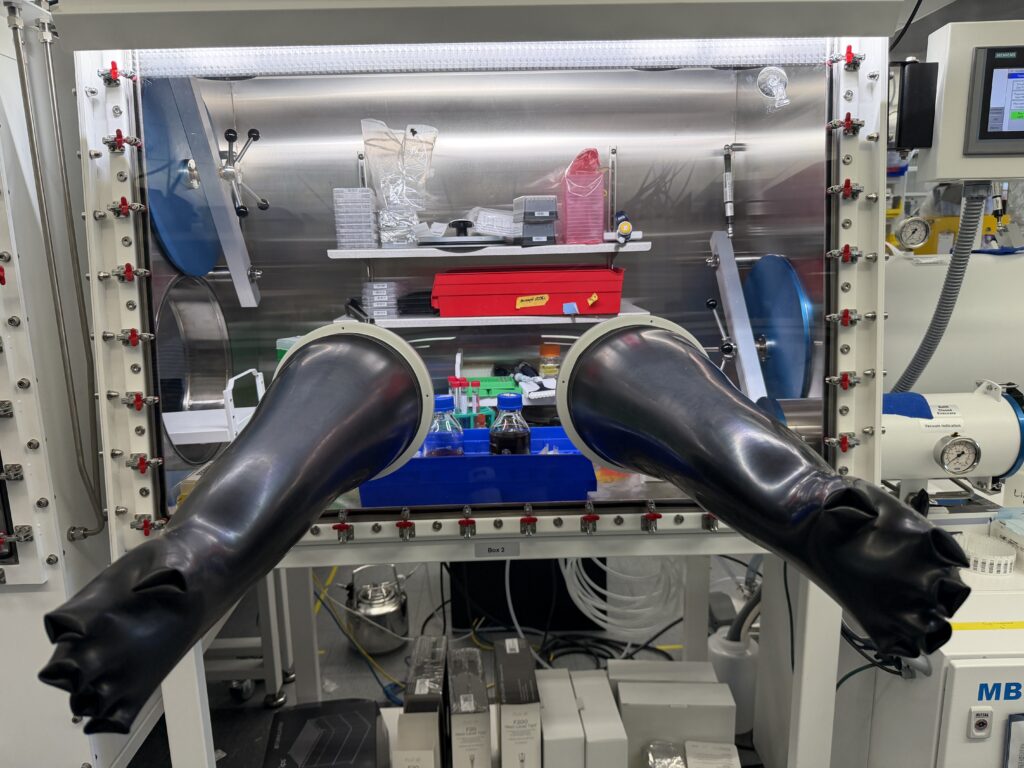
UW-Madison already has one in use called Proteus, an autonomous lab at the Great Lakes Bioenergy Research Center on campus. It has been in use for just over a year, and both Borhani and BioAutomation Lab Director Michael Botts said during an afternoon tour of the lab that it has exceeded expectations in just how much work it’s been able to complete.
Johnson said Madison is also growing quickly year after year in biotech jobs, growing at a much faster rate than the U.S. overall. Wisconsin is leading in major sectors including biopharmaceuticals, biomanufacturing and more.
“This is where innovation and companies are coming,” Johnson said. “Do not look at the reports that people are leaving Wisconsin. The students, they are coming here. Talent is coming here because of this industry, because of the growth, companies are coming here. Companies are expanding here.”
What may be the next challenge is ensuring students know of the advantages and opportunities Wisconsin has as a biotech hub, of the variety of jobs that will be in the industry, like production engineers, or of the entrepreneurial opportunities in the sector.
“We have to inspire that next generation,” Ahuja said. “We need that talent.”