
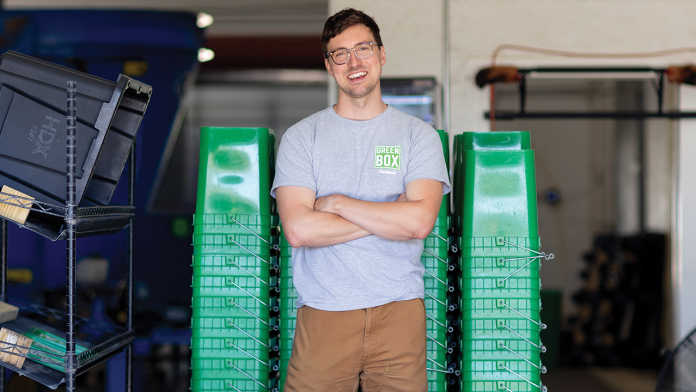

Green Box Compost founder Ben Stanger said he had “kind of a weird family” growing up, and it took him a while to realize their practices were different from those of their Stoughton neighbors.
A fence screened their backyard from public view, concealing a large vegetable garden, family dogs and a compost pile.
Composting is the process of recycling food and yard waste and other organic matter into a dark, nutrient-rich material that can be used to enrich soil.
“My sisters and I were raised vegetarian by my parents … and when you’re younger, you think everybody’s kind of like your family,” said Stanger. “When I’d go to my friends’ houses, they’re not composting, and then eventually you start to realize … why.”
He said often people may not feel they have the time, space or knowledge to make composting a part of their routine, but the practice is important for reducing the amount of waste that goes to landfills — and creating fertilizer that can be distributed to communities and organizations in need.
In 2021, after moving to Chicago and working several jobs in sustainability-related fields — including a position at the compost collection service WasteNot Compost — Stanger said he became “stir crazy” from the COVID-19 pandemic and wanted “to have some bigger effect on the world … and the Madison area.”
He founded Green Box as a compost pickup service to serve both residential and commercial customers in and around his hometown, with the goal of growing the compost collection infrastructure and making the practice more accessible. By spring 2027, his business will also include compost sales.
Green Box employs nine full-time employees (including Stanger) as well as four part-time workers. The business operates out of a Sun Prairie site at 325 Linnerud Drive, where staff process the contents of the collected compost buckets.
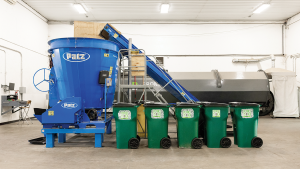
photo: Sharon Vanorny
An agricultural mixer shreds the food scraps and other nitrogen-rich organic material and mixes them with carbon-heavy matter like wood chips, cardboard, sawdust and a special type of charcoal to undergo a curing process to become finished compost.
“There were a few other companies in Madison doing (this) on a smaller scale,” Stanger said, but “I knew I wanted to get big enough that anybody could (compost) … and keep that cycle going.”
He noted that many Madison-area communities forbid food scrap composting due to concerns about rats and other pests, and that Sun Prairie had to amend its zoning code for Green Box to operate there.
“It’s a small system in the grand scheme of … commercial composting setups, but it’s really intensive, and it’s indoors … so no smells get out, no pests get in. … It’s very clean,” said Stanger.
On the residential side, customers pay $26 per month for one compost bucket — with the option of adding more for an additional charge — that Green Box swaps out for a clean bucket every other week. Roughly 1,200 Madison-area residents belong to that plan.
“(With) backyard composting … generally, you only want fruit and veggie scraps because those will break down quickly, they won’t smell bad and they won’t attract pests as much,” said Stanger. “But we take all food scraps — anything — including meat, bones, dairy … certified compostable products … avocado pits or coffee grounds… other things that you might not expect.”
Options for businesses include a variety of bucket sizes and pricing options, with basic plans starting for around $100 per month. Customers can order a 35-gallon compost cart that is swapped out for a clean cart weekly, or a 65-gallon cart that is emptied weekly — more like a traditional trash pickup service.
Stanger said Green Box has around 50 commercial customers at this point, but many have several locations.
“We have all the Willy Street Co-ops — that’s four locations … two Whole Foods locations … 15 Starbucks (locations),” he said. “We have very small restaurant kitchens, all the way up to Epic and UW-Madison, our two biggest accounts.”
University Housing Dining & Culinary Services’ partnership with Green Box began in February, and housing sustainability coordinator Malorie Garbe said the university is grateful for the service’s convenience.
“Green Box has helped us to grow our composting program to all five dining markets on the UW-Madison campus, preventing thousands of pounds of food scraps from (going to a) landfill each week,” she said in a statement.
Brandon Isaacs, Epic’s culinary program manager, added, “Green Box has the knowledge and capacity to compost the large volume of food scraps and other material we send them. They’ve been great to work with.”
Green Box has grown quickly over the past few years, diverting over 50,000 pounds of food scraps per week, Stanger said, or roughly 2.7 million pounds per year. He said those numbers are double last year’s, and next year he expects them to double again.
“I would like to be able to do 10 times that in this area,” Stanger said. “I’d say we could be there in five years.”
He added that the company is profitable for the first time this year, with annual revenue totaling around $1 million. That is generated by its compost collection services, and he anticipates a boost when Green Box begins selling its finished compost product.
Right now, the company mainly gives away finished compost to schools, community gardens and nonprofits, Stanger said, which in turn use it to enrich soil for planting beds. Starting in early June, however, Green Box began running a compost site in Fort Atkinson, which will generate a substantially higher volume of finished compost.
“We’ve outgrown the composting setup here (in Sun Prairie),” said Stanger. “With (the Fort Atkinson site’s) yard waste and the food scraps that we’re bringing there, we’re going to end up making probably 5,000 (cubic) yards of compost by next spring. … So we’ll start selling at a large scale next year.”
Stanger said while the company’s early growth has been rewarding, at its core, Green Box remains a “communal endeavor” to expand composting from a private backyard practice to a habit the greater public embraces.
“There are so many issues going on right now, and things like this hopefully are part of the solution,” he said. “Seeing more people sign up, and the (composting) community grow bigger and get more connected, is really cool.”
Green Box Compost
withgreenbox.com

