




Trying to make up some lost COVID-19 ground, retailers have launched the 2020 holiday season far earlier than usual. In the early stages of the pandemic, it was thought they would have to start holiday sales the day after Halloween. Scratch that. Mid-October was the unofficial launch date for many retailers as they tried to cut their expected losses during a season when they typically generate the bulk of their annual sales receipts.
In this look at the possibility of a retail rebound, we talked to independent retailers on State Street, who also were impacted by racial unrest, and on Monroe Street. We also talked to retail experts at the University of Wisconsin–Madison and at Madison College to get their take on what shoppers can expect this holiday season, the shaky future of shopping malls, and how Madison’s embattled restaurateurs, still limited by public health orders, hope to salvage something from the 2020 holiday season.
What we found is that the pandemic has made the Amazon Effect even more pronounced, and it has forced retailers to be more creative with their online and social media marketing and merchandising. The pandemic has also been a boon to the market share of other massive retailers such as Home Depot, Costco, and Target, which have millions of dollars in resources to throw at a pandemic problem and solve it.
The fact that Amazon, which is investing millions of dollars in new distribution facilities in suburban Milwaukee and in Madison, has emerged as an even more dominant retail force comes as no surprise to industry observers. The retail giant now claims nearly 50% of the e-commerce market, and while independent retailers are trying to play catch up, that share could grow if the pandemic lasts well into 2021. “It’s partly because the rest of the industry wasn’t prepared, and this was their sweet spot,” notes Jerry O’Brien, executive director of the Kohl’s Center for Retailing at UW–Madison. “If you don’t want to leave your house and have something delivered, Amazon is the brand. It’s like Kleenex and facial tissue.”
As of this writing, Dane County was still in Phase 2 of its reopening plan, which has been the case since June 12. Phase 2 allows most businesses, including retail stores, to operate at 50% capacity. That was replaced, at least temporarily, by Gov. Evers’ Oct. 6 order directing Department of Health Services Secretary-designee Andrea Palm to issue an emergency order limiting public gatherings to no more than 25% of a room or building’s total occupancy. This directive will remain in effect until Nov. 6 and applies to any gatherings at locations that are open to the public such as stores, restaurants, and other businesses that allow public entry, as well as spaces with ticketed events.
Weather permitting, Dane County had been allowing outdoor gatherings of up to 100 people, with proper social distancing, while indoor gatherings are limited to 50 people. With winter approaching, outdoor dining will no longer be a viable option, and the local business owners we spoke to say it would certainly help if Washington could pass another round of stimulus before more retailers and restaurateurs pass out.
Still, as independent retailers have pivoted to COVID-19 realities, not to mention the damaging aftereffects of societal unrest, there are some silver linings. First and foremost, small retailers that have put off advanced e-commerce capabilities found they had no choice but to connect with customers in “virtually” every conceivable way, and if they can survive the pandemic, their enhanced e-commerce capabilities have them poised for a strong rebound.
Retailers that are nimble and can “omnichannel” will have a competitive advantage as they try to salvage something out of 2020 with reasonably strong holiday sales. Betty Hurd, marketing instructor and retail expert at Madison College, notes that home-shopping habits are already well ingrained. “You know the old-school saying that it takes 21–28 days to form a habit? Well, we’re into this pandemic for more than 20 weeks,” she notes. “We’re at home or not going out as much, and we’re more comfortable shopping online.”
With the 2020 holiday season underway for the better part of two weeks, consumers may have already noticed the varied ways retailers are trying to meet them more than halfway. The in-store and curbside pickup employed during the early stages of the pandemic remain, and gift cards will be more important than ever. During the summer, some mall retailers set up outdoor tent sales that may or may not survive the holiday chill, and malls plan to set up secondary pop-up locations and are promoting their buy online, pick up in store services.
Soapy sales
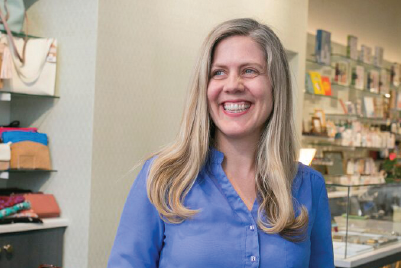
Like most retailers, 2020 got off to a strong start for Stacey Scannell, owner of The Soap Opera, 319 State St. From January through early March, sales were strong for her bath and grooming products, but when the pandemic hit, it caused even more emotional damage than financial damage.
“It was really scary because nobody knew what to expect, and everybody was stocking up on things,” Scannell recalls. “We didn’t do terribly, but the thing that really hurt us in March was having to close our doors.”
Well, not entirely. The Soap Opera upgraded its website in 2016, so many products carried in the retail store — it has more than 4,000 stock-keeping units — are presented on the website. “That saved us,” Scannell states. “I don’t know what I would have done without a website. We were cranking out orders.”
However, Scannell had to let go of some of her staff — the sales floor employees and part-timers who were students — because it didn’t make sense to keep them. It did make sense to hang on to her web staff and transition one long-time floor worker to the web because that’s where help was needed. “We just had to switch gears really fast when everything hit because the lockdown happened fast,” she says. “One minute we were doing business as usual and then the next week, it was close your doors right now. You’re not allowed to be open. It was so crazy.”
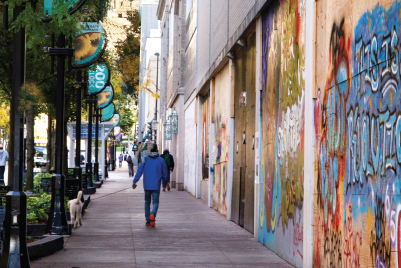
Having an e-commerce website was a lifesaver even after the lockdown ended. The Soap Opera was closed from March 17 until the end of May, but in-store sales never picked up again, and the societal unrest that followed the May 25 police-involved murder of George Floyd in Minneapolis explains part of it. State Street businesses saw their storefront windows smashed and some were looted as violent demonstrators took it out on local business owners. “My in-store is down significantly to unsustainable numbers,” Scannell acknowledges.
The tension may have lifted, even after another round of vandalism following the Aug. 23 police shooting of Jacob Blake in Kenosha, but stores remain impacted because of the inability to get beyond Phase 2 of the Dane County reopening plan and lingering safety concerns.
Scannell’s customers have admitted as much to her. One customer drove for an hour to shop, only to find the store boarded up. She turned around, got in her car, drove home, and called to place an order over the phone and have Scannell ship it instead. “There is a sense of downtown being unsafe right now and being scary for a lot of my customers, which definitely affects us,” Scannell acknowledges. “I can’t say it doesn’t.”
In the isolating environment of a pandemic, it doesn’t hurt to sell pampering products, but it’s her e-commerce capabilities that give Scannell hope for the holidays. Even though the pandemic prevented Scannell from attending trade and product shows — both Tracey and her husband have respiratory issues — she started ordering holiday merchandise in July with the help of vendors who sent her catalogs. She’s ordering more conservatively than she normally would, but not too conservatively. “I don’t want to risk having too much inventory after Christmas,” she explains. “On the flip side, I’ve talked to other business owners and they are saying, ‘I’m just going to get what I know sells and just keep to that,’ and I don’t think that’s the right approach. The right approach is let’s get things that make sense.”
Holiday sales typically comprise 50% or more of The Soap Opera’s annual receipts, and as much as Scannell would like to maintain that, she can’t realistically forecast it. “I have projected that sales will most likely be down roughly 30% overall,” she notes. “That’s kind of where we’re floating. I’m hoping that ends up not to be the case, but you never know.”
Necessities and luxuries
With one key exception, it’s a somewhat similar story for Amy Moore, owner of Little Luxuries at 230 State St., which offers what Moore calls a carefully curated collection of spa, tabletop, and personal interest gifts. As 2020 unfolded, she was looking forward to celebrating the store’s 30th year on State Street, but the events of this bewildering year are hardly what she anticipated.
What was supposed to be a milestone year turned into a challenging one in large measure because of one key difference between her store and The Soap Opera. Prior to the pandemic, Moore had started to work on her website’s design elements, but the pandemic required more than the brochure site she had established to give shoppers an idea of what was in store. “It took us a little off guard when the pandemic hit home here. Immediately, we were impacted pretty greatly because we were not set up to offer goods on our website,” she explained. “We’ve always had a website where people could get a flavor of who we were, but when we closed our doors immediately, which happened initially, we quickly needed to jump over to social media.”
The closing gave Moore some breathing room to develop a website that gave her the capability to sell online, but not before being drastically impacted on the front end. Since then, Little Luxuries has worked with a local business to establish a ramped-up web platform, and work to grow that platform continues. “We have carefully curated gift collections with gift boxes of various themes, and then we have our favorite items available online,” she says. “So, now, we’re working on driving our customers to that destination.”
At the time of the interview, Little Luxuries could allow 10 people into the store at a time, with the usual COVID-related trappings of the mask requirement, ubiquitous hand sanitizer, and Plexiglas barriers. In addition to in-store opportunities, Little Luxuries offers curbside and delivery service and shipping. The online sales pivot helps Moore connect with customers in the ways they are comfortable for them.
Having to scramble at the onset of the pandemic kept Moore as busy as she would have been had the store remained completely open. “We just quickly pivoted over to selling online,” she says. “While that was still in motion, that wasn’t up and ready to go immediately. With social media, we just kind of posted online and we had to shift to our own homes initially. Using USPS [U.S. Postal Service], we relied heavily on flat-rate shipping boxes and just tried to make the shopping experience as easy as possible.”
With sales growing again after that initial halt, the store is nowhere near what it’s accustomed to, especially given its location on State Street — normally, one of the more heavily trafficked streets in Madison. Their perception of safety is part of the calculation, and that reinforces the need to have robust e-commerce.
“To go from the traffic that we’re used to where we are currently — we have pedestrian counters on the street, and at points you can see we’re down 50% traffic, 60% traffic,” Moore laments. “As far as sales go, that lower traffic count can immediately align with sales if you are not already established online. So, now that we do have a [e-commerce] website, it’s all about marketing that before the holidays and making sure that people still know the way to connect to us.”
For independent retailers, the cost of shipping, and time commitment associated with it, can be excessive, but Little Luxuries has found ways to make it as efficient as possible. Moore created a shipping and receiving space in the basement, but with the amount of time it takes, it’s like balancing several businesses. With a commercial website, delivery, and in-store sales, “those are all uniquely different ways to operate as a business,” she notes. “Considering our team is quite small, it will be an interesting experience, unlike anything we’ve had to do before. We’re kind of learning as we go.”
As a result, holiday sales expectations are tamped down even though the holiday season is starting earlier. “Thirty percent of our sales, on average, is what is determined in that mid-November through December period — the holiday season,” Moore notes, “and I’m assuming it will be 30%, but when we talk about 30% in a year like this, that volume will be less than what we’re accustomed to just due to the limitations.”
The silver lining is that if Little Luxuries can survive the pandemic, it’s new ways of doing business should really bear fruit on the back end. “It will take some time, but once we get there, we’ll be established, and we’ll be doing business in a new way,” Moore says. “This expansion online will definitely stick with us and offer more ways in which we can connect, and especially multigenerationally connect. On the back end of this, we’re going to be stronger as a business and more connected to our community than ever before.”
Monroe doctrine
With the completion of reconstruction work on Monroe Street, Abigail Barth, owner of ReFind Style, 1639 Monroe St., thought her 3-year-old consigned clothing store cleared a hurdle, but street construction has nothing on COVID-19.
So, here she was, with this wonderfully revamped street, and then comes a pandemic. During the reconstruction of Monroe Street, it was about everyone coming together, being together, getting through it together. What is interesting about this scenario is that everyone’s struggle is so different from person to person and from business to business.
“That’s been devastating,” she acknowledged. “Everyone was looking forward to a lot of the new things to come from Monroe Street. I was really looking forward to this summer and the expectation that there was going to be this new vibrancy on Monroe Street. There was a day a couple of weeks ago, a really slow day, and I walked outside, and I looked down the street and there were no cars. Just sad.”
Barth describes her primary customer demographic as a woman in her mid to late 30s who knows who she is, knows how her style represents her, and can have fun with the apparel ReFind Style provides. The 2020 business slump is all the more disappointing because the year started out pretty well and because Barth is going through that crucial third year of business that tells retailers whether or not they will have the momentum to keep moving forward. Heading into March, it felt like full steam ahead. “We looked back and painfully laughed because we really felt good at that point,” she relates. “Then, when everything fell apart, it was pretty devastating.”
After allowing herself a day to cry and take a few days off when the shop was closed, Barth came back, put her head down, and started to develop a better website on her own, using a website template maker that people could shop from. She had dabbled in getting some of her vintage items on Etsy, but she had to take a 72-hour self-education session on how to make a website.
“My consignment is about 50%–60% vintage clothes, and then Etsy is out there for the really serious vintage buyers in the world, and I thought to myself, everyone in the world is sitting at home, doing nothing, and so let’s crank up that Etsy shop as well. That was our focus for about two months.”
Call it a refocus, a pivot, or a transition, but whatever it was, call it very necessary. “That felt very difficult for so many reasons, from people concerned about the health crisis and that not being dealt with correctly, and then it just felt the problem as a whole was handed over to the business owners.”
As a sole proprietor, she applied for but did not receive a PPP loan, but she would try again if and when Congress extends the program. She did receive $3,000 in assistance from Dane County, which was most welcome. “That was a lifesaver, literally, thrown to me out in the middle of the ocean,” Barth says. “The transition has been the most difficult. My sales are down exponentially. I mean, right now, I’m doing 30% of what I was before.”
When it comes to buying things on consignment, many people prefer to see merchandise in store. Adding to Barth’s challenge is that people aren’t going out as much, and they aren’t spending money unnecessarily. One way she’s tried to overcome that is by arranging private shopping sessions for customers who don’t want to come to the store if other people are there. “It helps them to feel special,” she says.
Interviewed in early September, Barth noted she had a customer in the store the day before who was very excited to treat herself, but she’s an exception to the current rule. “People are very excited to treat themselves to something special, but I also understand that my demographic is the people who are following the recommendations of the CDC [Centers for Disease Control and Prevention] and not leaving their house and not going into places they don’t need to go,” Barth states. “It’s frustrating, though, because you go into Target and it’s full of people, but they won’t come into my 800-square-foot store.”
Asked if she feels the need to cater to those who need remote, working-at-home attire, Barth notes that remote working has inspired certain trends, but not for local buyers. At the moment, sales to people outside of Greater Madison account for 60% of her business. “I just kind of flipped my store seasonally and it was really strange because I had to think differently about what kinds of products that I want in there,” she says. “They are not coming in and buying dresses or clothing for work. It’s been more advantageous online because there is a whole trend toward vintage styles like kaftans, muumuus, house dresses, and vintage lounge wear.
“There is a whole trend globally and so I have found those people and I found that niche,” she adds, “but that’s not in Madison because they are going to Target and buying stretch pants and sweatshirts. I don’t have that, nor will I ever.”
Orange groove
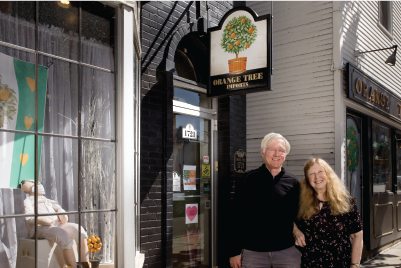
On Monroe Street, Carol “Orange” Schroeder wears two hats. First, she’s co-owner of Orange Tree Imports, a 45-year-old specialty retailer at 1721 Monroe St. Secondly, she’s chairman of the Monroe Street Merchants Association board, so she’s not only worried about her own shop, she’s concerned about the whole street.
Yet the COVID-19 pandemic hasn’t been the worst thing that’s happened to her this year. On Aug. 11, her husband and store co-owner Dean Schroeder suffered a heart attack while biking with friends. He was hospitalized for the better part of a month and likely won’t be able to help around the store this holiday season.
To put it mildly, 2020 hasn’t exactly been a great year for the grins. From an operational standpoint, Schroeder’s biggest challenge has been pivoting from providing a meaningful in-store experience for shoppers to finding alternative ways for them to access the store’s merchandise. This work includes working with a vendor to increase online offerings, which is combined with a curbside pickup option that so far has been embraced by customers.
Orange Tree Imports also makes good use of a back porch where people can come in on the alley and pick up their purchases. So far, that has worked pretty seamlessly, but even that alternative could be undermined during the winter by a debilitating snowstorm, and Schroeder isn’t sure that customers will want to wait outside in the cold because the store can only welcome a handful of in-store customers at a time. Given the restrictions mandated by public orders, Orange Tree Imports has set up a model where a limited number of mask-wearing customers can come into the store and shop, but Schroeder feels that experience is not as much fun as shopping under normal circumstances.
Even with adaptations that keep the train running, Schroeder is very concerned about what the holiday season will bring because it represents about 40% of her business. “Right now, we allow five to six customers in the store at a time, and if you’ve been in Orange Tree Imports during the holidays, you know that’s a small fraction of the number of people who are usually there, filling up shopping totes full of gifts and gift wrap and ornaments and all of the things that make the holidays special,” she says. “We are concerned, and realistically we know that the 2020 holiday season is not going to be what we hoped it would be.”
Not only does she have to temper her expectations, she has to temper her buying. While Orange Tree Imports hasn’t canceled orders that it placed for the 2020 holiday season, it is being very cautious going forward because Schroeder knows it’s been a very challenging year for both suppliers and sales reps. “One of the things that is giving everyone anxiety is the idea that we have no idea when things will return to any sense of normalcy,” Schroeder states. “When will in-person shopping be carefree again?
“We just don’t know.”
Is COVID the death blow for malls?
Haven’t been to a mall or shopping center lately? If not, it might be easy to assume they have outlived their usefulness. Before the pandemic, they were making the transition to a hybrid of well-trafficked stores and experiences. COVID-19 undermined both.
One sign of damage was when CBL Properties, which owns East Towne and West Towne Malls in Madison and more than 100 retail centers in all, reached a restructuring support agreement with debt holders in response to the effects of the COVID-19 pandemic. Terms of the agreement provide for a comprehensive restructuring and will slash $900 million of debt and at least $600 million in other obligations.
While day-to-day operations and business continue during the restructuring process, such news leaves the impression that COVID-19 has joined Amazon as the two horsemen of the mall apocalypse. “Malls are really in deep trouble,” states Betty Hurd, retail expert and marketing instructor at Madison College. “We’re going to have to look at the whole experience of the mall and what people really want to do. People don’t want to just hang out and clothes shop anymore.”
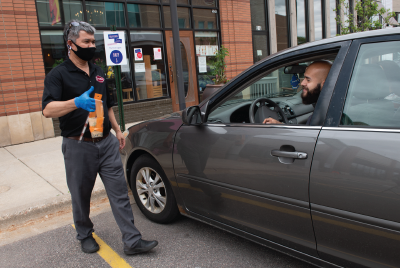
Mall operators caution not to write their obituaries just yet. Melissa Cavanagh, senior marketing director for CBL Properties, says traffic has continued to build following the reopening of its properties, and customers are visiting the mall with the intention to buy. “Heading into the holiday season, and given the occupancy limits in place for individual stores, we’re working with certain retailers to open secondary pop-up locations, helping to promote their BOPIS (buy online, pick up in store) services, and we’re designating more parking to accommodate those that offer curbside pickup,” Cavanagh states.
On the future of malls, Cavanagh notes an important evolution is underway. “Over the last several years, we’ve been working to redevelop our properties from traditional malls to suburban town centers that offer visitors a variety of uses and experiences,” Cavanagh notes. “Retail will always be an important component of our properties, but we’re working to strengthen and shrink its footprint by replacing underperforming retailers with in-demand retail.”
Hilldale in Madison is also still punching, recently announcing four new additions, including the Shake Shack burger joint, Burn Boot Camp, a fitness destination, the Glitter Workshop, a do-it-yourself crafting shop, and Indochino, a men’s custom apparel brand. Nanci Horn, general manager of Hilldale, noted the concepts reflect its emphasis on experience-first retail, and she talked about the adjustments Hilldale, which has the benefit of being open air, has made during
the COVID-19 pandemic.
Since April, Hilldale has made available over 30 quick pickup parking spaces that are placed conveniently between retailers whose customers have requested one, and shoppers who pick up orders have been courteous about obeying the 15-minute parking time limit. For the holidays, Hilldale has plans to create warming huts so that visitors can more comfortably wait for coffee after ordering it on a phone app. As for individual stores, some fashion retailers have created wardrobe pick-up and try-on programs where shoppers can work with a personal stylist to curate a wardrobe. Other retailers are taking in less occupancy than they are allowed, just to make sure customers feel safe while shopping in their stores.
With such creativity, there is no doubt in Horn’s mind that the transition to experience-based retail can succeed once shopping centers get past the pandemic. “We’ve seen it here,” Horn states. “The experiences are a little bit different, and our retailers have been great with being able to pivot in this environment.”
Restaurants’ holiday hope
Other than hotels, no industry has suffered more sales and job losses during the pandemic than the restaurant industry. Even since reopening, they have been relegated to limited indoor seating, outdoor seating where possible during the summer, and carryout and delivery options, and the forthcoming holiday season probably won’t provide a yuletide respite for restaurant operators.
Given the loss of 2.3 million jobs from the industry’s February peak — yes, that includes recent job gains — the National Restaurant Association now believes the industry’s return to pre-COVID employment levels will take years, not months.
In fact, the other “NRA” conducted a survey of 3,500 restaurants from Aug. 26 to Sept. 1 and found that 33% of Wisconsin restaurants are unlikely to be in business six months from now if pandemic restrictions continue. In addition, 68% of restaurant owners in the state don’t expect their restaurant’s sales to return to pre-coronavirus levels within the next six months. That should set off some alarm bells.
In Madison, the local “Streatery Program” has been helpful for establishments that can offer an outdoor dining experience, and thanks to the people who want to support restaurants, they are doing good curbside and delivery business, but it’s not the volume they had with in-person dining prior to the pandemic.
Caitlyn Suemnicht, chief operating officer of Food Fight Restaurant Group, says better takeout and delivery business should keep the group stable through the spring, even without the benefit of outdoor dining. Food Fight, which is hiring again after the pandemic forced layoffs, is trying to expand its delivery footprint in Dane County with the help of partnerships with EatStreet, Uber Eats, and Green Cab.
Since not every Food Fight restaurant does great carryout business, management has discussed temporarily closing some for a few months if necessary. “Now, we haven’t pulled the trigger on any of that yet because we still need a little bit of time to see what happens in the next month now that people aren’t dining outdoors as much,” Suemnicht acknowledged before Avenue Club closed, “but if we have to do that to ensure the long-term survival or give us a better shot at long-term survival, we will.”
With that in mind, gift cards, especially for restaurants, will be crucial for holiday sales, and restaurants will be getting creative with them. Food Fight usually offers a $25 bonus certificate when people purchase $100 in gift cards, but given the pandemic restrictions, it will provide a book of offers valued at $100. The point of that is to drive foot traffic to every single location instead of just spending that bonus certificate at one place, one time, Suemnicht notes.
The state of Wisconsin has allocated more than $100 million to help hard-hit Wisconsin businesses, including restaurants, through the winter, but if more federal stimulus became available, would Food Fight apply for it? Absolutely, but with the understanding that it might be structured differently, perhaps to make up the difference between 2019 and 2020 sales. A couple of Food Fight restaurants have come close to pre-pandemic sales, but others have struggled, and additional aid might save jobs. There is always the possibility of a safe and effective COVID-19 vaccine, but Suemnicht has been conditioned not to think anything will make an immediate difference.
“Do I think there will be a vaccine and customers will come pouring in our door? No, but when there is a vaccine, I’ll be happy that we potentially won’t have to have six feet of space between customers in our restaurants.”

