


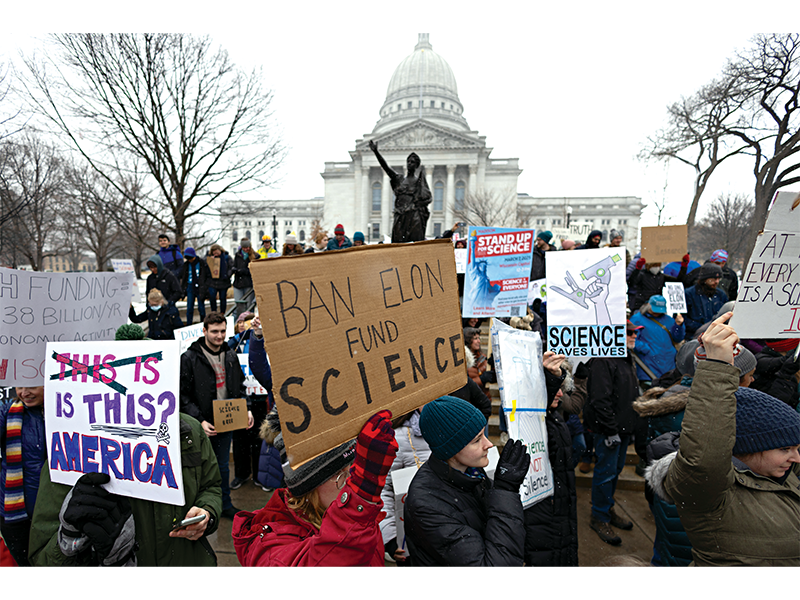
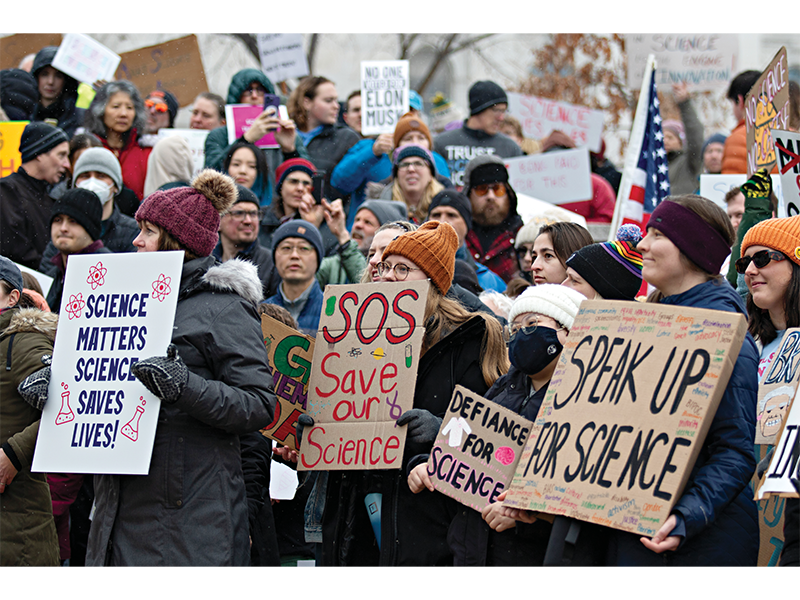
Student and professional researchers alike were among those who gathered last month at the state Capitol, worried that research careers could be over before they begin, lamenting that potential therapies and cures will be curtailed, and noting nearly every biomedical and technological breakthrough over the past century included fundamental research supported by the federal government.
The source of the dismay at the “Stand Up for Science” rally, one of 50 held nationally, was President Donald Trump’s proposed cuts to National Institutes of Health (NIH)-sponsored research grants.
Rally organizers said the cuts could cost Wisconsin $1.5 million per week in funding. They rank among the Trump administration’s most controversial actions, especially given the proven economic and societal value of academic research in medicine, biotechnology, and computer science.
“If people really care about the future of the country in terms of the United States being a leader in technology and biomedicine, then these cuts make no sense,” said John Denu, a University of Wisconsin-Madison biochemistry professor and the lead organizer of the rally. “Two decades ago, China decided that the way to become an international power was to invest in technology and medicine, and it’s working. If the U.S. doesn’t make science a priority, we run the risk of no longer being No. 1 in the world.”
For universities, NIH funding has always been a bedrock, a foundational piece in support of research in the U.S. In particular, the indirect costs of NIH grants are in the crosshairs. Under Trump, the NIH recently implemented a policy capping the indirect cost rate for research grants at 15%. These are expenses such as facility maintenance, administrative support, and utilities that are not directly tied to a specific research project.
The cuts could result in a significant financial strain for research institutions such as the UW-Madison, the nation’s No. 6-ranked research university with $1.7 billion spent annually on research.
It prompted the attorneys general of 22 states, including Wisconsin’s Josh Kaul, to file lawsuits against the NIH, arguing the new policy could severely hinder research capabilities and harm America’s economic competitiveness. U.S. District Judge Angel Kelley temporarily blocked the NIH’s cap from taking effect and later extended her ruling while the lawsuit moves forward.
In fiscal year 2023, the federal government spent nearly $60 billion on university research, about 1% of total federal spending, according to Tom Still, president of the Wisconsin Technology Council, the science and technology adviser to the governor and the Legislature.
The $60 billion outlay represented about 55% of total research and development spending at universities, and the remaining 45% was matched by private dollars. As recently as 2023, Still said NIH funding (all sources) to Wisconsin institutions totaled $654 million, supporting nearly 7,800 of the 140,000 life science jobs statewide.
Direct and indirect costs
Anjon “Jon” Audhya, senior associate dean for basic research, biotechnology, and graduate studies at UW-Madison, oversees programs that assist faculty and students with finding and applying for research grants and managing grant funds, and navigating technology transfer to the private sector. Audhya, also a professor in the university’s biomolecular chemistry department, said capping indirect costs could lead to profound consequences.
He used a grocery store analogy to explain the difference between direct and indirect costs. “I can go to the grocery store and buy a great-looking steak to bring home and cook for my family, and that’s the direct cost,” he said.
“I come home and find the electricity is out. That’s an indirect cost because I need that electricity to keep my steak cool so that I can cook it in the evening. If I find the gas is out and I can’t actually put it in the oven, that’s another indirect cost. So, in that scenario, all I’m left with is a raw piece of meat.”
With academic research, the direct funds cover the actual research, while the indirect costs help the university provide the necessary infrastructure, whether it’s building management and maintenance, equipment, or administrative support “that allows us to actually get the work done,” Audhya said. “You can’t pull them apart from one another. If you deplete one, that just means we can’t do our research.”
Audhya said the university has negotiated a standard, 55.5% indirect cost reimbursement rate with the NIH, so for every $1 it receives for research, 55 cents is added to cover indirect costs. Every academic institution negotiates that rate because the cost of doing business varies by location.
“Generally speaking, Columbia University or another school in New York is going to have a very different and much higher indirect rate than what we receive here in Madison,” Audhya said.
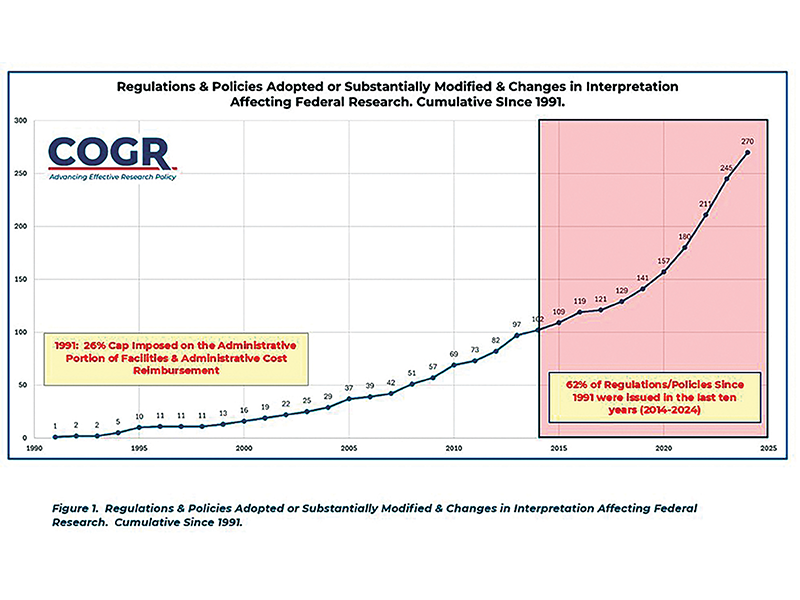
Over the past decade, the number of federal compliance requirements has skyrocketed, Audhya said, and those costs are not reimbursed. According to the Council on Governmental Relations (COGR), which monitors federal policies and regulations affecting U.S. research institutions, 62% of new regulations imposed on these institutions since 1991 have come in the past 10 years. The regulations include new or substantially modified policies or changes in interpretations of existing rules.
“Just to meet the regulatory requirements of the federal government for doing our research, we depend on those indirects,” Audhya said. “If you look at some of the regulatory requirements that have come along, especially over the last four or five years, those have been challenging to meet, and there’s just no more dollars at the table.”
He said the additional rules have not led to “any dramatic increase in indirects. So, we’re having to cover all of those additional regulatory and compliance pieces with other university funds in order to do the work.”
For clinical trials, the reimbursement rate for indirect costs is only about 30%, he said.
“It’s not possible,” Audhya said, “and so we get additional investment from our campus in order for us to do that clinical trial because it is ultimately within the mission of the university to (support) this research to improve patient care downstream.”
If the regulatory requirements don’t change, the university can’t do as many clinical trials with industry partners.
“Already, we’re starting to think about this,” Audhya said. “We’re not starting up new trials because of the concern that exists. This just means that even though we have great ideas that are ready to be rolled out in a very safe way, we can’t do it because the funding isn’t guaranteed, and that’s the biggest effect of all of this.”
Industry partnerships
Audhya also is concerned about how the NIH cuts will affect technology transfer — moving ideas from university research labs to private businesses. Other types of federal funds that are not subject to the 15% cap on indirect costs, like Small Business Innovation Research (SBIR) and Small Business Technology Transfer (STTR) grants, foster public-private partnerships. Those partnerships may never materialize if the cap has a dampening effect on scientific research. SBIR grants provide funding to small businesses to develop technologies with potential for commercialization in the health care field, and STTR grants promote collaboration with businesses and research institutions.
UW-Madison does a number of research projects in coordination with an industry partner, and those SBIR and STTR grants enable these collaborations. If the indirect rate is permanently dropped on those, Audhya said it will reduce the incentive for the university to participate in that work. Ultimately, the goal of spinning off a new technology into a company gets more difficult, and industry has to provide more funding to sponsor the work.
“We’re already doing that in the space of clinical trials,” Audhya said. “I can tell you right now, our pivot towards industry-sponsored trials is already happening because of what’s happened with the federal government over the last couple of months.”
When uncertainty is introduced, it makes the institution question whether it should be doing research in academic medical centers. “Should we be standing up clinical trials or should we just completely rely on other countries or pharma to lead this effort?” Audhya said.
“I don’t think that pharma is going to want to do the same type of work that we do in an academic institution. All of the rigorous work that happens to get us to the point where we want to move a small-molecule therapy or a gene-cell therapy toward a clinical trial, pharma comes to us and scoops that up after we’ve developed it.”
A boost for health and business
Wisconsin Technology Network’s Tom Still said the resurgence of GE HealthCare is a prime example of how academic research pays dividends for human health and economic development.
GE HealthCare operates a training center in Waukesha, a factory in Madison, and has a new 10-year collaboration agreement with UW-Madison that expands beyond medical imaging to digital technologies and disease-focused research.
Still said the company almost stalled out 40 years ago because there were only a certain number of uses for its magnetic resonance imaging (MRI) machines, which produce scans that provide clear images inside the human body.
Still said research funded by NIH led to better ways for MRIs to investigate vascular systems, map blood flow blockages, and detect tumors. As the applications for MRIs expanded, so did the opportunities for selling those machines.
“There’s now about 13,000 MRIs in the U.S. today, and probably about 50,000 around the world,” Still said. “So, a continuous federal investment has helped improve health care, improve lives for millions of people, but also helped expand an entire industry.”
For its part, an executive for GE HealthCare said the company is committed to improving patient care through research and innovation and will continue its work with the university.
“UW–Madison has a world-class research team, and we have been proud to collaborate with them for many years to help foster the future of biomedical technology,” said Jay Hill, vice president of advanced technologies for GE HealthCare. “Medical research is a critical enabler of the U.S.’s thriving biomedical ecosystem, and we remain committed to supporting this important work.”
TomoTherapy (now Accuray), NimbleGen Systems, Third Wave Technologies, NeuWave Medical, and FluGen are all examples of past federal grant recipients, and there are many more, according to John Neis, managing director of Venture Investors LLC, which has offices in Madison and Ann Arbor, Michigan. All of these companies have been part of Venture Investors portfolio after receiving venture funding from the firm.
Neis said many of the grants come through the Small Business Innovation Research (SBIR) program from federal agencies such as the National Cancer Institute or the National Institute of Allergies and Infectious Diseases under the umbrella of NIH. He said much of the basic research funded by the NIH at UW-Madison results in fundamental discoveries that trigger company formation.
Under the 1980 Bayh-Dole Act, any research with government funding gives rights for filing patents to the Wisconsin Alumni Research Foundation (WARF), which is UW–Madison’s licensing arm.
“The overwhelming majority of all their intellectual property is the result of government funding and for spinout licensees focused on health,” Neis said. “Most are NIH, some are DOD [Department of Defense] given their veteran health care needs, and some are NSF [National Science Foundation], but mostly NIH.”
Scientific speed bump?
Overall, Wisconsin’s biotechnology and other businesses in the life sciences industry appear to be on a roll. The biennial “Industry Landscape and Economic Impact” report from BioForward, the state’s life sciences trade association, found that Wisconsin’s biohealth employers have increased their payrolls by nearly 12,000, or 25%, since 2018, and employ more than 58,000.
Wisconsin’s designation as a biohealth hub continued the momentum, and a recent report on the Madison life sciences market showed a real estate footprint larger than Broadwing Advisors LLC, the local real estate firm that conducted the study, expected. In fact, it found that Madison had more square footage devoted to the life sciences than Atlanta, Houston, and New York City.
“There’s still a great deal of innovation and a great deal of enthusiasm in the life science industry here,” Still said. “The NIH cuts in indirect costs, if carried out, would have an effect, and maybe even a disproportionate effect because of how our institutions in Wisconsin have performed historically in attracting such grants.”

