
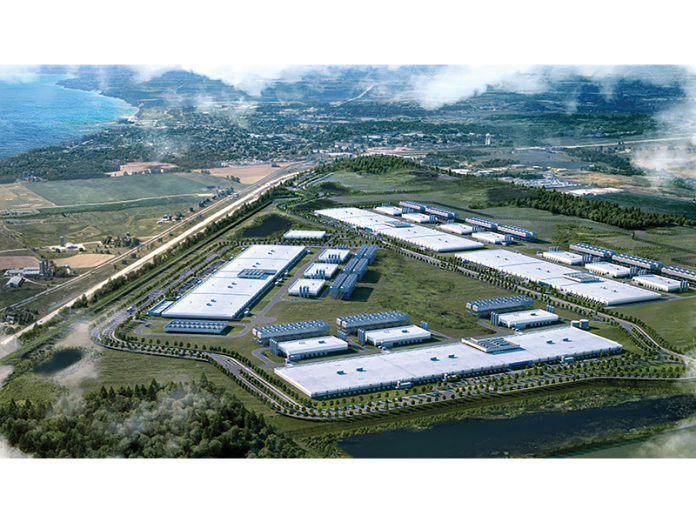

The city of Madison held a virtual public information meeting on its data center moratorium late Wednesday afternoon — a moratorium that buys the city staff some time to amend its zoning code to regulate future data centers, especially proposals to develop the increasingly controversial hyperscale data centers.
Following an informational presentation in which city staffers outlined the process for enacting a land-use ordinance to regulate data centers, Christie Baumel, deputy mayor for housing and sustainability, and other city officials fielded questions from the public and indicated there would be several more opportunities for public input as 2026 unfolds.
While the ordinance will cover data centers of varying sizes, much of the attention focused on regulating the large facilities that accommodate artificial intelligence applications but also can strain energy and water use, emergency services and air quality.
“We realize that our regulations don’t reflect current best practices and how this industry is evolving,” Baumel said. “We needed time to update our code to make sure we’re managing the potential impacts the best that we can.”
City staffers said the moratorium does not affect existing data centers, and they revealed that most of the available land that would be suitable for hyperscale facilities is located on Madison’s eastern periphery.
They also said that discussions about community benefits agreements that can be negotiated with data center operators would come outside the context of land-use planning.
Moratorium minutiae
With the controversy surrounding hyperscale data centers growing more intense, the Madison City Council voted on Jan. 13 to approve a temporary, 12-month moratorium on issuing zoning approvals for new data centers with a floor area larger than 10,000 square feet.
The moratorium only applies to data centers that are the principal or primary use of the property. It does not apply to data centers or telecommunications centers that serve another principal or primary use allowed on a property, such as one serving a research lab or office building.
At the moment, the city’s zoning code does not include a definition or specific standards for data centers, and its zoning for telecommunications centers is considered outdated for this purpose.
The moratorium, which will end when an ordinance is adopted, is a planning tool that pauses the consideration of any potential data center proposals and gives the city time to establish rules for a new land use category.
No zoning policy proposals have been drafted, as the city is in the research and engagement phase of the process.
City agencies, including the Office of the City Attorney and the Department of Planning, Community and Economic Development, are in the process of researching possible best practices and safeguards, including the creation of a definition of data centers that will be added to the zoning code.
Baumel cautioned that the city does not regulate energy or even water usage, but in terms of land use, it can define a use, determine which uses are allowed, and the parameters or conditions of approval for that use. That could include building design, size and height, lot size, setbacks and landscaping. A separate ordinance regulates noise.
Asked what areas of the city would be suitable for a hyperscale data center, Meagan Tuttle, city planning division director, said there areas on the city’s periphery that are large enough, but she said they would need access to high-capacity utilities.
“Certainly, when we start talking about the potential scale of the hyperscale data centers, the land area that we would expect to be able to accommodate that in the city becomes pretty limited because of our existing growth patterns or the ways that we have already planned for future growth and expansion,” Tuttle said.
“In some of our research, we’re seeing that there could be some places, particularly along the periphery of the city, where somebody might be able to assemble a number of pieces of property to create a space big enough for a hyperscale data center,” she said. “We don’t have individual properties that we’re aware of at this time that would be large enough to host a data center that big on its own.
“And so, as we’ve been doing some of our research, we know that we have more of that capacity service on the east side of the city,” Tuttle said. “So, as we’ve been looking at places that would be most likely to accommodate those large-scale data centers, they would be more oriented around the east periphery of the city.”
City officials also were asked about negotiating community benefit agreements with data center operators, and they stressed that it’s something that cannot be addressed as a condition of land use. The city can address jobs or economic benefits through incentive programs, but they are not a requirement the city can regulate around.
Tuttle said in other parts of Wisconsin, data center operators have worked with local municipalities in the creation of tax increment districts or TIDS, which is an economic development tool that helps with the creation of infrastructure.
“We also know that in some cases, in one case in particular — a data center that does not seem to be moving forward — some of those conversations have been linked to things like annexation agreements, so actual discussions around property coming into the city,” she said. “So, there are (other) mechanisms where some of those conversations can happen … generally around incentives or around how to mitigate the impact of the infrastructure itself, which is different than actually using those community benefits to say yes or no, you could get a zoning approval.”
Future feedback
There likely will be additional opportunities for public feedback on the topic. According to the city, proposed zoning code changes typically are reviewed by the city Plan Commission, which includes an opportunity for public comment once a proposed zoning code change is formally drafted and introduced as an agenda item.
The process could include referrals to additional committees, providing additional, well-publicized opportunities for public input. Baumel said the first policy discussion will take place at the June 11 Plan Commission meeting.
“There’ll be future discussions as well to shape policy, but this will be kind of their introduction to the topic,” Baumel said. “We expect to be proposing a draft code in September, and then we would have the ability for future public input on that draft.
“We’re hoping to introduce it into our official legislative process in September or October, where it would be referred to committees for more consideration, discussion, public input opportunities and then back to the (City) Council for their final action, probably in December.”
The yearlong moratorium will also allow the city to gain insights from the newly created Dane County Advisory Committee on Data Centers.
The Dane County Board is expected to vote June 4 on its own proposed data center moratorium, which was approved in committee May 26.

