
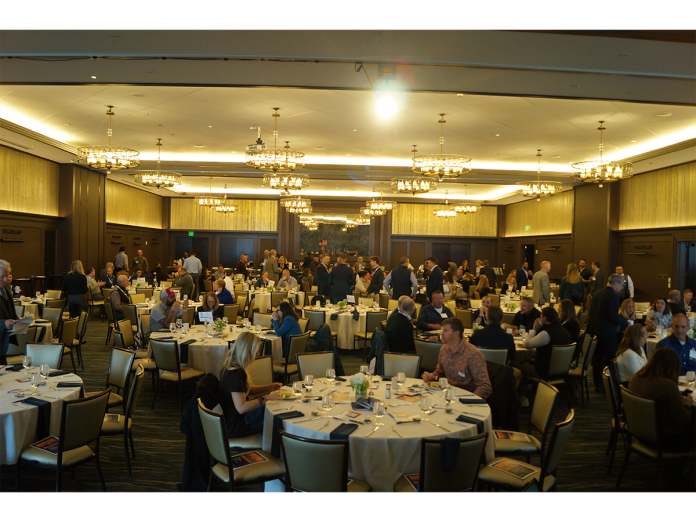

Large data centers and the housing shortage — two issues challenging government and business leaders — were explored Feb. 12 at the fourth annual In Business Madison Real Estate & Construction Symposium held at the Edgewater.
The symposium brought together more than 200 industry professionals to discuss trends in these critical areas and offer insight into how Wisconsin’s Capital Region can successfully navigate both.
Data driven
The symposium opened with a data center panel moderated by Brittney Kenaston, staff journalist for In Business Madison.
Panelists included Alex Allon, community development director for DeForest, which recently rejected a data center proposed by QTS Data Centers; Tyler Byrnes, senior research associate for the Wisconsin Policy Forum; Coleman Peiffer, senior manager of data center services for Alliant Energy and attorney Kevin Ramakrishna, a shareholder in Reinhart’s real estate practice.
In the last year, the controversy over large, hyperscale data centers and their energy requirements (and effect on ratepayers) as well as land and water use issues have quickly risen to the top of the list of key development topics. The operations are needed to accommodate artificial intelligence demands, and have the potential to bring long-term construction jobs, sustainable employment during their operations, and significant increases to the local tax base to help fund schools and other community needs.
Yet the potentially negative effects — and, some panelists argued, the misconceptions around them — have contributed to intense opposition in several communities where such facilities have been proposed. A public backlash in the northern Dane County village of DeForest recently forced QTS Data Centers to withdraw plans for a data center there.
Peiffer said data center proposals are coming at a faster pace for several reasons, beginning with the 2023 passage of sales and use tax exemption for data centers in Wisconsin, essentially leveling the competitive playing field for data centers with neighboring states.
With the shift from cloud computing to AI tools such as ChatGPT or Microsoft Copilot, Peiffer said data centers no longer must be within reach of the main fiber trunks along the Interstate 80 corridor, the backbone for high-speed internet infrastructure across the U.S.
Several states along that corridor, which runs from San Francisco to New Jersey, are reaching their power capacity, he said, so Midwestern states are becoming more popular data center sites.
Regarding the DeForest project, Peiffer also said a new electrical substation to serve northern Dane County was already in place, which provided more confidence about long-term generation, speed to market and the ability to build on an initial investment with data center expansion.
Even with the recent public pushback, “I don’t see that (interest) going away,” Peiffer said.
Tyler Byrnes of the Wisconsin Policy Forum recently put together a comprehensive report on how data centers could change Wisconsin’s utility landscape.
Byrnes said the public’s biggest fears are what AI could do to shrink the workforce and the data centers’ effect on utility and water rates, as well as municipal budgets and property taxes.
The WPF report said data centers would add demand for electricity and water but do so after years of declining usage of both. Planned data centers could require costly utility upgrades, so it will be important to ensure those potential costs are fairly distributed, the report said.
“One of these data centers could use about 1.5 to 2% of the electricity generated in the state in a year, and so that’s a pretty big number and it’s going to need new generating capacity and new transition capacity,” he said. “I think concerns about how this is going to impact our (utility) rates — they make sense.
“There’s a lot of effort by both legislators and the PSC (Public Service Commission) to make sure that the folks that use electricity pay for that.”
On the water side, there is less concern about conservation and it is not only due to innovations such as closed-loop cooling systems, which recirculate water instead of having it evaporate.
“Let’s say these data centers use 10 million gallons of water a year,” Byrnes said. “That’s probably a high estimate but even still it sounds like a lot of water. Well, it does until you realize that statewide water utilities sell something like 130 billion gallons of water a year, and so the scale even at the high end of these water use estimates for these data centers is just completely different.”
In contrast, Byrnes said a paper plant could use 1.5 billion gallons of water a year, which is hundreds of times more than a data center would.

DeForest decision
Panelists said the DeForest proposal was withdrawn even though the village had negotiated substantial public benefits.
Byrnes said his independent review of an annexation agreement between DeForest and the town of Vienna, which involved 1,600 acres, showed that QTS Data had agreed to pay for on-site EMS personnel, the cost associated with new roads that would be needed, costs associated with fire service, and $100,000 a year for Yahara River cleanup efforts.
“There was a lot of stuff that QTS was willing to put into the deal and comparing it to other investments, this was going to be about $10 billion or in that neighborhood,” he said.
Allon, who helped negotiate the deal, said the investment figure was closer to $12 billion, but even with all that, overwhelming public sentiment against the development carried the day.
“I would not argue against (Byrnes’) assessment at all,” Allon said, generating laughter from the audience. “But again, to me it comes down to the basis upon making these decisions, so I don’t sit in the chair of the decision-maker of a local elected official who’s got to go to the grocery store and hear comments about this and understand how their community feels.”
Panelists also addressed how developers, municipalities and community members can work together to bridge the perception gaps and deal with the public’s uncertainty about how large data centers will affect their communities.
They recommended dealing with any misconceptions, and misinformation, head-on; reminding community residents of the kind of improvements an expanding tax base can fund; and negotiating agreements with data center operators to mitigate potentially negative effects.
Yet as the DeForest case shows, they also acknowledged that until there is more experience with the long-term effects of hyperscale data centers, it’s a difficult sell, but the potential benefits are worth the effort.
Reinhart’s Ramakrishna said overcoming state levy limits imposed on municipalities, which make it more difficult to fund utility improvements, is one potential benefit.
“I know that there’s at least one data center that’s going up where one of the community benefits is (data center operators) are fronting $10 million of utility improvements in the municipality and then recovering some of that through pay-as-you-go TIF (tax incremental financing),” Ramakrishna said. “Those are the types of things that you need to be thinking about.
“You need to take advantage of these opportunities that are sitting in front of you,” he said.
Housing headaches
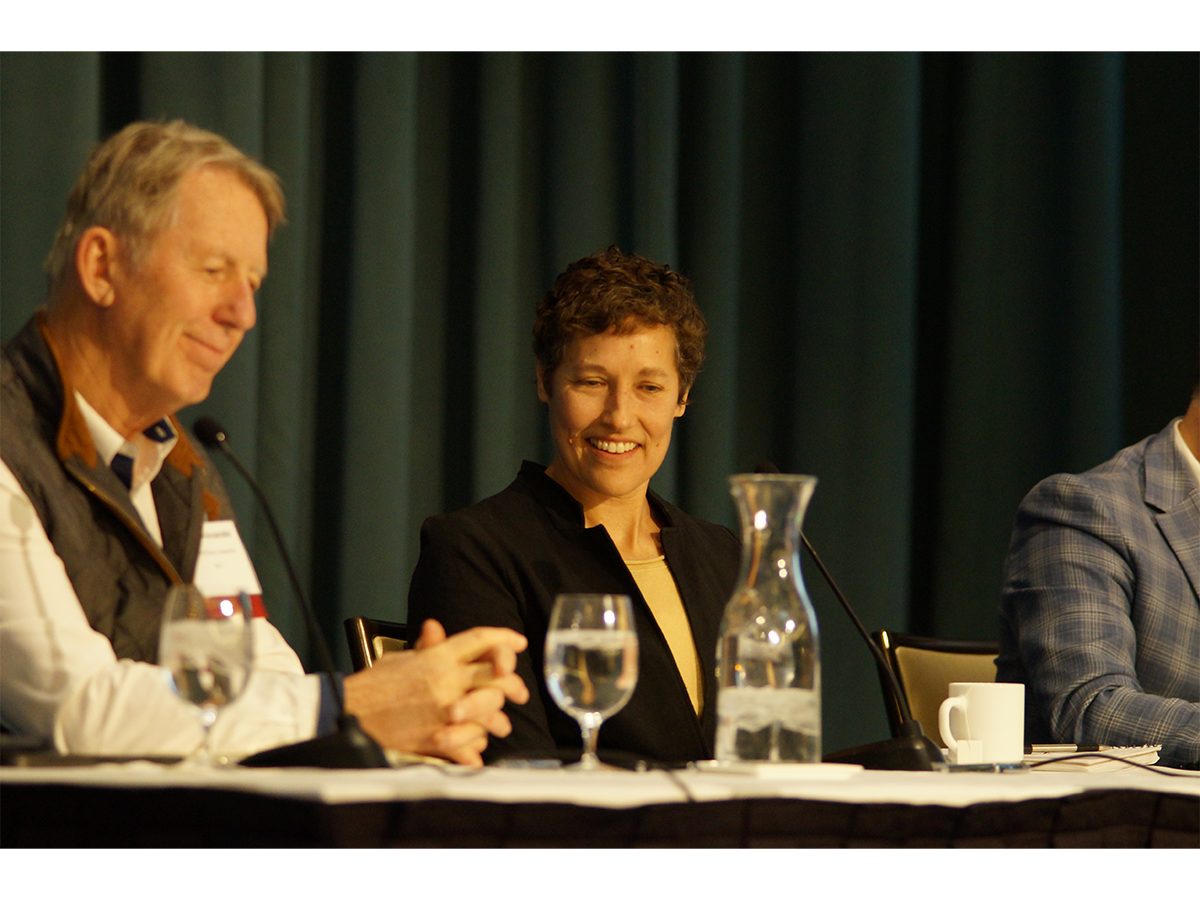
The second panel of the day focused on housing, with several panelists arguing that Wisconsin’s Capital Region will be hard pressed to meet its housing needs over the next 25 years without a review of costly fees and regulations, and some creative approaches to foster development.
Panelists included developer Randy Alexander, CEO of Torque Companies; Zach Brandon, president of the Greater Madison Chamber of Commerce; Chris Ehlers, president of Veridian Homes and Heather Stouder, administrative services manager for the city of Madison Department of Planning, Community & Economic Development. Attorney Joe Shumow, chair of Reinhart law firm’s real estate practice, served as the moderator.
Dane County is scrambling to align housing development — multifamily, single family and other forms — with the area’s projected population growth. The county still is playing catch up, having underbuilt housing during the previous 15 years.
Daunting numbers
Shumow cited Boulder, Colorado, as an example of a similar community that has used regional planning to meet its housing needs. Asked by Shumow whether planning should be done regionally — rather than municipality by municipality by communities with conflicting objectives — Brandon began by quantifying the challenge.
Brandon said the most recent projection is that Dane County’s population would grow by 325,000 people by 2050, which translates into a need for 160,000 more housing units.
In the past 10 years, he said Madison built 13,000 fewer housing units than needed, or less than half of what was required to meet the population growth that already has occurred.
Local units of government, particularly Madison, are picking up the pace, but the community is still playing catch up.
He said Dane County’s goal is to have 7,000 more housing units every year until 2050, with 3,700 of those rental units and 3,300 single-family homes. The county tallied about 5,600 total new units in the past year.
“We’re not doing well but we’re doing better,” Brandon said. “If we look at Madison specifically, this is the most pro-housing City Council that we’ve ever had.”
However, its processes and plan committee structure still create a time lag, so “speed to approval” is still not where it should be.
Instead of 13,000 units of “underperformance,” Brandon said we now have 8,500 in underperformance.
“How we’re going to make that up and get to 160,000 new units is going to require some different level of thinking,” he said.
The Greater Madison Chamber of Commerce recently assumed greater regional economic development responsibility by integrating the work of the Madison Region Economic Partnership into its own. Brandon said not every community in the region has the same housing goals, which only adds to the challenge of housing density.
“I was at a dinner a couple weeks ago sitting with local leaders who said, ‘I don’t want multifamily in my municipality. I just want big homes. That’s what we want,’” Brandon said. “I don’t know how that works but … every municipality has its own decision-making process.”
Stouder agreed that housing is more of a regional issue but said institutions and laws would have to change tremendously to make regional planning work here.
She said there are cross-boundary relationships and collaboration at the staff level, and Dane County put together a regional housing report with an ambitious goal for 15,000 new units by 2030.
“We’re tracking that on our city’s housing tracker. We’re using that regional kind of prompt to guide what we’re trying to measure over time,” she said.
Stouder said there also is good work being done by the Capital Area Regional Planning Commission, a regional planning agency established to coordinate land use development and water quality management.
She said the commission is helping smaller communities that don’t have a staff of 30-40 people look at housing data and think through things they might do better.
“So, it’s happening a lot at the ad hoc level but again the institutional shifts that would have to happen in Wisconsin to do truly regional housing planning would be tough,” she said. “But we’re trying our best to share lessons learned, share examples, share ways of communicating data to really operate better as a region.”
Demanding demand
Ehlers of Veridian was asked what local municipalities could do to help increase the supply of housing, which can bring down housing prices.
He said tax incremental financing for housing would help increase the local supply. Some western states have incentivized housing development with community facilities districts.
Under these districts, he said developers get bond reimbursements to build infrastructure, allowing developers to be reimbursed over 15 to 30 years for the infrastructure they build to accommodate housing. Developers dedicate the infrastructure back to the municipality and in return for the cost savings, they agree to pass those savings on to the home buyer.
“It’s been very effective out west,” Ehlers said. “That’s how California, Arizona, Colorado and Idaho have been able to navigate high housing demand and be able to still build houses that are attainable for the markets that are out there.”
Ehlers described the gauntlet of costs Wisconsin home builders face compared to developers of multifamily housing, data centers, commercial and industrial properties, all of whom get tax credits and incremental financing help that home builders don’t.
First, home builders pay full price for land. If they buy 100 acres, he said at least 30 to 40 acres must be dedicated to and built for stormwater management to protect local lakes. Developers build those ponds, seed those ponds, and get them in working condition for five years.
After that, developers have to build the infrastructure — the roads, grading and the installing of gas and electric utilities for the subdivision.
“We have to pay MGE, and they’re paying their subcontractors,” Ehlers said, “and by the way, their subcontractors’ costs have gone up over 50% in the last three years because it’s a seasonal job. It can only be done from May to October, and guess what’s going on in May to October? Data centers are going in and all that labor’s getting paid three times as much for (that) work.”
This not only affects home costs, but it reduces the availability of labor to build houses, Ehlers said.
“At that point we have to build a quality house. We’re getting pressured to build a quality house that has an attainable price point… for entry-level buyers with no assistance, no tax assistance, no government assistance, no finance assistance. We must… sell that house for less than $400,000 to a first-time buyer who can barely afford the down payment or mortgage rates that are at all-time highs right now.”

Community will
Alexander of Torque also talked about local willingness and flexibility when it comes to reducing costs, including the time and cost of getting projects approved.
“When you have building permits and all the other fees that are involved, they are substantial,” Alexander said, “and the community has the ability to waive a certain number of those fees. That would go directly to the bottom line and help each homeowner.”
Another example of what Alexander views as an unnecessary infrastructure cost is municipal mandates to use more expensive concrete pipes for all storm systems.
“That’s about eight times more expensive than using heavy duty PVC, which has been proven to easily stand up to loads,” he said, “but in a lot of communities, the engineering department is unbending.”
To incentivize a 500-unit residential development, Alexander said Poynette was willing to pay 100% of the infrastructure costs through a pay-as-you-go TIF. It also had an easy entitlement process that saved time and money.
“What was the result? We can sell a house 20 minutes north of Dane County … for $100,000 less there than we can buy the same house in DeForest, Waunakee or Windsor,” Alexander said. “Same square footage, same general quality.”
Some of that cost savings is dictated by factors such as location, but Alexander said the Poynette example gives people an idea of “how far down you can bring the price of homes for people within your community that you need here, that need to live here, that would strengthen the family unit if you did that.”

