
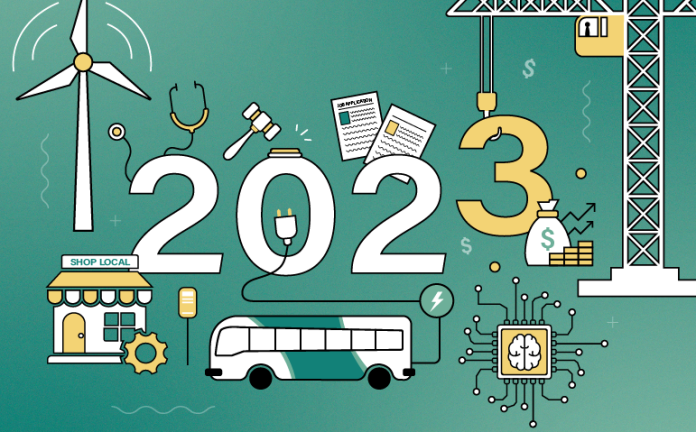

Label 2023 as the year of defiance, mainly because the recession we were told was sure to come never materialized. Employers kept right on hiring, gross domestic product (GDP) moved further away from recessionary territory (not toward it), and by year’s end, a growing number of economists believe the Federal Reserve can reach it’s 2% inflation target without a having ignited a recession — mild or severe — with higher interest rates.
Those more upbeat economists are still in the minority, but they are not hard to find. One of them is Mark Eppli, director of the James A. Graaskamp Center for Real Estate at the University of Wisconsin–Madison, who predicted continuing moderate GDP growth during his keynote address at IB’s first annual Real Estate and Construction Symposium.
It was an interesting year any way you slice it, but nothing occurred that is changing Greater Madison’s trajectory as a shining economic star — in the state, the region, or nationally. With that, we present the most significant business and economic stories of 2023 and what they portend for 2024.
- Economic resiliency
At the beginning of 2023, most forecasters were predicting a mild recession in the second half of the year or in early 2024, but the economy is still growing despite the Federal Reserve’s program of interest rate increases to quell inflation. Nationally, most expect the 4.9% advanced estimate of third-quarter growth to be revised downward — in the second quarter, real GDP grew 2.1% — but neither figure is indicative of an economy headed toward recession. Still, many don’t expect the summer boom to last even though Q3 consumer spending, inventory growth (an indication of strong sales), and exports all were strong.
Elliot Eisenberg, chief economist for GraphsandLaughs LLC, cautions that consumer spending will slow down because consumers have been drawing down savings, ramping up credit card use, and many now are starting to pay off student loans. “It’s as though our economy in ‘23 had a COVID hangover, but a positive hangover, so this is not bad,” Eisenberg notes. “It’s a good thing, and we’re still getting back to normal, and this getting back to normal is causing our economy to perform pretty well.”
- Epic expansion
On the local front, the city of Madison made more progress toward implementing bus rapid transit, and while several prominent companies announced layoffs, Epic executed plans to expand its campus and workforce. Due in part to its dive into the research side with the rise of artificial intelligence (AI) and its partnership with Microsoft, its sixth campus in Verona — featuring five office buildings with a capacity of about 300 employees each — has begun to take shape, and the medical records company is considering a seventh campus with five buildings and a parking garage.
By next year, Dane County’s largest private sector employer plans to have about 13,300 employees — including 1,700 new hires this year — and this population explosion isn’t lost on Zach Brandon, president of the Greater Madison Chamber of Commerce. According to Brandon, Epic’s expansion could not only add more momentum to the local multifamily building boom, it could bring the metropolitan area on par with other notable technology hubs.
Brandon touts the promising demographic trends that have emerged during the past 15–20 years, and the planned Epic expansion could take it to another level. During a panel discussion on regional development held during the annual Stark Summit put on by Stark Company Realtors, Brandon identified the following four key indicators that portend a bright future for Madison.
Innovation jobs
Where are the next wave of innovation jobs being created in industries such as digital technology, advanced manufacturing, and biotechnology? The usual suspects include established tech hubs such as Seattle, Silicon Valley, and Boston — all what he called the superstars of innovation — but Brandon encouraged summit attendees to “look at where the puck is going, not where it’s been.” From that vantage point, Madison has been a Midwestern star, seeing its fair share of innovation jobs since 2005 while regional hub cities that come readily to mind — Minneapolis and Chicago — have shed innovation jobs. “From 2005 to 2019, the Midwest share of innovation jobs happened right here in our own backyard,” he stated.
Where is population growing?
Madison is one of the few cities in the upper Midwest that is growing in population — not just in the broader metropolitan area, but in the city proper. While the city of Milwaukee keeps losing population to other communities in its metro area, Madison keeps adding on. During the COVID-19 pandemic, when other cities were shedding residents, Madison’s population grew and continues to grow — from 278,012 in 2022 to 286,785 in 2023, according to the state Department of Administration (DOA). While most of that growth is from the dissolution of the town of Madison (population 6,212), the city still added 1,679 residents organically. “We’re now the 15th largest Midwest city, so city proper, not region, not metro, not county,” Brandon explained. “We’re the only city [in the region] with significant growth during the pandemic.”
Based on the city’s own projections, Madison’s growth will accelerate over the next several decades. Recently updated population projections estimate the city will grow by about 115,000 residents between 2020 and 2050.
Where is the next generation going?
Remember the brain drain? Thanks in part to the city’s focus on innovation jobs, it is enjoying a brain gain. The key demographic to look at is people ages 18–26, the so-called Generation Z in which Madison is ranked ninth in the country for broad net migration. The difference in the migration gain between Madison and booming places like No. 5 Austin, Texas and No. 6 Nashville, Tennessee is about 500 people, and the expansion plans of a certain medical records manufacturer could soon close that gap. “Epic alone will hire 1,300 people in the next 12 months net on top of their base,” Brandon noted. “There’s no reason why we won’t be in the top five in another two years when it comes to that [net Gen Z migration].”
In addition, Madison ranks No. 1 nationally where Gen Z is finding jobs, Brandon added, and because of that, it’s one of only five cities in America where more than 20% of the workforce is now in the 18–26 age range, and that’s not only due to the presence of a large public university. “People say, ‘Well, that’s the college.’ It’s not,” Brandon stated. “It’s the workforce and they’re moving here at an accelerated pace, and because of the Gen Z net migration to Wisconsin, the state now leads the Midwest in Gen Z migration. When’s the last time someone said that Wisconsin was actually in a brain gain dynamic, not a brain drain dynamic?”
Climate resiliency
Another reason Madison is changing the narrative is the local focus on fighting climate change, which is as highly valued by Gen Z as any measure of social governance. Brandon predicted that global communities along the 43rd and 44th parallels such as Madison will become more popular destinations because it sees fewer heat waves, wildfires, flooding, and shoreline erosion, especially if the city and county continue to make investments in climate resiliency.
As Brandon explained, that’s an attractive selling point. “Climate resiliency is one thing that a lot of people aren’t yet talking about, but I would tell you to pay very close attention to this if you want to figure out where people are going to live 30, 40, and 50 years from now,” he stated.
- Taking a hike
While we avoided a recession, the Federal Reserve’s program to raise interest rates to quell inflation started having the desired effects. Inflation is down, although not all the way down to the Fed’s 2% annual target. But just because the rate hikes have ended for the time being, that doesn’t mean they soon will come down, and the length of the “rate pause” is anyone’s guess. Historically, according to Eisenberg, rates start coming down four or five months after the last rate hike. Since the last increase was in July, the economy would be due for a cut early in 2024, but the Fed will hold out longer if the downward inflation trend stalls. If that happens along with rising unemployment, political pressure will build on the Fed to cut rates.
While recession has yet to rear its ugly head, Eisenberg notes several signs that higher rates are dampening the national economy. Chapter 11 bankruptcies among firms with assets exceeding $100 million tripled in the first half of 2023 compared to the same period of 2022, and “mega bankruptcies” of firms with assets exceeding $1 billion (such as Bed Bath & Beyond and Yellow Corp.) reached 16 in the first half of the year. That number surpassed the comparable half-year average of 11 from 2005–2022.
Kurt Bauer, president and CEO of Wisconsin Manufacturers and Commerce (WMC), notes the role stubbornly high inflation, along with rising interest rates to combat it, play in the cost of production and business borrowing. Both have a profound impact on businesses — inflation raises costs and shrinks profit margins, while rising interest rates stifle growth by making borrowing less affordable.
Higher financing costs are having varied effects. IB’s first annual Real Estate Symposium revealed a consensus view that the local multifamily boom will continue despite the recent rate hikes. This belies what is happening nationally, where there are disturbing real estate trends. For example, in September, the Architectural Billing Index, a 9-to-12-month leading indicator of construction activity, slid to 44.8, the lowest reading since December 2020. Reduced billings were reported in all regions, and multifamily billings are the weakest, followed by commercial-industrial billings (institutional billings remained flat). Moreover, there appears to be rising client hesitation to commit to new projects, with backlogs falling to 6.5 months from their peak of 7.2 months.
- Dodging a banking fail
In the view of local residential realtor David Stark, no other business story trumps the abrupt change in Fed rate policy that began in 2022. From his perspective, there’s more at play than simply the resulting increase in mortgage rates. “More broadly, what the Fed’s action has done is increase the underlying cost of capital for every business in the country, and while the impact is perhaps most direct on the mortgage and housing markets, it goes beyond that,” Stark notes. “One clear example that’s already played out to some extent is the banking crisis that erupted a few months ago.”
The bank failures of 2023, which were isolated (not systemic), caused momentary panic as higher interest rates revealed the folly of poor management decisions. Stark noted that banks had been operating with unusually cheap deposits for years, and in the case of Silicon Valley Bank, much of its liquid reserves had been kept in treasury bonds that lost value as interest rates went up. Suddenly, they were faced with a liquidity crisis when their clients started to withdraw their funds and park them elsewhere.
Overall, however, Doug Nelson, regional president of Johnson Financial Group, believes the U.S. banking industry remains resilient and well positioned to meet customer needs and that regulators have effective tools to address the unique circumstances that arose from the 2023 bank failures. “Banks today, including JFG, are healthy and well capitalized,” he states. “Capital levels for the industry have improved from pre-pandemic levels.”
The questionable decisions, however, went beyond a handful of banks because startups that for years were running on cheap money suddenly had to “reckon with the need to actually make a profit,” Stark adds. The valuations placed on some of them are being questioned by investors, and the silver lining is that risk is being priced realistically again after years of Fed suppression through its quantitative easing policy. This change, he said, “will affect everything that businesses do for years to come.”
As for real estate, the effects are straightforward. Even if the Fed does begin to lower rates in 2024, don’t expect a return to the historically low rates that followed the Great Recession of 2008–09. “Much has been written about the affordability challenges that homebuyers face, and that’s true as far as it goes, but my personal opinion is that we all have to face the fact that mortgage rates are not returning to 3%, or even 4%, probably ever again,” says Stark. “I expect 30-year mortgage rates to settle out somewhere in the 5–7% range for the long run, and the housing market has no choice but to adapt.”
Commercial real estate will vary by sector, with office space being the most likely to struggle, albeit as much from vacancies than to mortgage rates themselves. Stark believes “higher for longer” rates is more than just a Fed talking point until inflation is under control.
“The Fed will back off eventually from its current policy stance, possibly sometime next year, but even that backing off will not take us back to pre-pandemic policy,” he states. “We forget that mortgage rates were around 7% in 2007 when the last financial crisis hit. Seven percent is closer to a normal 30-year rate than 4% is, and we can expect a more normal cost of capital going forward, unlike the quantitative easing years from 2010 until last year.”
The good news, Stark adds, is that savers can once again get a real return on their savings, and investors will look increasingly to real businesses that can actually generate a real return, rather than simply trying to go public with a moonshot valuation based on cheap money. “The real economy will work much better in that environment,” Stark adds, “but it may take us a year or two to fully transition to the new reality.”
- Hub designation
In Wisconsin, the good economic news included the addition of Microsoft, which is building a facility in Mount Pleasant, to its portfolio of blue-chip companies, and the more than 9,500 small businesses taking advantage of $10,000 Main Street Bounce Back grants to facilitate the move to vacant downtown spaces, an example of economic infill that occurred in all 72 counties. But perhaps the biggest story came late in the year with Wisconsin’s designation as a Regional Technology Hub (Tech Hub), an initiative created by the federal CHIPS and Science Act. Wisconsin will receive a $350,000 planning grant to execute its bio-health tech hub strategy.
The designation gives the state an opportunity to pursue additional federal funding — an application for that funding is due on Feb. 29 — it represents another link in the Madison to Milwaukee innovation corridor, and it has the potential to expand north to Green Bay and the Fox Valley and west to Eau Claire. The designation was pursued for the Madison and Milwaukee metropolitan statistical areas (MSAs) and by a consortium of 15 organizations that include the Wisconsin Economic Development Corp. (WEDC), GE Healthcare, Exact Sciences, and UW–Madison. They formed the consortium to provide governance and collaboration, and for Missy Hughes, secretary of the WEDC, the hub is an illustration of the Wisconsin Idea come to life.
“The tech hub is really private sector driven,” Hughes explains. “You see companies like Epic, Exact Sciences, and Accuray in Madison, and then you have GE Healthcare and the Medical College of Wisconsin as you head over to Milwaukee, but we also have companies like MilliporeSigma in Sheboygan and Plexus in Green Bay, and we have Eau Claire doing really interesting work with the Mayo Clinic. So, because it’s so private-sector driven, it’s not confined to where a particular government entity is. The private sector is finding these connections and making these connections across the state.”
What’s most exciting about it is that Wisconsin has research that’s being done at its universities, and it’s got companies that are taking that research and applying it, she adds. “They’re building incredible machines at GE Healthcare and Accuray that deliver radiation therapy or diagnostic opportunities. So, that advanced manufacturing piece is really there, and then those machines and all of that work is being deployed in our hospitals, and patients are receiving the benefits of it.”
- Laboring for labor
Workers in several industries, especially health care and vehicle manufacturing, continued their push for better working conditions and unionization, and they have more leverage now than ever before. The labor shortage continues to be the biggest overall challenge facing Wisconsin businesses, even as hiring slows and state and national unemployment rates tick up ever so slightly. The shortage largely is due to the graying of society because as baby boomers retire, the challenge to replace them becomes more acute, and since the pandemic, a lack of accessible and affordable child care means fewer women are working.
“At a recent WMC Board meeting, a member said we may not be in a recession, but we are in something,” recalls Bauer. “That statement elicited both laughter and nods from the other board members, which told me it hit the mark. Short of a deep recession or some other national or global crisis, the acute labor shortage will continue to be the biggest economic challenge facing Wisconsin employers in 2024 and beyond.”
Bauer says the labor shortage is a huge obstacle to the Fed’s effort to ease inflation because even in a slowing economy, businesses are reluctant to lay off workers, knowing they will be needed when times improve. “To that point, the labor shortage will keep the unemployment rate relatively low, even if the economy weakens,” Bauer says. “That in turn will keep inflation above the Fed’s 2% goal.”
While there is a silver lining to big-firm layoffs — small employers gobble them up — the state’s aging population will continue to present a challenge (even though Madison has mitigated this by attracting more of the aforementioned Gen Zers). Laura Cataldo, director of construction and real estate advisory for Baker Tilly, points to the state’s labor force participation rate. “The fact that our labor participation rate is only at 66.4% demonstrates that there are a lot of workers that could be working that are not currently engaged in the labor market, which is a challenge certainly for employers when across every industry, they’re saying they don’t have enough people to fill the needs of their business,” she notes.
This will strengthen the trend of using automation and artificial intelligence (AI) “to meet the needs of human capital that employers aren’t able to fulfill with workers,” Cataldo adds. “The challenge for employers is to dissect the work within their business to identify where there’s opportunity to minimize their reliance on human capital and supplement it with technology.”
- Ascendence of AI
With the 2022 introduction of ChatGPT, and the scandals and financial losses in the cryptocurrency industry, AI superseded crypto as the disruptive technology of the year. It was quite a coup for a technology that has been under development for years and has been cited for both peril and possibilities. ChatGPT opened the eyes of corporate America to its business applications, and more employers are taking it out for a spin.
The ultimate impact of AI has been the subject of dystopian predictions. The late British physicist Stephen Hawking once said it could spell the end of the human race, but most others believe AI, which has been characterized as the ultimate search engine by Google co-founder Larry Page, will evolve in a more constructive way.
During IB’s recent AI seminar themed “Unlocking the Power of AI,” business operators were encouraged to have their employees do just that for a variety of tasks and functions, from ideation to marketing pitches. Panelists said the sheer number of applications is extensive and noted that business-to-business and business-to-consumer customers will want to know that people they do business with are using AI to good effect. However, they also made it clear that organizations should build guardrails and establish best practices around the use of AI and remember that the human element should not be lost in shaping AI-generated content.
- Courting change
Last spring’s election of state Supreme Court Justice Janet Protasiewicz changed the ideological balance of power on the state high court from right to left and the impact on the state’s business climate could be profound in 2024 and beyond. While left-leaning business groups view this development in a positive light, especially when it comes to its likely empowering impact on labor, Bauer believes the court now has an activist progressive majority that “endangers the very core of Wisconsin’s business climate.” From the WMC’s vantage point, this includes Right to Work, Act 10, funding for School Choice — a lawsuit already has been filed to challenge the program on consitutional grounds — and other matters that impact taxes, regulations, and litigation.
Numbers game
2024 also is a presidential election year, which can cause business operators to hedge their bets and delay necessary investments, but the world also has suddenly become a more dangerous place, especially the Middle East, and the attempt by the so-called BRICS nations (Brazil, Russia, India, China, and South Africa) to replace the U.S. dollar as the global reserve currency remains a threat to the U.S. economy.
Greater Madison still is likely to benefit from the traditional layers of insulation that have protected it against the harshest aspects of past economic slowdowns. Johnson Financial Group’s Nelson notes that many companies in Madison and throughout the state continue to expand, unemployment remains low, and the pace of inflation has subsided.
“If we were to enter a recession in 2024, its impact on Greater Madison would likely be less severe than elsewhere considering our history and the benefit that results from being home to the University of Wisconsin and state government.”

