
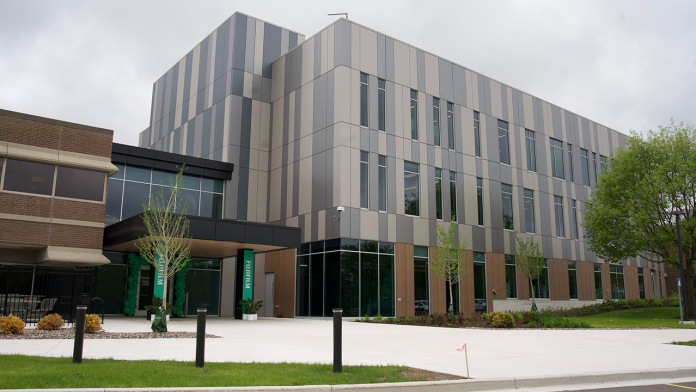

Drug discovery and regenerative medicine got a booster shot recently with Fujifilm Cellular Dynamics new $200 million headquarters and expanded stem cell manufacturing facility in Madison.
The 175,000-square-foot facility, located at 8402 Excelsior Drive, will quadruple the company’s capacity to manufacture human induced pluripotent stem cells, or iPSCs, which are considered to be more biologically relevant research products serving the biotechnology industry. It also houses a dedicated space for gene editing.

“It will allow us to grow our team in a home for them to work in,” said Fujifilm Cellular Dynamics President and COO Delara Motlagh, “and it brings all of our functions together because we have not just manufacturing but our R&D group, our folks in production and supply chain. … Everyone is able to become co-located, which also supports innovation and the ability to be able to build and do more.
“And so of course, as our business grows, we will be hiring more people as well to support some of these extra activities.”
The new facility, which opened in May, will give the company more ability to take advantage of regulatory guidance in the U.S. and Europe away from animal testing and toward new approach models such as iPSCs, which more accurately reproduce human biological functions.
It will serve as a factory for isolating and producing these stem cells for sale to domestic and international researchers, pharmaceutical firms and contract research organizations.
Originally known as Cellular Dynamics International, the company is a classic example of technology transfer from the University of Wisconsin-Madison to the world of commerce.
It was acquired by Fujifilm Holdings in 2015 for $307 million and currently acts as a wholly owned, consolidated subsidiary of the larger Japanese conglomerate Fujifilm.
Fujifilm CDI, which also has a facility in Thousand Oaks, California, does not publicly release its annual revenue, but as part of the Fujifilm Holdings Corp., it’s a growing segment of a $22 billion (in U.S. dollars) global conglomerate.
The local expansion was hailed by everyone from business interests to Gov. Tony Evers, who called it an illustration of the state’s leadership in biohealth and biotechnology.
In its most recent economic impact report, BioForward Wisconsin, the advocacy organization representing over 250 members of Wisconsin’s biohealth sector, said the industry’s economic impact was $37.7 billion in 2024.
The report said the industry supports over 141,000 jobs in the state, with nearly 58,000 direct jobs — reflecting a 25% increase in employment since 2018.
In Madison alone, the local life science real estate market has more square footage than life sciences companies in several of the nation’s largest metropolitan areas, including New York, Atlanta and Houston, according to the first Madison-focused “Life Science Real Estate Market Report” published in 2025 by Broadwing Advisors.
With an inventory of 4.8 million square feet of lab space in nearly 90 lab facilities, Madison also had a much lower life science market vacancy (2%) than most large markets, according to the Broadwing report.
Both studies will be updated this year, but BioForward CEO Lisa Johnson said the Fujifilm Cellular Dynamics expansion is the continuation of an encouraging local trend.
“We continue to see these expansions like Fujifilm CDI from their original transaction 11 years ago,” Johnson said. “They’ve stayed here and they’ve expanded now. That wasn’t always the case for biohealth firms.”
Facilitating innovation
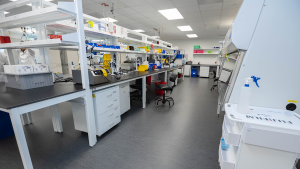
While Fujifilm CDI’s new facility adds capacity, it also serves as an innovation hub to accelerate drug development across all types of biologics as well as for therapeutic purposes.
Among the company’s founders is noted UW-Madison cell biologist Jamie Thomson, who developed a patented method of isolating and culturing human embryonic stem cells for research.
These embryonic stem cells are “pluripotent,” meaning they can become any cell in the body, but extracting these cells from an embryo, or blastocyst, was controversial because once these cells are removed, the blastocyst can no longer develop into a viable fetus (though they were surplus embryos from fertility clinics that were never going to be implanted).
Amid that controversy, Thomson later developed a way to “reprogram” adult stem cells such as skin cells back to an embryonic state, meaning they also are pluripotent and can become any cell in the body.
These are the induced pluripotent stem cells (iPSCs), and they are the key product line for Fujifilm CDI.
The company operates with two primary business units, including a unit focused on discovery and research for drug discovery, toxicity testing and disease modeling.
There is also a therapeutics business unit, which focuses on regenerative medicine with contract development and manufacturing organization (CDMO) services.
The company, which sells domestically and internationally, can provide “off-the-shelf” cell lines or tailor the induced pluripotent stem cells to the customer’s exact requirements.
Motlagh said for the discovery research business, “we are able to have human relevant testing models, and this is because of the cell source that they’re starting with, and then differentiate them into many different cell types.”
Part of the company’s value proposition, one that will help boost its revenue by an estimated 25% over time, is that by using human models, scientists use fewer animals for testing drug therapies.
“So, we’re sparing animals, we’re saving cost in development and accelerating the drug development process,” Motlagh said.
With the new facility, the company now has more space for gene editing, where scientists can make changes to DNA to alter physical traits such as disease risk. The technologies act like scissors, cutting the DNA at a specific spot and allowing scientists to remove, add, or replace the DNA where it was cut, according to the National Genome Research Institute.
“Let’s say there’s a cardiac cell type where you want to put in a mutation to show a disease, we can do that, too,” Motlagh said. “That’s where gene editing comes together with the ability to manufacture any of these cell types. This is part of the innovation.”
Motlagh said gene editing can support both business lines. Scientists can do gene editing for therapeutics like personalized medicine, and they can use gene editing to make different models for testing.
“The space that we have is for our team that does both reprogramming as well as gene editing, and that team is a world-class team that is able to use many different techniques in gene editing,” Motlagh said. “We will be able to perform this for our own products that can be used for disease models in testing, but it can also be used for therapeutic development.”
The area with the most growth potential is new approach methodologies or NAMS, which addresses the use of animal models. With its reprogrammed human adult stem cells, Fujifilm Cellular Dynamics is well positioned to curtail this controversial practice.
“This is very important,” Motlagh said. “It’s huge. It is such an incredible tool and we are one of the leaders in this because we can provide any cell type and it’s not just the cell type by itself. You can have a culture with complex cell types. … You can do organoids like little organs in a petri dish. There are so many different ways that you have sophisticated mechanisms to probe and ask questions without having to use an animal.
“This also will make development so much faster,” she said. “If you think of the billions of dollars that are spent in drug development, this helps to reduce that cost burden to the companies as well as the health care system.”
The technology enabling iPSCs is patented and licensed through the Wisconsin Alumni Research Foundation (WARF), the licensing arm of UW-Madison, which is a source of much of the company’s scientific talent. Motlagh said the opportunity to do meaningful work at a local company is a big advantage in recruiting talent from the university and other local colleges.
From Motlagh’s view, the company’s relationship with the university and its licensing arm remains strong.
“We have a strong and long-lasting partnership with them and we do have that (stem cell) technology,” Motlagh said. “So, Jamie Thomson’s work has come to great fruition in all of the things we touch.”
While Thomson has retired and moved away from the Madison area, Motlagh said his legacy lives on.
“We have many people who worked with him directly from the university that are still at CDI, so while he’s not as directly involved on a day-to-day basis, his legacy is living on through the many folks that he has mentored that came from his lab and are still with us today,” Motlagh said.
Local and larger
BioForward’s Johnson said Fujifilm Cellular Dynamics joins a growing list of biotech companies that have completed or announced major expansions, including pharma giants that acquired Madison companies and not only kept them here, but also expanded them.
From the local expansions of Arrowhead Pharmaceuticals to MilliporeSigma, and from Catalent to Thermo Fisher, Johnson said the trend bodes well for the future.
“Times have changed and there’s no question that companies are coming here and expanding here rather than moving them to the coast, which they did in the past,” she said.
Thirteen years ago, when Zach Brandon took the helm of the Greater Madison Chamber of Commerce, one of his stated goals was to help turn Madison into a global innovation hub.
Brandon said the recent investments of biotech firms “are the proof points that we have arrived, that companies see the value that they get by being in Madison.”
That value comes in a lot of different forms, he said, but perhaps the most pronounced is the quality of the scientific talent they get here.
“Increasingly, we’re seeing companies that are looking to move to Madison because of that but certainly companies that have acquired companies, whereas just a few decades ago the thought process would be to buy it for its value as a company and move it to wherever you’re based,” Brandon said. “And now they’re seeing its dual value. It’s the value of the company and the value of the place.”
In the case of Fujifilm Cellular Dynamics, that value has been a two-way street, illustrated by the company’s willingness to provide local public safety entities with personal protective equipment at the onset of the COVID-19 pandemic in March 2020.
“We went out to our partners, our members, and asked them if they had extra PPE to give them to public safety at a time when we didn’t fully understand the pandemic,” Brandon said. “We just knew it was spreading rapidly and Fujifilm was the first company to respond. … We were able to collect that and give that right to public safety within days.
“Sometimes it’s hard to conceptualize what it means to be part of a community,” Brandon said, “and certainly we value the investment and we value the employees that they have here. The great quotes like, ‘We’re a global company based in Madison, Wisconsin,’ those are all value adds, but what it really comes down to is what does it mean to actually be part of this community?
“It manifests itself in real ways,” he said. “You could never even have conceptualized the need for PPE for police officers and firefighters until you needed it, and they were the first to step up.”

