
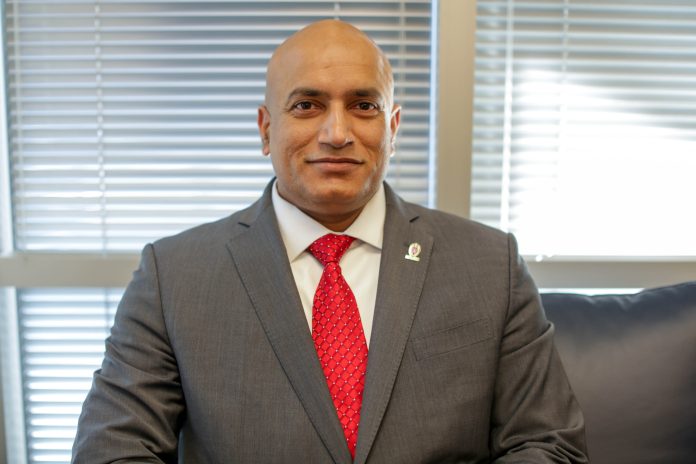

The University of Wisconsin–Madison announced Wednesday that Devesh Ranjan, a mechanical engineer and a leader at one of the country’s largest and highest-ranked engineering programs, will become the 10th dean of the College of Engineering at the university. A former UW–Madison graduate student, he will begin his tenure on June 16.
Ranjan is set to usher in a new era for the College of Engineering, overseeing the construction of the new Phillip A. Levy Engineering Center, a 395,000-square-foot centerpiece for UW–Madison’s engineering campus. He takes the reins from Dean Ian Robertson, who will continue as a faculty member in the Department of Materials Science and Engineering.
“This is an exciting time to begin my role as dean, with the new Phillip A. Levy Engineering Center underway,” said Ranjan in an interview. “I look forward to building upon the foundation Dean Robertson and many others have laid to advance the building to this point, and I am eager to arrive on campus and start having conversations with our stakeholders.
“I am thankful to the state and to the network of stakeholders who have brought the project to this point. Their support and dedication have been instrumental in our progress.”
Ranjan noted the College of Engineering has produced many talented graduates who should be so sought-after that they draw established and startup companies to set up shop in Wisconsin.
“I want to know how many of our people are now in CEO and CTO suites in the state of Wisconsin,” Ranjan said. “I’d love to meet those people, to understand how [we can] enhance our value proposition for the state.”
Ranjan said he plans to meet with local and state business leaders to understand the evolving needs of industry and ensure that the College of Engineering is at the forefront of preparing students for 21st-century jobs.
“By establishing regular dialogues and collaborative initiatives, I aim to align the college’s curriculum with the skills and knowledge required in the modern workforce,” Ranjan told IB Madison.
Through these meetings, Ranjan hopes to foster industry partnerships, promote innovation and entrepreneurship, and enhance opportunities for students to gain hands-on experience through internships and co-op programs. He also plans to work closely with the college’s Industrial Advisory Board to strengthen and develop these industry collaborations.
Additionally, Ranjan said he wants to focus on building a supportive and inclusive culture that encourages continuous learning and adaptability among students, faculty and staff.
During his first 100 days, Ranjan told IB Madison he plans tol travel the state, further developing these important relationships with industry leaders, alumni, and stakeholders. “Where these connections already exist, my goal is to deepen and expand them. This approach is the embodiment of the Wisconsin Idea, which emphasizes the university’s commitment to serving the people of the state and beyond. By engaging with the community, we can ensure that our efforts are impactful and that we are preparing our students to meet the challenges of the future.”
Ranjan said while at Georgia Tech, he learned the value of investing in people and fostering a supportive and inclusive culture. At UW–Madison, he aims to build on this by creating opportunities for students, faculty, and staff to thrive.
“We are very fortunate to bring an engineer with Prof. Ranjan’s energy and vision back to Madison,” said Provost Charles Isbell Jr. in a statement. “His commitment to people and paving the way for their success is a perfect fit for a time of growth at the College of Engineering.”
After earning a doctorate at UW–Madison in 2007 in the lab of professor Riccardo Bonazza, Ranjan joined the faculty at Texas A&M University in 2009. He moved to Georgia Tech in 2014, where his own work has focused on the dynamics of fluids at very high speeds — such as air across the surface of supersonic jets, the plume of a volcanic eruption, and shock waves that fragment kidney stones — and designing next-generation power cycles optimized for solar energy sources or incorporating the efficiency of supercritical carbon dioxide as in heat pumps.
In 2021, Ranjan became a fellow of the American Society of Mechanical Engineers, which presented him with its Gustus L. Larson Memorial Award for outstanding achievement in Mechanical Engineering in 2023. He was tapped for a National Science Foundation CAREER Award and U.S. Air Force Office of Scientific Research Young Investigator Award in 2013 and became Georgia Tech’s first recipient of a Department of Energy Early Career Award in 2016.
In January 2022, he became chair of Georgia Tech’s George W. Woodruff School of Mechanical Engineering, the campus’s largest school, with nearly 3,000 undergraduate and graduate students and 95 faculty spread across 19 buildings.
The significantly larger UW–Madison College of Engineering enrolls approximately 6,500 undergraduate and graduate students across eight academic departments. In addition to traditional research-based graduate programs, it offers 13 undergraduate majors and a portfolio of online and in-person professional education programs that serve thousands of learners annually.

