
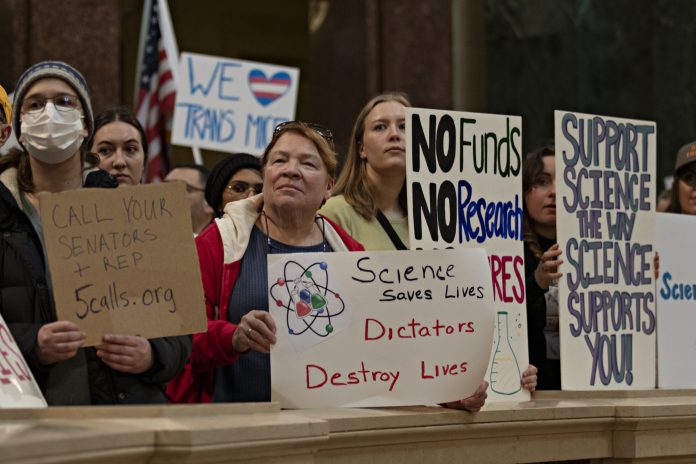

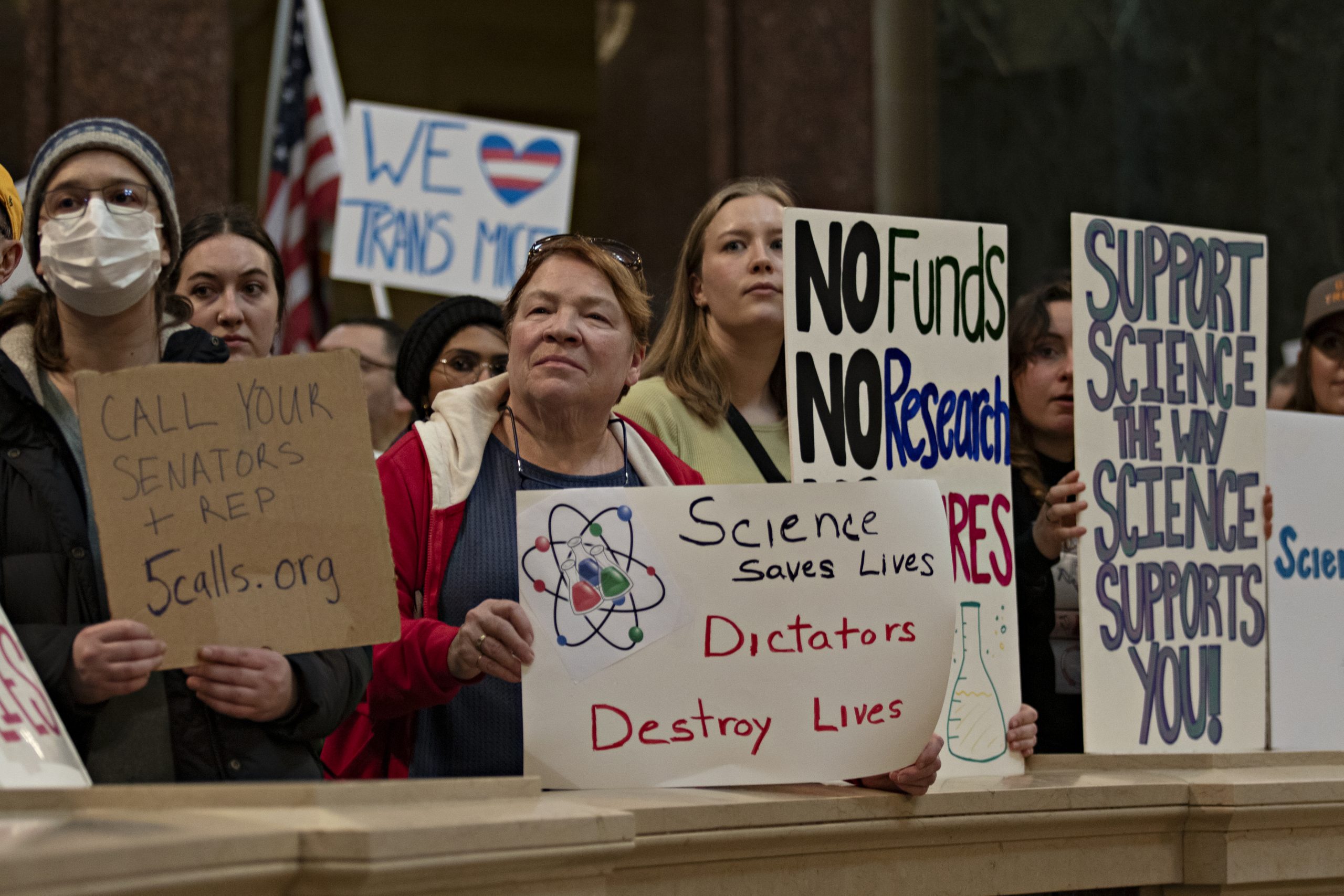
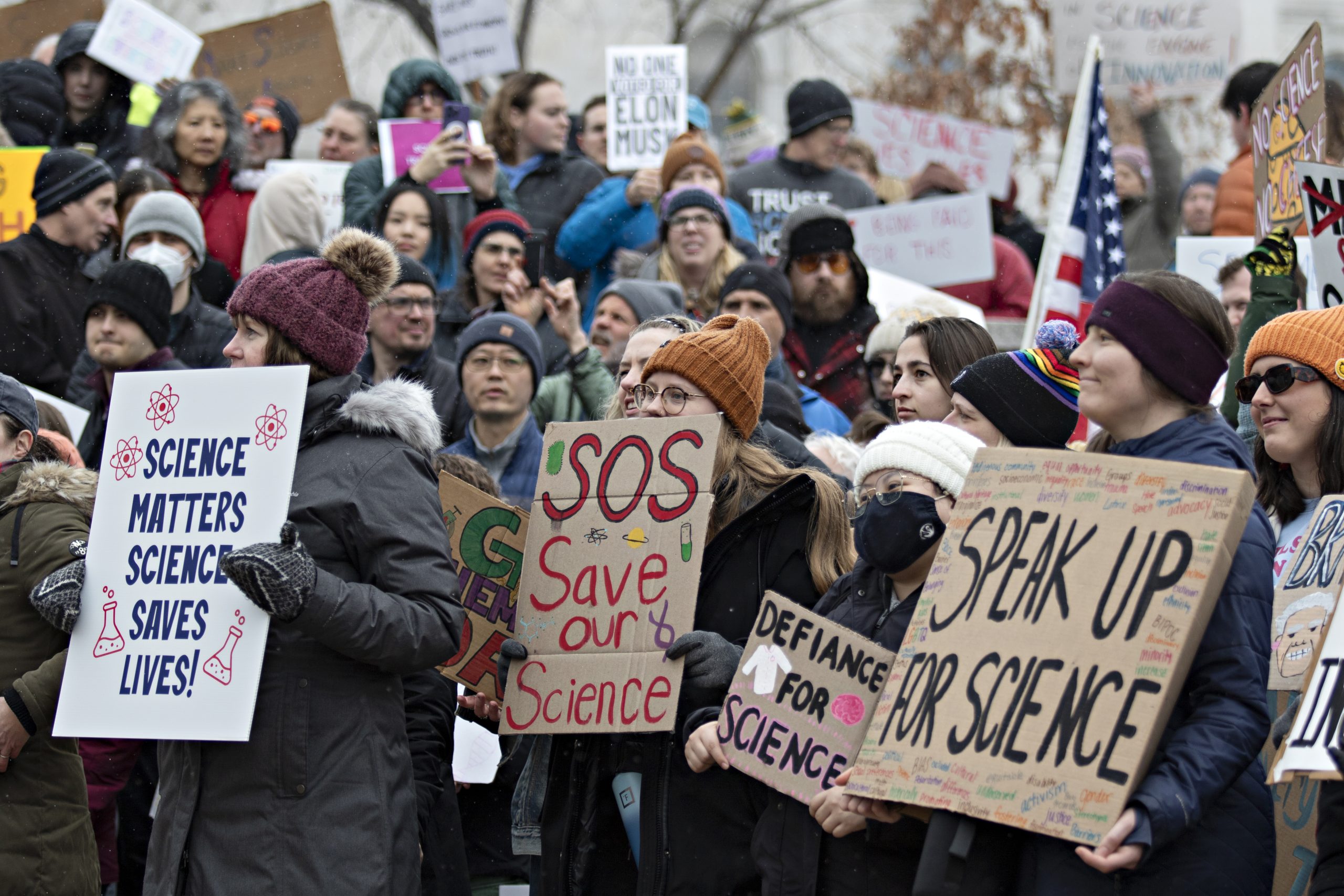
A crowd of about 500 people — students, researchers, cancer survivors, and other stakeholders — applauded, chanted, and held up signs at the Wisconsin State Capitol Friday in support of the academic research under the microscope in Washington, D.C.
At the “Stand Up for Science” rally, people gathered to hear testimony about the value of scientific research in an effort to convince federal lawmakers to reject President Donald Trump’s proposed cutbacks to government-sponsored research grants.
The rally was one of 50 demonstrations planned nationwide in response to recent executive orders that have dramatically reduced the funds available to perform ongoing research projects, including a significant reduction of F&A (facilities and administration) costs that are associated with performing contracted research.
Each of the speakers issued a call to action for attendees to contact their elected representatives and otherwise get behind a nationwide effort to restore the funding.
University of Wisconsin-Madison professor John Denu, a biochemist and the lead organizer of Friday’s rally, said the state of Wisconsin stands to lose $1.5 million per week in National Institutes of Health (NIH)-sponsored research dollars. He said the cuts would undermine American economic competitiveness at a time when China, our chief global competitor, is ramping up its investments in fundamental research.
“The U.S. prides itself on being a leader, and if you cut innovation and if you cut science, then the consequences could be dire for the country,” Denu said.
Denu and other speakers emphasized that they spoke more as concerned citizens than scientists. Before a bust of progressive hero Robert La Follette, and amid a supportive audience that held up signs that read “Science not Silence,” “No Funds, No Research, No Cures,” and other supportive messages, speakers continually stressed the economic value of academic research.
Laura Hernandez, a professor of dairy science in UW-Madison’s Department of Animal & Dairy Science, spoke of the importance of science as it pertains to maternal health, agriculture, and dairy cows, plus the future training of scientists — undergraduates, graduate students, and post-doctoral fellows. She said the cuts not only hurt research, but they could shut down the pipeline of training because student researchers are paid through NIH, the U.S. Department of Agriculture (USDA), and National Science Foundation (NSF) grants.
Asked whether she’s optimistic that a lawsuit filed by 22 state attorneys general, including Wisconsin’s Josh Kaul, would restore the funding, Hernandez was guardedly optimistic but acknowledged she is worried about the overall direction of the federal government.
“I hope the lawsuit does restore the funding, and I hope we keep pushing for that because this is critical to our future,” Hernandez said. “If we shut down science over this period of time, we will really fall behind the rest of the world.
“It’s not only important to biomedical work, but it’s really important to agriculture and food safety and public health. Without our work, we will negatively impact the economics of our state, particularly because we’re an agricultural state.”
Venture backing
Attendees also heard from venture capitalist John Neis, managing director of Venture Investors, one of Wisconsin’s largest venture capital firms. Neis said the firm has backed nearly 30 companies spun out of UW-Madison, many of which have relied on NIH discoveries. He said the research has created thousands of jobs in the state and affected every industrial sector, including companies with supply chains of manufacturers that make machine components, plastics, and packaging.
“The economic impact is broad and significant,” Neis said.
Investment in academic research is a federal policy that dates back 80 years, Neis said, and it developed with bipartisan support. It was a fundamental decision during World War II, when at the direction of President Franklin Roosevelt, engineer and inventor Vannevar Bush, who Roosevelt had appointed chair of the wartime U.S. Office of Scientific Research and Development, wrote a report titled “Science: The Endless Frontier.” Neis said the report created the blueprint for how the U.S. could advance its prosperity, security, and health by investing in basic research.
“It’s a blueprint that we’ve followed since, and it has made us the envy of the world,” he said. “Our economy has been the strongest in the world because of that blueprint, and we just want to continue to honor it. It is in our national economic interest to support this research.
“It is our core strategic advantage as a nation, and it is the fundamental driver of our economy. I don’t want to give up on that advantage.”

