
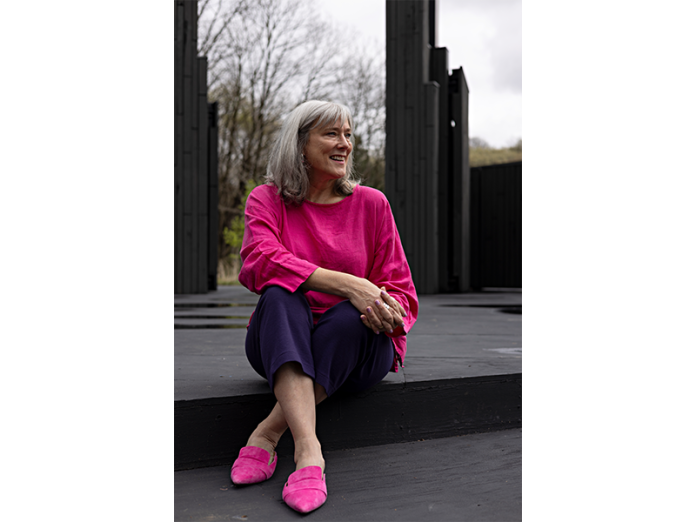

Curiosity and a can-do attitude catapulted Brenda DeVita to her leadership role at American Players Theatre, where for over three decades she has worked to instill a deep sense of community and encourage the candid exchange of ideas across all levels of the organization.
Driven by a zeal for classic theater and language, DeVita has aimed to preserve the mission of the nearly 50-year-old company to reach broad audiences with an emphasis on Shakespearean works, and also to expand APT’s goal to incorporate more diverse voices, increasing its focus on equitability. Her transformational leadership has centered on programs that increase employees’ sense of belonging and empowerment, while amplifying the scope of APT’s shows for broader representation and more universal appeal.
As ATP gears up for its new season — starting this month with William Shakespeare’s “A Midsummer Night’s Dream” and continuing through November with a mix of classic and contemporary shows — DeVita looks back on a storied career and forward to cultivating the next generation of talent.
How did your early career set you on the path to your current role?
I was a professional actress. I met my husband, I got married, and he was an actor as well. It was a kind of crazy life to live and a lot of time apart, so we made a vow that the next person who got the gig, we’d go together. And then he got the job here (at APT in Spring Green) to play Romeo in 1995.
I was like, “No.” I ran screaming from a town that size when I was 18. I was never moving back to a tiny town in the Midwest, but we had made this promise, so I came with him. I quickly found out that … (the staff at APT) lost their company manager. I had gone to school with a lot of the people that were working here, and they called me and said, “You’re going to be here this summer, you could be the company manager.”
I was like, “Are you out of your mind?”
It was a really hard job, but what it did was open the door to this community. The idea of having a community as an artist was really foreign, and I was trying to make a community everywhere I went. I’m from a big family — aloneness was never a thing that happened, whether I liked it or not — so when I got the opportunity to do this job, it was just ingrained to do the work that’s in front of you.
What I tell young actors and young artists all the time now, is, this is an incredibly unpredictable career and industry, and it’s not your choice how you make a living often. Choices are very few and far between for artists, and I just say to them, you have no idea — if you do the next thing in front of you really, really well, the best you can, perhaps you’ll be lucky enough to find a way.
We fell in love with this theater. It was extraordinarily unique and incredibly challenging — and we like challenging. We were young and had a lot of energy, so I said I’d stay for a couple years, and then go back to acting. I went ahead and put together a series of plays to be in, and I was backstage, and I was like, “Wow, this isn’t the thing anymore for me.”
I was really fortunate that the man who ran the theater, (then-Artistic Director) David Frank — I have no idea why — but he started listening to me. I just started doing a lot of work that wasn’t my job, besides my job, and they let me learn everything.
I really do believe that I was blessed with the (attitude of), “Yes, I can. I can figure it out.” And I did.
How has your leadership transformed APT?
I would never say that I transformed it. I would say that (it was) the circumstances, the necessity. … I tried to create a place where what’s actually going on is what we’re talking about.
Because I come from a creative background and the rehearsal room, I knew the rooms where people felt safe, and I knew when everyone was afraid. It’s not (about) not being afraid — it’s being safe being afraid. And that is a key to my leadership.
There’s just not enough time to spend it posturing or pretending or hiding. … I implemented a kind of accountability, a (culture) of, it’s OK to be afraid. It’s OK for us to call out the stuff that’s not working. It’s best if we do, and it’s best if we do it with kindness and love. I believe that.
I implemented these exit interviews we started doing with every person that worked here. I’ve been doing them for 25 years. We have 300 employees at the height of the season. We talk to every person — most of them are seasonal — and we make sure that we ask them how we did, and if what we said was what we did, and if we didn’t get there, why they thought we didn’t. We really, really shut up and listen to them. Don’t tell them why it’s that way, just let them know it’s OK to say things.
Also very apparent is the work that we’ve done with hiring and diversifying our company — the work we’ve done with having more plays for women, about women, by women. … Now, we have a really diverse company of artists that work here that all love language, and love stories, and believe in telling them well. I think that’s the work I’ve been trying to do: Create those relationships authentically.
We have cooler stories and better stuff because it’s what we wanted it to be — which is universal — and it’s not universal if everybody looks alike and sounds alike and has the same experiences.
Talk about what you consider to be your greatest career milestones.
David and I sat down, and we were talking about how we keep really great actors here. Because if you can do what we really want you to be great at, you can do about anything, and work about anywhere. So, how do you hold onto great talent?
The forming of the core company, David and I worked on that together. … That stabilizes our work in a way, and transforms the work for the audience — as long as you have really brilliant, humble, hardworking geniuses that are willing to work in the woods with the bugs — that’s probably a milestone. We actually believed enough in that idea that some folks were convinced. I love to call (APT) “the island of misfit toys,” because it’s all these brilliant toys, and this is where they choose to be.
Reevaluating and creating a real apprentice program here has been a gift that I’m just relieved is wanted by young folks — that they would come and work with us and they would value the work that we’re doing as young people. Because it’s hard and difficult and a lifetime kind of choice.
Helping to build the Touchstone (Theatre) was another big milestone for me — it was helping to design that and put that in the world and help to convince the board that we could do an indoor theater, that APT wasn’t just outdoors.
What makes APT such a unique place?

The location makes it insanely unique.We have to go four miles to town and then 45 minutes to a movie theater, an hour away to get tacos. There’s hardly a place on earth that has 1,000 people sitting outdoors in the light so they can see each other.
It takes such an intention to come here — you have to get in your car, drive here, pack your bug spray… walk up the hill, commit to that many hours, you have to plan it ahead of time, you might bring your picnic. All of that intention is a very different way to enter a space to hear a story. It’s just built in — I had to give this a whole evening. I had to make this the APT night.
You get up to the top of the hill, and you’re looking out over the valley, and you’re sitting down with a bunch of people who made the same effort — I just don’t think there’s a lot of places where we do that.
It makes for a really different feeling in that house than most houses. The first time my husband came home after doing Romeo that (first) year, he’s like, “I don’t imagine I can perform for another audience anymore.”
One of our designers said, “It’s an amazing shedding of yourself when you walk up that hill. You can be critical, and angry about whatever you’re doing, and it’s not working, and all of a sudden… something else happens.” He said you don’t do that consciously, normally. You just walk into work. Here, you’re walking into (work saying), “Ah, here I am, and I’m ready to see or feel or think something different.”
What are you looking forward to in the future at APT?
I’m in the middle of learning and meeting a lot of new artists — directors especially — and I have a lot of people visiting this summer (who) have never been here, never seen the work, who I think are possibly people for our future.
The industry is really changing and it’s scary. Change is scary, right? Lots of people left during the pandemic — a lot of our technical people in the theater industry left — and so we’re training a lot of new folks. We’ve had a lot of young folks, and anybody that runs a business knows, training takes real effort and real focus and intentionality, and resources are tough. I feel confident about the next generation of APT staff. That’s so exciting to me to see (these) people.
You worry, at some point — I’ve been here 31 years — “Did I stay too long? What have I done?” I’ve got to make sure that this isn’t just the way I feel about this place, or the people around me that have been here for a long time.
We have an insane retention rate here — people stay for a really long time. There’s always something new to do. … It doesn’t get boring.
I feel like there’s a lot of reasons people stay around, but I think that the most exciting thing I see is these young people that are so much cooler than us that are here doing the work alongside us. I’m really excited about that. I’m really excited by the possibility of what I’m going to learn from them in the next few years because they say what they think, which is what we want.

