
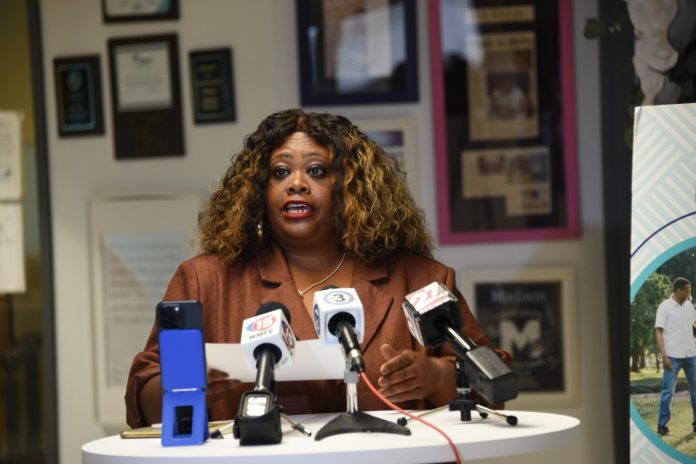

At a press conference on Wednesday, Sabrina Madison, founder and CEO of the Progress Center for Black Women, recounted an urgent email she received at 12:35 a.m. Tuesday night. A woman scheduled a meeting as she “needed solutions to (her) current housing challenges.” And Madison said, like in most of these situations, the center was a last resort.
“That line has been sitting with me all morning, even over my coffee, because imagine how stressful life must be for her to reach out for help a little bit after midnight,” said Madison, who leads the nonprofit that offers community and career support to Black women. “It’s a reminder that the work we do here isn’t just about programs or services, it’s about real people trying to hold their lives together in the middle of systems that too often fail them. And she’s not alone.”
Madison announced the Progress Center is expanding its Ambition program, which focuses on workforce development and workforce advancement, to help women like the one who emailed her.
The center will include on-site resources in the form of career and wellness hubs at the Meadowlands apartments and at a local shelter in 2026 for any community members in need. The nonprofit already has a steady presence at the Meadowlands, a lower-income housing complex.
“These hubs will bring essential career and stability services directly to where people live, eliminating transportation and child care barriers that too often keep women from getting help at these hubs,” Madison said.
Community members will receive career navigation, workplace advocacy, job strategies for difficult situations, resume help, networking, career coaching and more.
Wage disparity
Nearly 300,000 black women have left the labor force this year, according to the U.S. Bureau of Labor Statistics, and the disparity in wages is stark.
According to national wage gap data, Black women in Wisconsin earn only 63 cents for every dollar paid to white, non-Hispanic men, and the gap widens to 57 cents when part-time and seasonal workers are included, Madison said.
“For many, that means even full-time work does not guarantee economic security, so as wages stagnate, while rent, child care and health care costs continue to rise, too many Black families remain just one single paycheck or one single medical bill … away from their next crisis,” she said.
She cited the 2025 State of Working Wisconsin report when explaining how, for decades, Black workers in the state have been more than twice as likely to be unemployed as white workers.
“Many now facing housing instability, little to no financial safety net, widening wage gaps and growing health stressors from inadequate or unaffordable health care here in Wisconsin,” Madison said.
‘We can’t wait for permission to survive’
Funding has become especially important after President Donald Trump’s administration began pulling back on equity-related initiatives through executive orders.
Madison said the federal government changed how equity-based grants are reviewed and awarded.
“Programming like ours that explicitly and boldly serve Black women are now being categorized as high risk,” Madison said, citing language the National Council of Nonprofits uses. “I also can’t miss reminding people that often, locally funded programs receive dollars that are passed through from the federal government. That means we face increasing grouping, new restrictions and declining access to public or foundation funding simply because of who we serve.
“This political climate under the Trump administration threatens to undo years of our progress for women of color, especially Black women, small equity-based nonprofits and the communities that depend on us. And because of that, we can’t wait for permission to survive.”
During the press conference, Madison vowed to make as many phone calls as possible over the next 90 days to get 1,000 supporters to pledge $20 a month for at least a year to the organization. She said the $20,000 per month contributions would stabilize the programming, pay staff and seed proven strategies.
And it would allow the center to keep helping women like the one who emailed Madison just after midnight for assistance.
“It means resilience,” Madison said. “It means that no matter what happens in Washington or how local companies shift their equity admissions to align with the Trump administration, we’re not bowing down to him, and we encourage others not to do as well.
“We can’t, because Black women especially depend on us for resources, for advocacy and for a community that refuses to turn its back on them.”

