

Innovation from Wisconsin now includes Alliant Energy’s Columbia Energy Storage Project, a groundbreaking demonstration of long-duration renewable energy storage.
It’s a first-of-its kind energy storage system, designed by European company Energy Dome, and will be built south of Portage near the current Columbia Energy Center. The system’s features aim to enhance grid stability, improve resilience, and ultimately deliver enough energy to power about 18,000 homes for 10 hours — a feat that could prove vital on the path to clean energy in a state where renewable energy sources like wind and solar are notoriously variable.
Following its selection last year to receive a grant from the U.S. Department of Energy’s (DOE) Office of Clean Energy Demonstrations, Alliant filed a project application with the Public Service Commission (PSC) and now awaits approval that could take as long as nine more months. In the meantime, plans are taking shape with the support of several financial partners, and Alliant’s project collaborators are gearing up for the opportunities that the Energy Dome technology presents for community engagement and workforce development, leveraging Wisconsin’s capacity for manufacturing and innovation.
Mike Bremel, director of engineering and customer solutions at Alliant Energy, and Tony Palese, its senior communications specialist, are among the evangelists for the Columbia Energy Storage Project and the company’s overall Clean Energy Blueprint. Bremel says Alliant has implemented smaller-scale lithium ion projects, which are shorter duration projects with a range of four to eight hours of storage, but the company recently turned its attention to longer duration energy storage, which may come with a higher initial price tag but could provide long-term energy savings and has invaluable implications for sustainability and statewide employment.
Bremel also says the project became financially viable due to DOE coverage of up to 50%, or $30.7 million, of the project cost, with the remainder spread among Alliant, WEC Energy Group, Madison Gas & Electric, and Shell Global Solutions U.S. “Our typical pilots are $10 million and less, and this was a significant departure from that,” Bremel notes, “but that really brought this technology and this larger-scale project down to a level that was acceptable for new technology demonstration and piloting.”
Palese talks about how long-duration storage could change the energy landscape for utilities and consumers. “If you think about the lithium ion batteries that Mike mentioned, those can help meet some of the peak demand that we see with customers. So, if everyone’s coming home from work in the evening and turning on the AC, we can get that little extra bump of generation capacity onto the grid to meet that need. Those short-duration energy storage systems are really good in that use case.
“And then we have these new long- duration systems that are becoming more prevalent,” he adds, “and there’s a greater need for that — where it’s not just meeting that peak demand for a couple hours in the evening, it’s about capturing a lot of that excess renewable energy when it’s not needed and putting that onto the grid over a longer period.”
According to Bremel, this is the initial pilot to understand how the technology works. Depending on what is learned, Alliant may deploy different durations and sizes across its system.
With a higher initial deployment expense, how would this technology prove more cost-effective in the long run? “Think about it — the grid — in your general economics of supply and demand,” says Bremel. “If you have excess renewable energy available to you, that energy is likely going to be more cost-effective, and we can store that more cost- effective energy and deploy it in periods when there isn’t as much energy.”
Bremel also highlights the possibility that the products involved in the construction of projects like the Energy Dome — mainly steel, standard generator turbines, heat exchangers, and compressors — could be sourced from Wisconsin and/or the U.S. “We would expect to see more efficiencies in terms of the construction, in terms of potential supply chain cost impacts.”
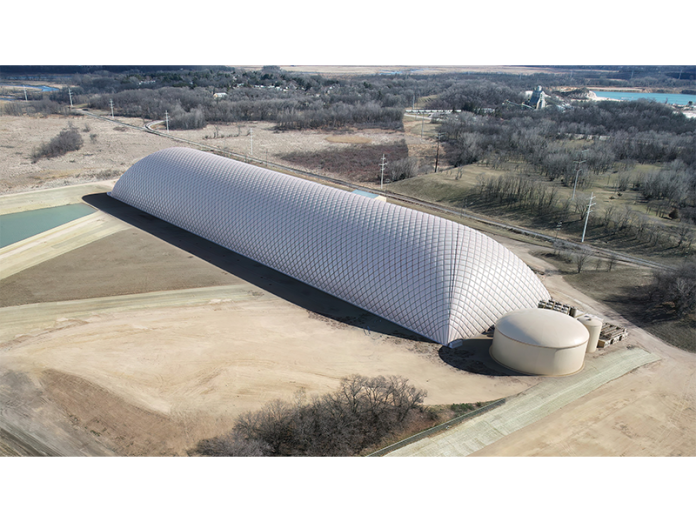
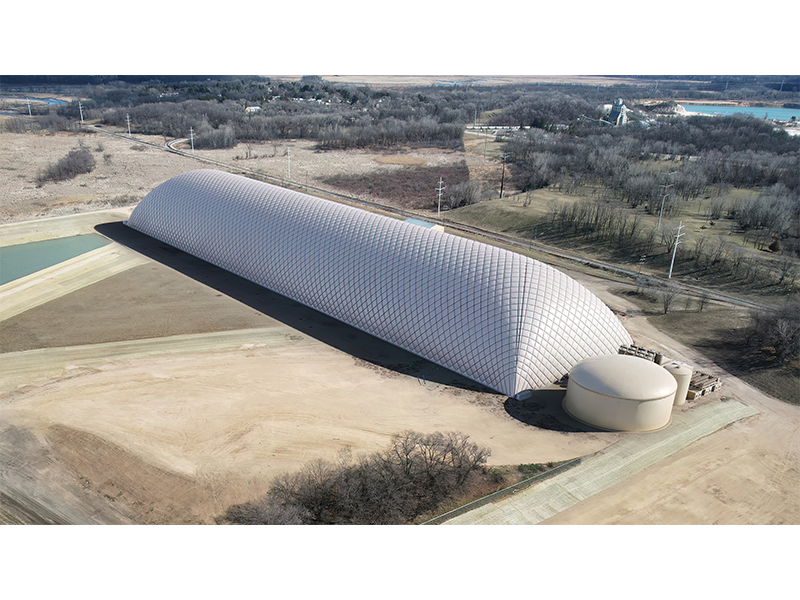
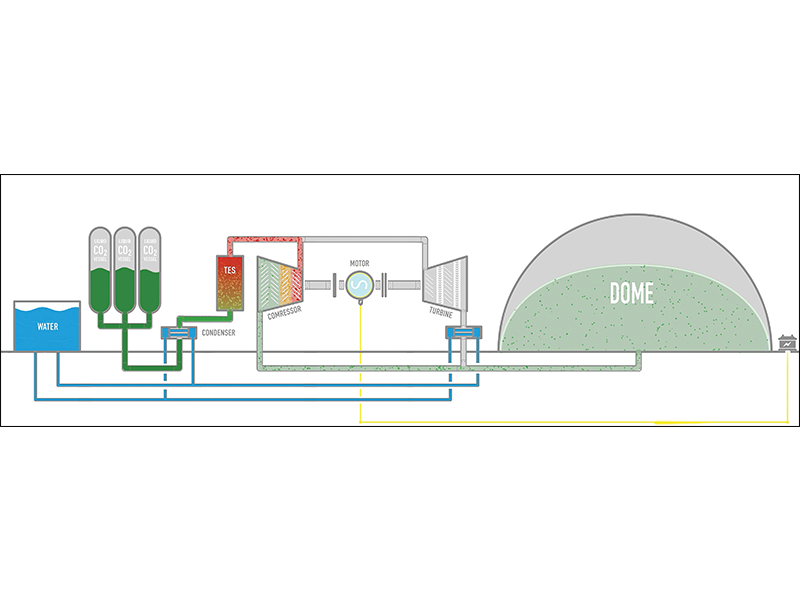
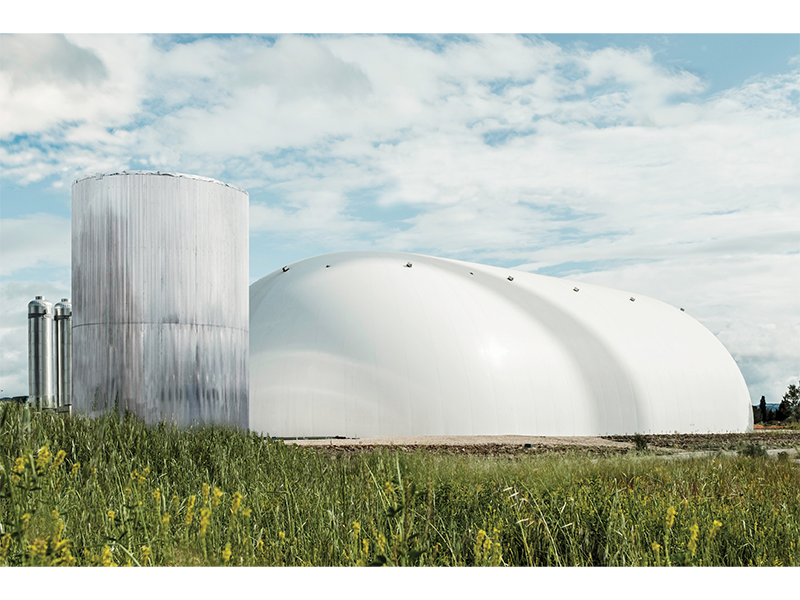
The technology itself, though revolutionary, breaks down into relatively simple and familiar components, harnessing processes that have long been utilized in energy for a new and different purpose. “The structure is a sports dome, a large, pressurized dome,” Bremel explains. “It has that outside structure, and then there’s an inner membrane, the bladder that basically blows up with the CO2.”
The carbon dioxide initially injected into the unit enters a closed-loop for the system’s longevity. The gas is pulled through a thermal storage system and then a heat exchanger, and stored as liquid carbon dioxide in a large tank before it is transitioned back into a gaseous state — a process that turns a turbine and ultimately creates electricity. Bremel emphasizes that there is no carbon dioxide leakage, that the gas is just repeatedly converted from gas to liquid and back. Carbon dioxide was chosen, he says, simply because it can easily be held at both a gas and liquid state at ambient temperatures.
“There are other long-duration energy storage technologies that may compress air or compress other solutions,” says Bremel, “but the Energy Dome, because it can be at ambient temperature, doesn’t require cryogenics and doesn’t require other mechanical complexities with the process.”
Bremel also points out the environmental friendliness of the dome’s overall design. “[It] covers about 13 acres … so it covers a lot of land. But there’s very little disturbance of the land that’s underneath the dome.”
The site is graded and covered with a weed membrane, he says, and then a foundation is built around the perimeter to provide an anchor, but once retired, “the polymer membrane of the dome is removed, and potentially recycled, and then the concrete can be removed, and the land is restored, so it’s a pretty environmentally conscious design.”
Communal benefits
As Alliant develops this new solution in renewable energy storage and looks forward to a promising era for overall sustainability, educational partners UW–Madison and Madison College are looking to maximize the Energy Dome’s community and workforce benefits.
Regarding the community benefits component, Palese says, “We work with the community to better educate them on the technology and renewable technologies in general, and source their support and questions and information.”
UW–Madison’s Oliver Schmitz, associate dean for research innovation in the College of Engineering and director of the Grainger Institute of Engineering, discusses the value of the university’s Clean Energy Community Initiative, a statewide effort that is supporting community benefit plans for more than 10 large-scale projects. Schmitz says the initiative creates a space to learn about community priorities and serve those needs with available technology.
“The community benefits [around the Columbia project] are as innovative as the technology itself … We are really interested to get engaged with this new technology and learn how we could present this, for instance, as an excitement item to [the] future workforce to choose clean energy as a career path.”
Schmitz says good pay and an expanding field add to the career pathway’s appeal for younger generations, but generating excitement among job seekers is the only way to ensure a sufficient workforce to build clean energy projects. “We have all these projects in our portfolio, and we can advertise this space to the population of Wisconsin and the surrounding states and show them that these are new jobs, this is a new career. You can be an electric installer, you can be a journeyman. It’s just new employment opportunities.”
This education and training, he says, will happen through UW–Madison’s higher-degree and certificate programs within the university’s College of Engineering and the Nelson Institute, and in partnership with Madison College, providing traditional education pathways and additional training for those who have already entered the workforce: “We can take the existing workforce and reskill it,” he notes.
Madison College Science, Engineering, and Renewable Energy Instructor Ken Walz, who also serves as director for the Create Energy Center, founded by the National Science Foundation, notes how the Columbia Energy Dome’s success could prove transformative, not only across Madison College campuses, but for Wisconsin’s energy sector. “When you look at the energy storage sector, right now it’s dominated by lithium ion batteries, and the vast majority of those lithium ion batteries are all made overseas, primarily in Asia. That’s problematic from a supply chain standpoint; it’s also a limitation from a technological standpoint.
“If you want longer duration storage,” he adds, “we need to be looking at other kinds of tech, and this Energy Dome project will be one way to do that. It’s an area of technological exploration and an opportunity for Wisconsin to lead on that front.”
Italian test case
A twin project in Sardinia, Italy is already underway and set to provide a critical window into the technology’s real-world performance. Says Bremel, “We’ll have some data points, and we’ll have a better understanding of how a large-scale project operates, and whether it meets the desired specifications and the expectations of both us and Energy Dome.”

