

How far should the state go in regulating the hyperscale data centers that are generating heated debate throughout Wisconsin?
If state Sen. Kelda Roys, D-Madison, has her way, the answer is far enough to have large data center operators fund alternative energy development in return for approving the facilities that power artificial intelligence apps.
In Roys’ view, a Republican-backed assembly bill, AB 840, which was approved in January by a vote of 53-44, doesn’t go far enough to protect ratepayers or the environment.
“We’re in an affordability crisis and people’s utility bills are out of control,” Roys said. “We have seen the Public Service Commission allow increased utility rates in recent years, and the boom in data centers is just going to supercharge this unless we take action.”

Battle lines
AB 840, passed along partisan lines, takes a lighter approach to regulating data centers. Republicans argue it protects Wisconsin residents from paying costs related to the construction of electric infrastructure for data centers and promotes water conservation by requiring closed-loop systems that use a fixed amount of water for cooling.
Senate Democrats have introduced their own bill to shield ratepayers from bearing the costs of large data center demands, requiring large data center operators to pay an annual fee based on their peak electricity demand. The fees could range from $2 million to $4 million depending on the forecasted demand and would raise revenue for renewable energy.
The Democrats’ bill also enables the Public Service Commission to establish and review rates for very large customers, and mandates reporting on data centers’ energy consumption and renewable energy usage.
Under the bill, large-scale data centers are defined as facilities over 25,000 square feet with at least $250 million in investment.
Roys, who is also the CEO of OpenHomes, a real estate brokerage, acknowledges the potential benefits of AI.
She also said the tech giants who operate large data centers are already among the wealthiest and most powerful corporations in the world and a balance must be struck.
“They have unparalleled economic and political power,” Roys said. “We need to make sure we have safeguards in place that protect people from the economic and environmental harms of not just data centers but of AI.”
The Democrats’ legislation also requires electric utilities to offer an optional renewable resource tariff for commercial and industrial customers.
A renewable resource tariff is a program that allows utility customers to purchase electricity sourced from renewable energy sources.
Roys said the Republican bill, which does not require data center operators to build off-site green energy facilities, will be counterproductive because alternative sources such as wind and solar are the “cheapest and fastest new energy sources that we can stand up here in Wisconsin.”
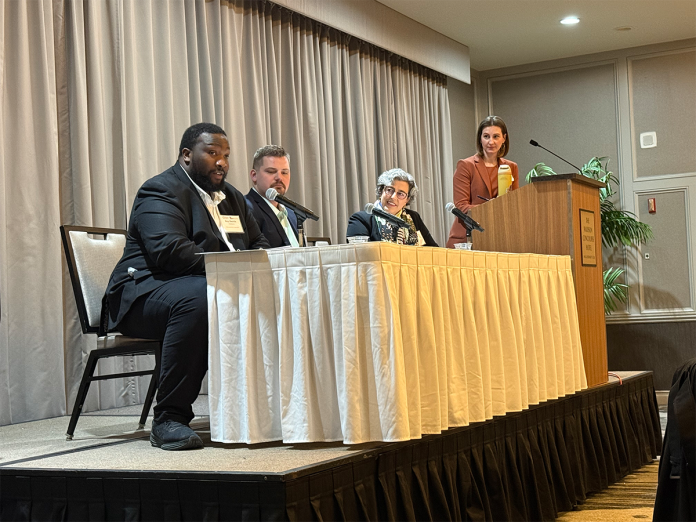
During a Feb. 5 panel discussion presented by the Wisconsin Technology Council and Microsoft, lawmakers from both parties outlined their divergent approaches to data center regulation.
Republican state Rep. Nate Gustafson, who represents the state’s 55th Assembly District, serves as chair of the Assembly Committee on Science, Technology and AI and voted for AB 840.
Gustafson said he favors managing the impact of investments in land, water and power consumption without stifling innovation and while making sure it’s done in a sustainable way.
During the panel discussion, Gustafson praised Microsoft for its approach to working with county and local officials on the Mount Pleasant data center.
That community has been receptive to Microsoft’s data center campus, in part because of the company’s new Community First AI Development Initiative, which was born out of the concerns and questions it has fielded.
The initiative is grounded in five commitments to communities that Microsoft believes will raise the bar for itself and others, including a commitment to water conservation with the help of a closed-loop cooling system in which water keeps circulating within a sealed piping system.
“My philosophy, which I’ve stated multiple times, especially within my committee, has been wait, don’t regulate,” Gustafson said. “And that is be ready, be prepared, understand what’s coming and understand that if there if there is going to be that moment where we don’t see adoption of the latest technologies that are going to be self-sustaining, as we talked about with the closed-loop system, then we may have to have a conversation about what that looks like.”
If a similar bill passed in the Senate, Gustafson said there likely will be negotiations between the two parties, as Democratic Gov. Tony Evers is reportedly skeptical of the Republican bill.

Microsoft mandate
State residents continue to question whether Wisconsin can take advantage of the opportunities presented by data centers while protecting against potential downsides. Microsoft’s approach has proven effective in Racine County.
Rima Alaily, corporate vice president and general counsel of infrastructure legal affairs for Microsoft, also took part in the Feb. 5 panel.
Alaily said Microsoft has made significant investment — over $7 billion — to build a multi-phase data center campus in southeastern Wisconsin.
In 2024, the tech giant broke ground on a data center in Mount Pleasant on the former site of the Foxconn project. The data center is expected to be operational later this year.
Microsoft also has broken ground and started construction on a second data center next to it, and the company has announced plans to expand onto other adjacent sites for up to 15 data center buildings in the area.
In addition to water conservation, Alaily said the other commitments of Microsoft’s Community First AI Development Initiative center on:
➤ Electricity: Microsoft is committed to “pay its own way” when it comes to electricity generation, which protects local ratepayers, Alaily said.
➤ Jobs: The company has pledged to help create jobs for residents, not only with 500 data center jobs at the center that goes online this year, but with the related construction work and by tapping into Wisconsin’s manufacturing supply chains for mechanical, electrical and HVAC equipment.
➤ Tax base: Microsoft’s data centers will add to the local tax base to ensure there is more revenue to invest in local schools, hospitals and other institutions. Alaily said the tax revenue data centers bring is substantial. Microsoft built its first data center in Quincy, Washington, a farming community two hours east of Seattle, 20 years ago.
“We’ve continued to build data centers there over the last 20 years and that county (Grant County) has seen property tax revenues go from about $60 million to over $180 million per year,” she said.
➤ AI workforce investment: Alaily said the company is making a conscious effort to invest in AI skills training so that local workers benefit professionally rather than be left behind.
“At the end of the day, it’s our belief that our ability to build out and deliver AI infrastructure really depends on communities coming to the conclusion that the benefits outweigh the costs,” Alaily said.

