
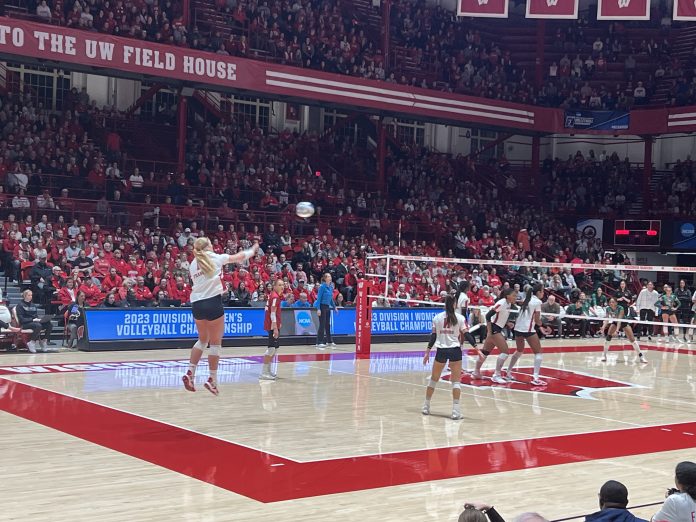

In what has been described as a first-of-its-kind deal in National Collegiate Athletic Association history, UW Health is the official title sponsor for all University of Wisconsin-Madison women’s sports.
While it’s already hard to miss the UW Health logos at Badgers women’s athletic events, the new sponsorship is designed to increase visibility of UW Health at these events and across the social media and digital marketing of women’s sports.
In return, it will also provide female athletes with various name, image and likeness (NIL) opportunities, featuring them in UW Health content campaigns to share health messages across marketing, social media and other channels.
“For years, we’ve had athletes connecting to the community, sometimes at public events and oftentimes visiting our children’s hospital,” said Chris Roth, chief marketing officer for UW Health. “The most logical place that you will see this visible for patients is actually in the athletes sharing stories.”
UW Health, an integrated health system associated with the University of Wisconsin-Madison, is Greater Madison’s largest employer. It will not only sponsor high-profile women’s sports such as volleyball, hockey, basketball and softball, but also sports that don’t generate as much media attention — soccer, golf, track and field, cross country, tennis, swimming and rowing.
The organization’s relationship with UW athletics precedes this title sponsorship. As the official medical provider for all of UW athletics, UW Health provides both sports medicine services and performance management to Badgers athletes.
“Both individual care for their acute needs but also ongoing care and monitoring,” Roth said. “We also have our Badger athletics program, which does high-end testing for athletes to help with recovery as well as performance management.”
Brand ambassadors
In the NIL era, collegiate athletes have the ability to serve as ambassadors for brands. Roth said UW Health is looking for synergy between health-related topics where UW Health wants to share content, educate the community or share patient experiences.
“Those athletes, whether they personally have that experience, whether it’s something they’ve been connected to through family or friends, or something they just feel passionate about, we’ve found some good success in marrying those health topics where the athletes then have the opportunity to help educate the community,” he said.
A recent example was around the topic of integrated specialty care for women. Those priorities were illustrated a year ago when UW Health opened Eastpark Medical Center, the site of a specialty care program for women.
Roth said the program is about caring for the highly specialized needs of women that oftentimes go untreated, and in a nod to the role mothers play as “health officers” of the family, UW athletes will encourage people to seek their mother’s wisdom.
“It was just the opportunity for those athletes to say, ‘Go ask your mom about it,’” Roth said. “Ask your mom and see if they are facing some of these challenges and let them know that there’s something they can do.
“So the concept was really to ask your mom as an opportunity for public health awareness that there are solutions for some of the things that sometimes go untreated among women,” Roth said.

Roth did not specify a dollar value of the title sponsorship, noting that it will depend on how the program unfolds. He said UW Health expects it to be a long-term partnership and nothing prevents other local companies from stepping forward with NIL opportunities for female athletes.
“We didn’t specify there had to be exclusivity around health care topics,” Roth said, “but there clearly can be others that will connect with the athletes. We would encourage that because we support women’s athletics and the movement that’s happening around sharing their voice and using that as an opportunity to help advocate for health or other topics.”
Fair play
In June 1972, Congress passed and President Richard Nixon signed into law Title IX, which prohibits sex discrimination in federally funded educational programs. It led to increased participation and equitable access to resources like scholarships, equipment and facilities for female athletes, whose numbers have grown dramatically.
Fifty years later, at the dawn of the NIL era, men have dominated the NIL earnings. According to the July 14 edition of Sports Illustrated, the top 10 earning collegiate athletes via NIL deals are all men, nine of the 10 are football players, and 8 of the 10 are quarterbacks — led by Texas signal caller Arch Manning’s $6.8 million NIL haul.
While it’s not unusual for collegiate women to generate a high level of interest — LSU gymnast Livvy Dunne was in the top 10 in 2024-25 with $4.1 million in deals, and former Iowa basketball star Caitlin Clark reportedly earned $3.1 million in NIL money — men still get most of the deals.
On the NCAA’s NIL data dashboard, in the period from Jan. 1, 2024–Oct. 31, 2024, football received 40.6% of all NIL deals, followed by men’s basketball, which got 12.8% of the deals, and (men’s) baseball, which got 8.5%.
Among women’s sports, basketball led the way with 8.2% of the deals.
In terms of dollar amounts, most of the deals in that 10-month period (58%) ranged from $0-$100, while only 1% of the deals were for $50,000 or more. In addition, 15% were valued between $100-$500; 7% were valued at between $500-$1,000; 13% were valued at between $1,000-$5,000; 3% were valued at between $5,000-$10,000; and 3% were valued at between $10,000-$50,000.
The dashboard is due to be updated with figures from the past year.
UW Health’s sponsorship of UW women’s programs is designed to bring more opportunities.
“We had some of those similar concerns, not necessarily to the partnership, but just with the evolving situation around NIL and how that may influence how dollars are positioned,” Roth said.
In pursuing the UW Health sponsorship, Roth said both Director of Athletics Chris McIntosh and Deputy Athletic Director/Chief Revenue Officer Mitchell Pinta have restated their commitment to supporting women’s athletics.
In a press release announcing the sponsorship, Pinta called the UW’s partnership with UW Health a milestone in support for women’s sports at UW-Madison.
“We are grateful for UW Health’s commitment to elevating these incredible student-athletes and excited about the opportunities it will create for them, as we together continue to foster an environment where they can thrive and promote the important messages of health to the Badger community,” Pinta said.
Roth also used the word “elevate” in reference to the sponsorship’s likely impact on women’s sports.
“To me, this is a good step in the right direction for both their position of supporting all programs, male and female, but also that they see this as an opportunity to elevate women’s athletics and generate additional interest and opportunities for those athletes in particular,” he said.

