

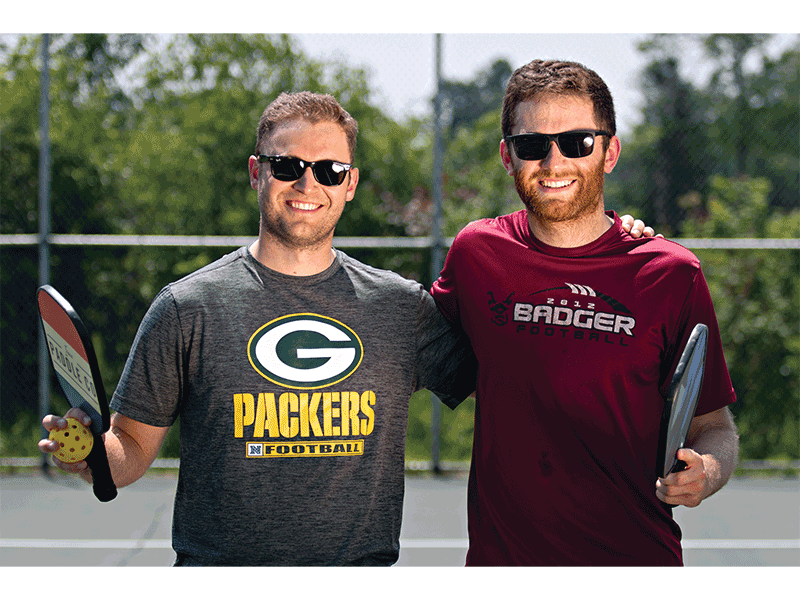
Caleb Ganansky and Jack Drake sat on the side of Tenney Park’s tennis courts on a sunny Wednesday afternoon, catching their breath from their last match.
“I am definitely sweating more than I should be,” said Drake, 28.
The game was not tennis, though. The two graduate school friends caught up over the fastest-growing sport in America. Your parents likely play it. Your friends, too. Maybe even your grandparents have joined the trend.
“Pickleball is humbling,” Ganansky, 28, said. “The first time I started playing was with my wife’s mom, who is obsessed, and it was just me and her mom and a bunch of people who were 50 and 60 years old — and I was getting smoked.”
The two have been playing for a few years, piggybacking on the sport’s sweep of the nation — a sweep that was not slow and steady but instead took over the country rapidly. Accelerated by the remoteness of the pandemic, pickleball has exploded in popularity since 2020, with municipalities and private companies leaning into the movement and building new courts and facilities for “picklers.”
Once seen as a casual retirement sport, pickleball is now an economic force: new businesses are opening around it, existing facilities are being repurposed to meet demand, and tournaments are drawing hundreds of players and spectators.
With the Madison Pickleball Open returning this July, the region’s largest tournament has become a fundraising powerhouse and a showcase for the sport’s staying power. From custom gear and paddles to themed leagues and social events, the pickleball economy is only getting more competitive, and more lucrative.
Early days of pickling
The Madison area has been ahead of the trend, tracing local interest in the sport to pre-pandemic times. The Capital Area Pickleball Association — also known as CAPA — got its start in 2016 as a way to offer pickleball enthusiasts the opportunity to improve their skills and socialize.
Kevin McPherson, president of CAPA, said his job looks a bit different now from when the organization first started.
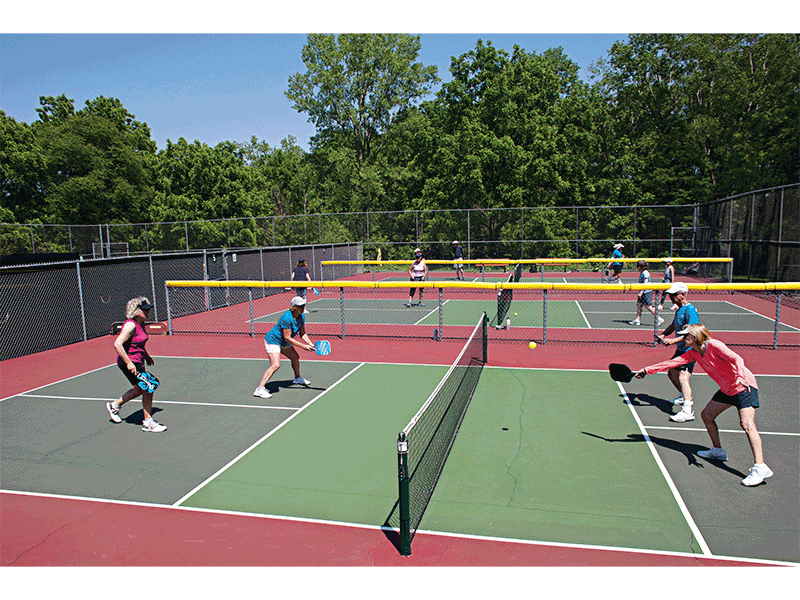
Much of CAPA’s early years had to do with simply explaining how to play: on a court about one-third the size of a tennis court, the game can be played in singles or doubles. Using plastic paddles and a perforated plastic ball, players serve underhand, and the ball must bounce once on each side before volleys are allowed. Games are typically played to 11 points, and a team must win by 2.
“When CAPA got started, I believe there were six dedicated pickleball courts in the area,” he said. “They were just fundraising to get the first courts built in Madison at Garner Park.”
Now, the Dane County area boasts at least 180 outdoor courts, 112 of which are dedicated to pickleball solely, according to CAPA records. CAPA grew to over 1,300 members last year, more than double its membership in 2021.
The sport’s rapid growth is unparalleled, McPherson said, so it was only a matter of time before Madison caught up to the rest of the country.
“The growth feels like it’s really snowballed. And once everybody starts buying in at the parks and rec departments, it gets an awful lot easier,” McPherson said. “There was maybe a feeling five or six years ago that this was a fad and was going to pass.
“Now we’ve got all the parks and rec departments building courts and announcing courts. … There are new indoor facilities coming, too.”
Courting players
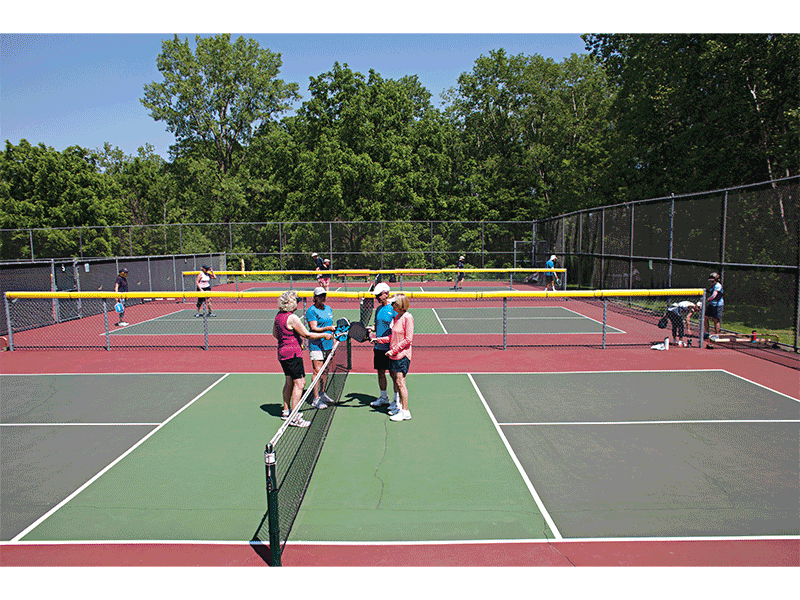
Outdoor courts in Wisconsin face a tough opponent each winter: snow. For what feels like half the year, courts are buried beneath the white blanket. Until recently, indoor options in Madison were limited to a few gyms and recreation centers offering makeshift court space.
That’s starting to change.
Madison may soon be getting two new indoor pickleball facilities, one on the west side and one on the east side. Meanwhile, Fitchburg is planning a new community sports complex with several courts. And across the region, indoor recreation centers are re-striping gym floors and re-lining tennis courts to make room for more picklers.
As the game has mushroomed, meeting the demand from players hasn’t been easy. Ganansky and Drake said getting playing time on popular courts in downtown Madison can be “vicious.”
Nancy Ketterhagen, who has been playing pickleball for the past five years, helps organize tournaments in Oregon and plays at courts across the county. She has seen that stress firsthand.
“As the sport explodes in popularity, municipalities are struggling to keep up,” she said, “not just building new courts but maintaining the ones already there.”
“The number of reservations has steadily increased in recent years,” said Ann Shea, a spokesperson for the Madison Parks Department. “We receive a fair amount of requests for additional dedicated courts.”
The city is planning on building eight new courts at Warner Park in 2026, which will cost between $350,000 and $450,000. Court lighting will be an additional $200,000, Shea said. New city development plans will also add pickleball courts at Old Timber Park in 2028, as well as in Country Grove Park and Vilas Park soon after.
“Parks intends to identify additional future locations spread throughout the city to serve as many resident pickleball players as possible,” Shea said.
Two new indoor facilities may also ease the pressure. In April, Madison’s Plan Commission approved a new indoor facility to be built at 8701 Blackhawk Road. The 10-court space would also feature a restaurant with a full bar inside the building, as well as an outdoor eating area and one outdoor court. Construction of Court and Cork is expected to be complete this summer.
The city’s Plan Commission also approved converting a former Amazon distribution center just off of the Beltline into a 28,000-square-foot indoor pickleball facility with 10 dedicated courts.
Located at 5004 Tradewinds Parkway, it will be the first Madison-area location for Dill Dinkers Pickleball, a Maryland-based chain of indoor pickleball clubs. It also will be the largest dedicated indoor pickleball facility in Madison with full programming, according to Damon Coella, co-founder of Dill Dinkers.
“We’re really excited to get involved in the Madison scene. There’s clearly a thriving pickleball community here — it’s ranked as a top 10 market in the country — and shockingly, there hasn’t been a facility like this yet,” Coella said. “This is a relatively new building in a great part of town, and we think it’s a great opportunity.”
The courts at Dill Dinkers will include fencing around each court to reduce interference from other games. The space will offer clinics, lessons, tournaments and open play for every level.
Those new courts join Pickle Pro Courts’ five hard indoor courts at 2907 N. Sherman Ave. Patrick Riha opened Pickle Pro just down the street from his restaurant, Beef Butter BBQ, in 2022.
It was the first building for indoor courts in Madison, and it began when an employee gave Riha a pickleball paddle. Riha wasn’t planning on starting a business, he just wanted a place to play.
“We had so much fun,” Riha said. “But then it started getting dark in the fall, so we hung lights on the fences and played well into the evening while everyone else was heading home.
“When it got cold, I said, ‘We need an indoor place to play pickleball.’”
He saw potential in a vacant grocery store space he knew in the Northside Town Center, and Pickle Pro Courts was born. Since opening three years ago, and with only five courts, which Riha admits is not enough, the business already has 7,000 registered players. Players can opt for an annual membership ($720), a monthly membership ($75) or a pay-as-you-go option for $15 per session.
The return on that investment came quickly. Even renovating the space to add bathrooms, redoing the floors and lighting, and with new cement work, Riha made his money back after the first year, he said.
“Now, what I get in revenue per square foot versus what my costs are per square foot makes it a profitable venture,” he said.
Riha is quick to admit that pickleball is not the best use of real estate, pointing to the demand for housing. But if you’re going to make a real estate investment in the game, he has one piece of advice: tie a restaurant to it.
“If people are choosing between bars, why not go to one with pickleball courts?” he said.
Community hub
Dill Dinkers is targeting a late July opening and hopes to stand out by keeping costs low while still offering people the best parts of the game, Coella said.
“Pickleball is this incredible mix of fun and community,” Coella said. “The courts become a watering hole where friendships form and players of all levels find a place to belong.”
The sport’s momentum — and its future — is rooted not only in accessibility and ease of play, but in the social glue that brings people back.
“There’s a stickiness to it,” Coella said.
That’s the very reason Erin and Dan Schettler started playing. The couple, who are retired, picked up the game during the pandemic as a way to stay active and reconnect with friends. What they didn’t expect was how central the sport and its social circles would become to their daily lives.
“I’m going to be 68 this year,” Erin Schettler said. “We started playing about four years ago, a friend introduced us, and then we connected with this welcoming, social group in Oregon,
Wisconsin. That got us hooked.”
But the Schettlers didn’t just join a pickleball community — they helped grow one.
Early on, they noticed that while the game drew plenty of players, everyone went home afterward. So they created Pickles and Beer, a Friday night event meant to extend the social side of sport.
“It’s not about beer at all — it’s about community,” Erin Schettler said.
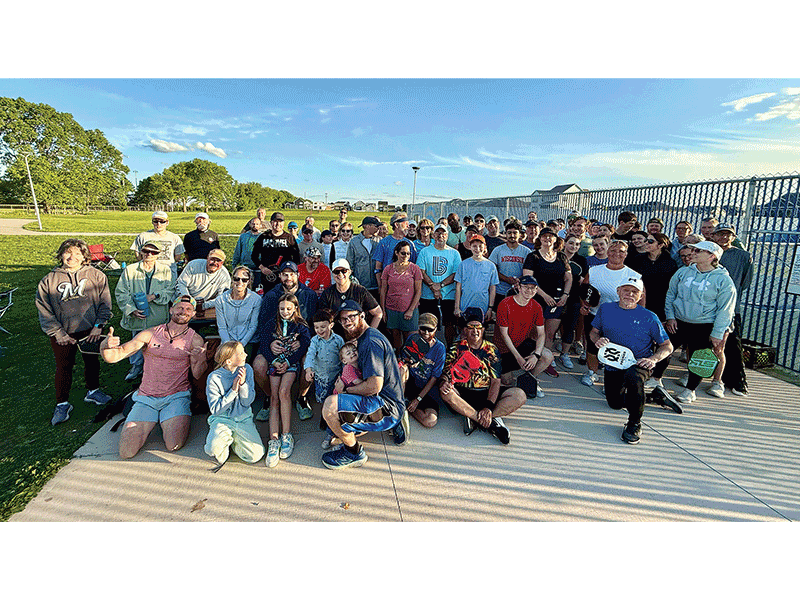
The gathering now draws up to 100 people to McGaw Park’s eight courts in Fitchburg. Players dink around the ball, socialize, bring chairs and snacks. Music plays. Kids kick around soccer balls.
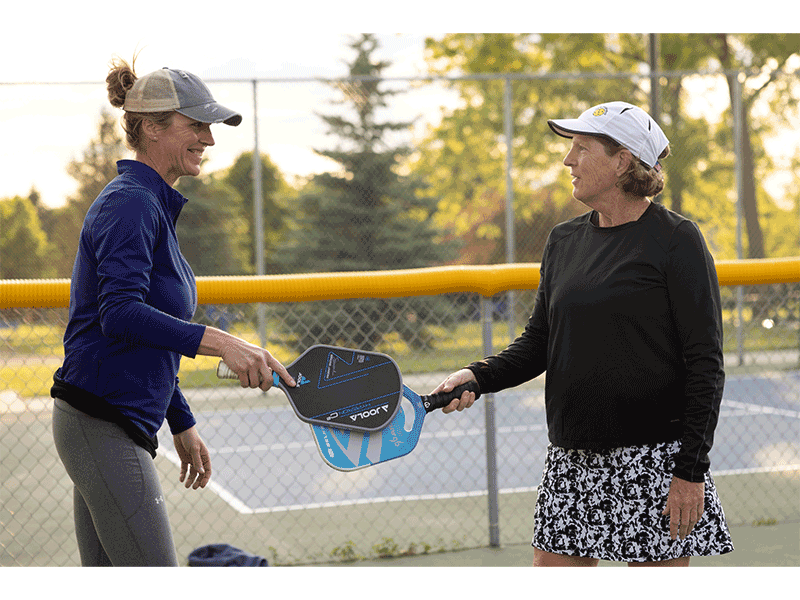
The best part, to the Schettlers, is that players of all ages and abilities pick up paddles and join in.
“It’s the largest weekly pickleball event in Dane County,” Erin Schettler said. “There’s a reason for that: One of our biggest things is that pickleball is about building friendships and this community.
“We welcome everyone — any age, any ability. It doesn’t matter,” she added.
The crowd is multigenerational — grandparents rally with kids, seasoned players welcome newcomers and young professionals from places like Epic Systems show up.
All ages dink around
While pickleball has long been associated with older adults, the demographics are shifting fast. That became clear to McPherson, CAPA president, driving through Madison two years back.
“We were driving by some pickleball courts and my youngest son said, ‘Wow, dad. Hot people play pickleball,’” he recalled.
According to the USA Pickleball Association, half of all serious players — defined as those who play eight or more times a year — in 2021 were over 55 but the majority of casual players are under that age. Even more telling: the fastest-growing segment of pickleball players are under 24.
“There has been a significant shift,” McPherson said. “In the last 10 years, the average age of a pickleball player has dropped by more than 10 years.”
The appeal of the sport across generations can be seen on any given day at almost any pickleball court.
On a recent Wednesday at Garner Park, which houses the only outdoor dedicated courts for pickleball in Madison, retirees who’ve played for close to a decade rallied back and forth adjacent to a younger contingent — a group that just learned the game two days before.
“I saw the paddles at Costco and they were really cheap,” said Christian Alvarez, 29. “So far, the learning curve is less steep than other sports.”
He played against Emily Diaz, 30, another new player, with their friend Alejandro Nunez, 29, refereeing from the sidelines.
“We say, ‘low floor, high ceiling,’” Nunez said. “It’s easy to pick up and Madison enables that now because there are so many pickleball courts.”
McPherson said as the sport gets more mainstream, it’s becoming a more viable option for people as a career, too.
“Pickleball pros make significant money now, enough that a lot of solid college tennis players who want to continue with a racket sports career are shifting to pickleball,” McPherson said. “Colleges are starting to offer scholarships. We’re seeing more middle schools and high schools have club sport teams.”
Ketterhagen, 63, said she often competes against younger picklers. It keeps her competitive spirit alive, she said.
“I call the 18-year-olds who come out and play ‘Gumby boy’ and ‘Elastigirl’ — they’re just a lot more bendy than me,” Ketterhagen said.
Erin and Dan Schettler have also seen the shift in demographics.
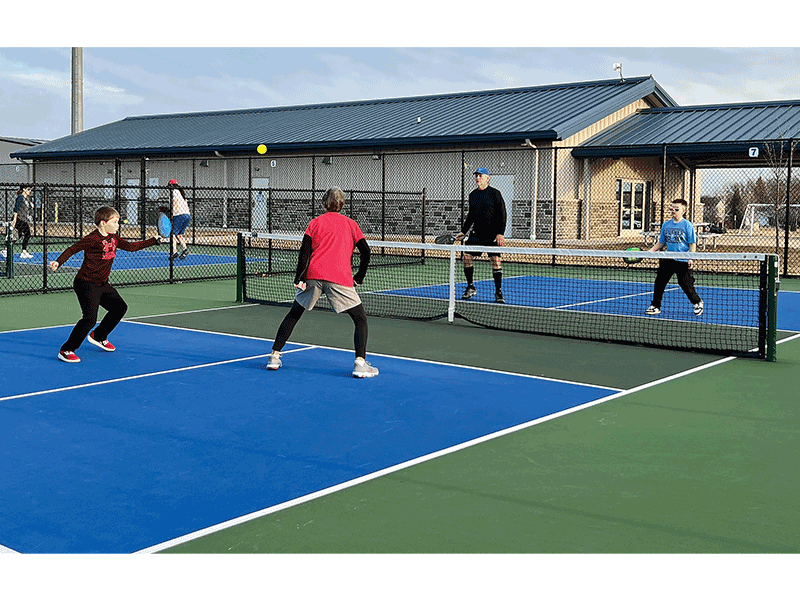
“We’ve had 10- and 11-year-olds come out and play with adults — and they’re good,” she said. “But the amazing thing is, they’re not afraid to play with someone like me.
“That doesn’t happen in every sport.”
The two hope the Pickles and Beer model spreads. Already, communities like Cottage Grove and Sun Prairie have started their own social nights. To the Schettlers, that’s proof that the real staying power of pickleball isn’t just in the paddle, it’s in the people.
“As long as people keep the true purpose of pickleball in mind — kindness, inclusion and fun — it’s just going to keep growing,” Erin Schettler said. “We always say, it’s pickleball. Just saying the name, you gotta laugh.”
Putting the fun in fundraising
The age of the players isn’t the only thing changing. Nonprofits and businesses are recognizing pickleball’s fundraising potential. Destination Madison’s Madison Pickleball Open is one of the most visible examples.
The tournament is set for July 11-13 at Wyndham Hills Park in Sun Prairie. Now entering its fourth year, the Madison Pickleball Open has raised nearly $36,000 for the Madison Area Sports Commission’s Youth Grant program, which helps connect underserved youth with local sports organizations.
“When COVID forced the cancellation of the Ironman, one of our biggest fundraising events, we started exploring other options to support the youth grant,” said Brandon Holstein of Destination Madison. “That’s when pickleball really came onto our radar.”
What started as an experiment quickly evolved into a flagship tournament.
“We dove in and that started our affinity with the sport,” he said. “It hits two of our key goals: supporting youth and bringing visitors to Dane County.”
The event draws players from across the Midwest. As new courts open and facilities expand, Holstein said the tournament will evolve and grow. That could include a financial component for more pro-level players.
“That’s one dream we have,” Holstein said.
For him, pickleball’s appeal as a fundraiser is clear.
“It’s accessible. It’s affordable. You just need a paddle, a ball and some friends,” he said. “If you compare it to something like (golf), pickleball offers way more chances to connect and be social. And that’s the trifecta for sports: community, accessibility and fun.”
“There’s no doubt it has staying power.”

