
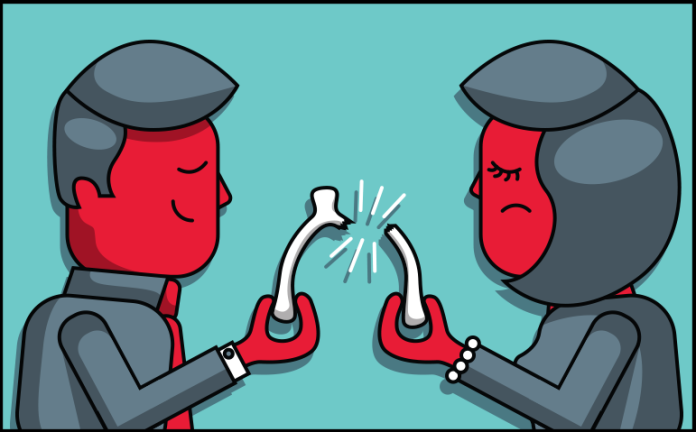

For more than 50 years, gender discrimination based on pay has been a violation of federal law, but pay equity advocates have long complained about a lack of strict enforcement. The Obama administration is attempting to address those complaints, but not everyone is happy with its proposed solution.
Earlier this year, the U.S. Equal Employment Opportunity Commission (EEOC) made public a proposed revision to the employer information report (aka EEO-1 forms) to include collecting pay data from employers, including federal contractors, with 100 or more employees. An estimated 60,000 American employers would be affected by the change.
At the moment, EEO-1 data provides the federal government with workforce profiles from private sector employers by race, ethnicity, sex, and job category. The proposed changes, which would become permanent beginning with the September 2017 report, would add aggregate data on pay ranges and hours-worked. In all, employers would be required to report on employees by 14 different gender, race, and ethnic groups — within 12 pay bands and 10 occupational categories.
With the public comment period having ended on April 1, the remaining obstacles to implementation are an Office of Management and Budget review, the announcement of any modifications the EEOC makes to its proposed changes (expected sometime this summer), and the defeat or veto of a bill to delay implementation of the revised EEO-1 report until the EEOC does more to estimate the cost of collecting the additional data and keep that data secure.
The EEOC enforces the federal laws prohibiting employment discrimination, including the Equal Pay Act of 1963 and the Civil Rights Act of 1964. Asked whether the period between now and September 2017 is basically how long employers have to examine their compensation systems and address any disparities before such disparities become a target-rich environment for lawsuits, one local attorney answered in the affirmative.
“That’s probably a fair assessment,” states John Gardner, a shareholder with the Madison office of DeWitt Ross & Stevens. “Certainly employers should be examining any pay disparities they have right now. That’s something they should do as a matter of course and I would recommend doing it on an annual basis.”
Another attorney agrees the situation is urgent because the law contains a so-called “look back” period of 12 months. William Morgan of the Madison office of Murphy Desmond says employers will bump up against that time frame very soon. “It’s actually going to be a little sooner than that because we’re looking at the third quarter, so July, August, or September — any of the pay periods in there — so from July would really be the trigger point,” Morgan states. “If they are collecting data, and the data suggests that there is a pay disparity, you really need to take care of it now, not a year from now because you’ll be locked into that.”
Prevention and enforcement
The additional categories of information purportedly are designed to provide the basis for assisting employers in evaluating their pay practices and strengthening enforcement of federal anti-discrimination laws, according to Labor Secretary Thomas Perez.
However, not everyone believes women seeking equal pay for equal work will be the main beneficiaries. Due to the potential for ramped up litigation, business interests smell a rat in the form of politicians and bureaucrats enabling the plaintiff’s bar to run amok at their expense.
Few people doubt the obligation would increase the burden employers face in completing their annual EEO-1 reports, but there are varying estimates as to how much. The U.S. Chamber of Commerce charges the EEOC, which pegs the annual cost of compliance at $10 million, is vastly underestimating the administrative burden on employers. The Chamber estimates the annual cost of compliance is closer to $700 million.
In an April 12 Wall Street Journal op-ed piece, labor economist Diana Furchtgott-Roth, a senior fellow at the Manhattan Institute, notes the EEO-1 form already has 140 data points, that the number of data points would increase to more than 3,300 under the new form, and companies with multiple locations would have many more than that. She also contends the occupational categories are too wide to even suggest, let alone prove discrimination, and that the new requirements will give businesses with less than 100 employees another reason to limit their own workforce growth.
Morgan agrees that annual reviews are necessary to prevent pay disparities and says the government’s approach might not be nuanced enough to factor in considerations like education and experience. “My concern is that the information they are gathering is not defined enough and it’s going to result in false positives,” he states. “If you are paying someone $70,000 because they have 15 years of experience and you are only paying someone in the same job classification $40,000 because they are fresh out of college, is that wrong? I don’t think so but that’s going to show up as a pay disparity because that question is not being asked.”
(Continued)
The revised EEO-1 report is in keeping with the EEOC’s announced enforcement goals for the period between 2013 and 2016. One goal was to target gender discrimination in compensation, and since 2013 the EEOC has filed a number of lawsuits charging various employers with discrimination against women regarding their pay. Enforcement advocates says the addition of pay data to annual EEO-1 reports should make it easier to spot trends in pay discrimination.
| “Certainly employers should be examining any pay disparities they have right now. That’s something they should do as a matter of course and I would recommend doing it on an annual basis.” — John Gardner, a shareholder with the Madison office of DeWitt Ross & Stevens |
Gardner notes that unlike termination or harassment-based discrimination claims, charges of bias based on compensation are often difficult for employers to catch because it’s not an obvious termination or hiring decision. In those situations, employers might be “more cognizant of how they are treating people in different groups differently,” Gardner adds.
With regard to pay equity, the EEOC is unlikely to miss obvious signs of discrimination. The EEOC is likely to use pay data to assess complaints of discrimination, focus agency investigations, and identify existing pay disparities that may warrant further examination.
Gardner believes most employers should be able to produce the additional information through existing business systems. If certain tweaks such as additional software modules are necessary, he says they will be well worth the expense because once the EEOC gets its hands on this information, the agency will start filing lawsuits against transgressors on behalf of employees and publicize these suits as a warning to others.
“It could be tens, it could be hundreds of different employees that are affected, and you could have significant litigation costs,” Gardner notes. “If you’re found to be liable, there are significant costs.”
Morgan believes an employer’s first step is to check with software vendors to see whether their systems can accommodate the change. “I would expect that many of them can’t,” he states. “They can certainly generate some of the information that is necessary, but whether or not they can compile it in the same format that’s being requested by the EEOC, I would be surprised if they could.”
Unlikely reversal
Any financial costs will be coupled with reputational costs. That’s why Gardner and Morgan recommend that employers use the EEOC’s announcement as a wakeup call and take a more proactive approach to addressing discriminatory pay in their workforces. Gardner cautions that while a new presidential administration will be in power by the time the change would go into effect in September 2017, it would be unwise to act as though a reversal is likely.
“I don’t expect the EEOC to backtrack from this unless there is a change in [political] party at the administration level in the White House,” Gardner says. “If that happens, I would not be at all shocked if this never went into effect. There is going to be a change from Obama to somebody else before then and I suppose if it’s a Republican, this might not go into effect. If it’s [Bernie] Sanders or [Hillary] Clinton, I would suspect it would go into effect.”
More information about the proposed revisions to the EEO-1 report, including a Fact Sheet for Small Business and a Question and Answer document, are available on EEOC’s website at www.eeoc.gov.
Click here to sign up for the free IB ezine – your twice-weekly resource for local business news, analysis, voices, and the names you need to know. If you are not already a subscriber to In Business magazine, be sure to sign up for our monthly print edition here.

