

From the pages of In Business magazine.
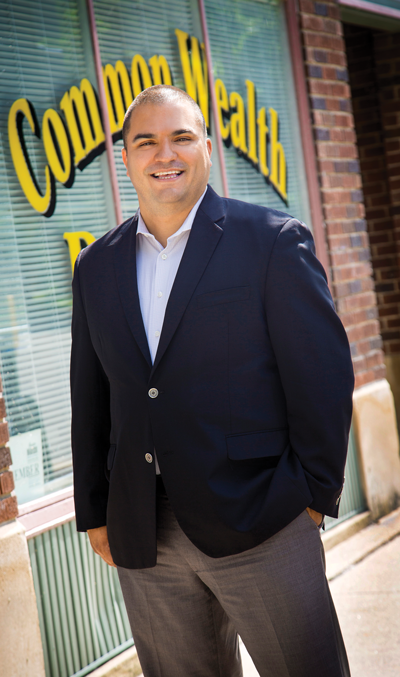
Thirty-seven years ago, at about the time former Common Wealth Development executive director Marianne Morton was joining CWD, Justice Castañeda was born into the world in a home on Ingersoll Street. In February, he became Morton’s successor.
His early life was mired in poverty. By the age of 18 he’d lived at more than 15 different addresses around town. He saw friends go to prison, or worse, and he credits the public school system and community members for getting him through some rough patches.
In 2000, he decided to join the U.S. Marines Corps. After eight years of service, Castañeda went on to complete a bachelor’s degree in urban studies and planning from the University of California San Diego. He then earned related master’s degrees from both Stanford University and the Massachusetts Institute of Technology, taught high school English and algebra, and consulted on both coasts before returning to Madison.
In a recent interview, Castañeda shared his unique insight.
IB: Explain what Common Wealth Development (CWD) does.
Castañeda: It’s a nonprofit development organization — meaning housing, economic development, and land use. We do business incubation, commercial development, workforce development, and youth and adult employment training. My framework is around health equity. A lot of people don’t think of CWD as a public health organization, but that’s what we are in the broadest sense. We support the fundamental root indicators of community-level health.
IB: What’s in your immediate wheelhouse?
Castañeda: Our CWD properties in southwest Madison need to generate cash flow for investment purposes. Economic development and programs are important and complex, but the car doesn’t go anywhere without the wheels. Housing provides the wheels.
We also want to rehab and update Main Street Industries and make the incubators work more nimbly and in alignment with conversations about racial inequities in the city.
IB: You’ve taught high school and you’re a product of Madison Public Schools. How do you react to reports of racial disparities in education?
Castañeda: A lot of what happens in school is not under the purview of the schools or the educators, but they make for a convenient whipping horse. I see it as a health equity issue. When kids are underperforming we need to ask, is the child breathing clean air? Did that child eat dinner last night? What did they eat? Did they have a roof over their heads, and what was the condition of the housing? Yet, when it’s time to look at disparities in education, we don’t invite housing providers or developers to come in, we blame teachers. It’s a ridiculous framework.
If a child has wet feet and an empty stomach, I don’t care if you have Yoda in the classroom, that child will not learn algebra today. If kids are out until 4:30 in the morning and you’re trying to teach them math at 7:30 a.m., they won’t learn. So teach them at 1 p.m., and feed them.
(Continued)
IB: The city is in the midst of an initiative to add 1,000 affordable housing units by 2020. What’s your take?
Castañeda: I greatly respect Paul Soglin, but my question is: Affordable for whom? We have to be very careful of San Francisco-itis (i.e., unaffordability). Instead of saying housing for median income households, say this is the salary you need to make to afford it. Then determine who fits into that category and which part of the population will be excluded. Let’s just be explicit. Otherwise, housing agencies and government housing programs will hide behind the concept of affordability.
IB: What other issues do you see here?
Castañeda: Tensions can be cut like a knife right now. Dialogue needs to move beyond politics. I don’t believe in binaries. Everything cannot be answered as either right or wrong, or by arguing every point in a graduate seminar.
To me, community is a verb, a process, a conversation. It needs investment. Many of our issues are very complex and shouldn’t be reduced to just yes or no votes. For a city that prides itself on intellectual acumen, we are averse to complexity, and I think that’s ironic. You’d think we’d embrace it.
Click here to sign up for the free IB ezine — your twice-weekly resource for local business news, analysis, voices, and the names you need to know. If you are not already a subscriber to In Business magazine, be sure to sign up for our monthly print edition here.

