
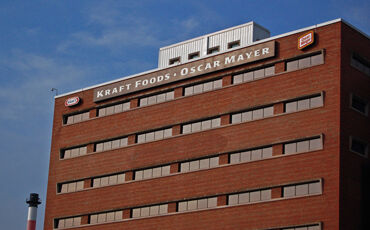

The writing may have been on the wall when the newly combined Kraft Heinz cut 165 jobs from Madison’s Oscar Mayer corporate offices — and 2,500 total in the U.S. and Canada — in August, but it still came as a shock today when news broke that Kraft Heinz will close its Madison Oscar Mayer plant entirely by early 2017. According to the Quad Cities Times, Kraft Heinz is planning a new $203 million state-of-the-art food manufacturing plant in Davenport, Iowa. The company is considering a major expansion there involving “the retention of at least 475 full-time positions.”
Given the Madison facility has been the home of Oscar Mayer for nearly 100 years, the news still came as a body blow. “After the last round of layoffs, it would be foolish to say there wasn’t some anticipation that there was going to be another follow-up announcement, but to have it happen this soon and to have it involve all of the employees was shocking,” says Paul Jadin, president of the Madison Region Economic Partnership.
Madison Mayor Paul Soglin, who was informed of the decision by officers of Heinz Kraft at the close of business on Tuesday, said in a press conference Wednesday afternoon that the local plant will be shuttered over a 12- to 24-month period. According to a corporate officer he spoke with, Soglin said the decision affects 300 corporate officers, employees, and staff, many of whom will have an opportunity to relocate to Kraft Heinz’s corporate offices in Chicago, and about 700 union workers. The Oscar Mayer brand will continue, but it will be managed out of Chicago.
Soglin, who was highly critical of Kraft Heinz’s decision to close its most productive hot dog plant, says the company will be putting in place an extensive plan to help affected workers “continue in the world of employment.”
Impact in the hundreds of millions
Given all that goes into the operation and the service businesses patronized by Oscar Mayer employees, “the potential economic impact on the Madison area is in the hundreds of millions of dollars,” Soglin said. “Our main focus right now is the workers, their employees, and related businesses that are dependent upon the vitality of this operation, this plant. I don’t know the number, but when you take the payroll, when you take the production, the packaging materials, all that goes into the operation at Oscar Mayer, which has been going for 100 years, and then extend that to the dry cleaners, the retailers, the supermarkets, the neighborhood groceries, the local dining spots, the kids’ sporting activities, this is very significant.”
Fortunately, he added, Madison has a relatively healthy economy with a number of solid employers whose role now will be to make decisions to expand their workforce, where they have the resources, to help make the transition of affected Oscar Mayer employees to other employers as seamless as possible.
“There will be discussions about what’s the role of our various governments,” Soglin added. “At this point, any speculation is premature. I’m not going to be proposing any amendments to the [city] budget that was adopted last week, but we will consult with the county, we will consult with the state, and if we find there are any adjustments we should make in terms of development or in terms of job placement, I’m confident that after the first of the year, we can adopt whatever budget amendments are necessary.”
Due to how well positioned Madison is to help workers transition to other jobs, Pat Schramm, executive director of the Workforce Development Board of South Central Wisconsin, asserted there has “never been a better time” in this community for this to happen. “People really need to know that,” Schramm stated. “We are very well positioned on the communications between the Chamber [of Commerce], the city, the county — all the people who can make a difference in helping people move into new jobs.”
(Continued)
Greater Madison Chamber of Commerce President Zach Brandon joined others in noting the news is both sad and unfortunate. “Oscar Mayer is deeply rooted in Madison’s history, and we expected it would be a part of Greater Madison’s next chapter,” he said in a prepared statement. “Nearly 100 years ago, the Mayer brothers saw great opportunity and purchased a failing meat-packing plant in Madison. As a community, we grew with Oscar Mayer and took pride in its success. Over the years, the company has not only been a major employer, it has been a major investor in our community institutions.
“Today, our attention turns to the employees, families, and suppliers affected by this decision, and the need for coordinated, intentional, public and private economic development efforts to ensure Greater Madison continues to be a place of great opportunity.”
State Senator Fred Risser, a former Oscar Mayer employee, called the closing “gut wrenching” and noted that he had spoken to Soglin and Gov. Scott Walker to see what could be done about keeping the plant in Madison. Other economic development agencies indicated they never had a chance to compete with the state of Iowa to keep the plant here. “We just learned of this relocation today (Nov. 4),” noted Steven Michels, who works in public affairs and communications for the Wisconsin Economic Development Corp., in a Nov. 4 email. “WEDC nor its partners were asked to put together any retention packages.”
Kraft’s merger with H.J. Heinz Co., announced in March of this year, created the world’s fifth-largest food and beverage company. The merger, reportedly in excess of $40 billion, was financed with the help of 3G Capital Partners, the Brazilian company that owns Heinz, and Warren Buffett’s Berkshire Hathaway Inc.
To lure the Oscar Mayer plant out of Madison, Iowa’s package of incentives reportedly included tax incremental financing, property tax abatement, and infrastructure investments. Jadin notes that Wisconsin is not allowed to offer property tax abatement, which he concedes is a “pretty significant” difference, but there are other incentives Wisconsin could have put on the table. “The bigger issue is we never had an opportunity to make that case,” he says. “We tried for the past seven months to get in for a retention visit, and I think the mayor did likewise, and that suggests to me that it wasn’t long after the merger agreement that they had some of these plans already.”
As for keeping the Oscar Mayer plant in Madison, Jadin says it’s worth an effort, but he wouldn’t want to raise hopes because it’s similar to the General Motors situation in Janesville, which languished for years. With the food processing industry strong in southern Wisconsin, he notes that another local or regional company might have a use for the plant. “The approach we need to be taking is how to occupy that building with another user,” he states. “A Wisconsin firm is a possibility and there are other possibilities throughout the Midwest. Will it ever be the kind of operation that it was in its heyday? I doubt it, but certainly there is an opportunity there for someone else to come in and use an existing facility that might need just a little bit of build out.”
Click here to sign up for the free IB ezine – your twice-weekly resource for local business news, analysis, voices, and the names you need to know. If you are not already a subscriber to In Business magazine, be sure to sign up for our monthly print edition here.

