
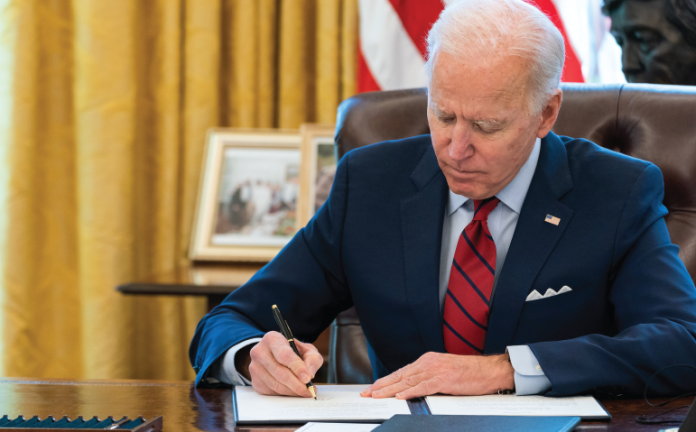

Thanks to President Joe Biden’s executive order designed to promote competition, Friday, July 9 may well become known as a watershed day in American business. That’s the day Biden signed a sweeping order that promises to deliver a more competitive, dynamic economy, and depending on the way federal regulators write the rules of the game, prominent companies in several industries could be forced to change the way they do business.
Biden’s justification is that in the past 20 years, the U.S. economy has been less dynamic in terms of new business formation and capital investment. The executive order makes clear what the Biden administration thinks of recent merger activity. “For decades, corporate consolidation has been accelerating,” the order reads. “In over 75% of U.S. industries, a smaller number of large companies now control more of the business than they did 20 years ago. This is true across health care, financial services, agriculture, and more.”
That lack of competition drives up prices for consumers. According to the administration, fewer large players have controlled more of the market, and markups (charges over cost) have tripled. Families are paying higher prices for prescription drugs, hearing aids, internet service, and other necessities.
Biden’s executive order includes 72 initiatives by more than a dozen federal agencies to immediately address what he views as some of the most pressing competitive problems. Directives permit the sale of hearing aids over the counter, which could make them less expensive, and the Federal Trade Commission has been directed to ban unnecessary occupational licensing, which would remove a barrier to entry for startup business owners. The order also encourages the FTC to ban or limit noncompete agreements.
But will the overall effect really be constraining to big business, which has more financial wherewithal to absorb regulatory costs? We contacted Jim Blair, managing partner, Aberdean Consulting LLC; Shawn Phetteplace, manager, Main Street Business Alliance–Wisconsin Chapter; Kurt Bauer, president and CEO, Wisconsin Manufacturers and Commerce; Rose Oswald Poels, president and CEO, Wisconsin Bankers Association; Jimmy Kauffman, president/CEO, Bank of Sun Prairie; and Cindy Van Asten, a partner and senior account executive with M3 Insurance.
Phetteplace appreciates the “whole-of-government” approach to including competition as a benchmark for regulatory and programmatic change — giving teeth to regulatory enforcement by antitrust agencies — while Bauer warns of government interference in the market.
“In total, higher prices and lower wages caused by lack of competition are now estimated to cost the median American household $5,000 per year, and there are fewer opportunities for existing small and independent businesses to access markets and earn a fair return,” Phetteplace states.
While Bauer says specifics aren’t yet available, he notes that government intervention rarely enhances competition. “Quite the contrary, government micro-management of the economy typically creates confusion, uncertainty, and higher costs for businesses and consumers.”
Banging on Big Tech
Economists believe the president’s order will open a new front in the battle to curb the influence of “Big Tech.” Under the present’s regulatory microscope are four areas where he claims dominant technology firms are undermining competition and reducing innovation: the acquisition of would-be competitors (aka “killer acquisitions”); the gathering of personal information; unfair competitive practices; and cellphone manufacturers and others blocking out independent repair shops.
The executive order enunciated a policy of greater scrutiny of mergers, especially by dominant internet platforms, with particular attention to the acquisition of nascent competitors, “serial” mergers, the accumulation of data, and competition by “free” products.
The order also encourages the FTC, the principal federal regulator of internet commerce, to establish rules on surveillance and the accumulation of data and rules barring unfair methods of competition on internet marketplaces. It also encourages the commission to issue rules against restrictions on the use of independent repair shops or do-it-yourself repairs of devices and equipment.
FTC Chair Lina Khan hasn’t been coy about the agency’s interest in giving more scrutiny to tech-sector mergers — past and future — particularly how they affect data accumulation and privacy. President Biden’s order appears to give Khan carte blanche to establish new rules that could affect the business models of the Big Tech players. In addition, Biden has nominated antitrust lawyer Jonathan Kanter, who is no fan of Google’s dominance of internet search and advertising, to run the Justice Department’s antitrust division.
As merger guidelines are reviewed and updated, one practice that will get special attention occurs when large companies run retail marketplaces and in so doing, they see how the products of small businesses sell. Consumer and small business advocates charge that these giant companies then use data accumulated from that retail marketplace to launch competing products. In issuing the executive order, the White House notes that retail marketplaces can market their “copycat” products more prominently than small businesses can display their original products.
Phetteplace applauds what he calls the guardrails on Big Tech, which he says are important to small businesses competing on — and with — giant platforms that also determine and control avenues to reaching customers. “We are definitely hearing this from our members [nationally],” he adds. “One member [Natasha Amott of Whisk, a retail cookware business in New York] has a story of shoppers coming into her retail store with a product from Amazon on their phones, asking her why her prices are not the same, and when she looked at the Amazon price, she saw that they were taking a loss to undercut the market. It was lower than wholesale.
“Another [Sarah Piepenburg, owner of Vinaigrette, an olive oil and vinaigrette store in Minneapolis] was kicked off her shipping contract because they took a larger one with Amazon, and she then had to scramble to find a new, four times more expensive shipping partner.”
Another common complaint pertains to monopolistic practices in the technology space in which small businesses are being nickeled and dimed to reach the followers they have cultivated. “So, it goes beyond the products, but also the advertising avenues, shipping lines, and across the economy,” Phetteplace states.
Bauer is more skeptical about federal agencies retroactively reviewing and perhaps reversing mergers that have already been approved. “That is a role for the courts, not the federal bureaucracy,” he states, “and as previously mentioned, this kind of hyper bureaucratic activism creates confusion, uncertainty and distrust, if not outright chaos.”
Regarding internet service, the order covers four issues that allegedly limit competition, raise prices, and limit consumer choices. This includes a lack of competition among broadband providers, a lack of price transparency, high termination fees, and the practice by larger providers of using their power to discriminatorily block or slow down online services.
The order encourages the Federal Communications Commission to prevent internet service providers from making deals with landlords that limit tenants’ choices, revive the so-called “Broadband Nutrition Label” and require providers to report prices and subscription rates to the FCC, limit excessive early termination fees, and restore net neutrality rules undone by the Trump administration.
Count Jim Blair of Aberdean among the skeptics of greater regulation, however well intentioned. “I have zero confidence in the federal government getting anything right when it comes to regulating the tech industry,” he states. “Our high-tech industry is our advantage globally, and if we hinder our tech sector, we are only going to be hurting ourselves in the long run.”
Banking and consumer finance
Over the past four decades, the Biden administration notes the U.S. has lost 70% of the banks it once had, with about 10,000 bank closures. The administration contends that this attrition, often due to mergers and acquisitions, disproportionately affects communities of color, and excessive consolidation impacts everyone by raising costs and restricting credit for small businesses. Bank merger applications are subject to federal review, but the administration notes that federal agencies have not formally denied a bank merger application in more than 15 years.
“Even where a customer has multiple options, it is hard to switch banks partly because customers cannot easily take their financial transaction history data to a new bank,” the administration claims. “That increases the cost of the new bank extending you credit.”
In the order, Biden encourages the Department of Justice and the agencies responsible for banking to update guidelines on banking mergers “to provide more robust scrutiny of mergers.” It also encourages the Consumer Financial Protection Bureau (CFPB) to issue rules allowing customers to download their banking data and take it with them.
Jimmy Kauffman (Bank of Sun Prairie) doesn’t think either part of the order pertaining to banking and finance will have much of an effect community banks. He notes that M&A activity has ramped up during the past few months because of potential tax changes — corporate and capital gains — proposed by President Biden, that much of the consolidation took place after passage of the 2010 Dodd-Frank Act (which Biden supported), and some local consolidation is from community banks merging with each other.
“The other thing to keep in mind is the regulatory process is no walk in the park for a merger-and-acquisition deal,” Kauffman notes. “You’re already going through a scrutinized process, but at the same time, the banks that are buying other financial institutions must be financially sound to do that. So, I don’t think it’s a situation where you have other banks that are not all that strong buying and merging with other financial institutions to create a less sound bank system.”
As for allowing customers to download their data and take it with them, he notes that customers generally face no restrictions. “The reality of the situation, at least at our bank, is that a customer can come in and get access to their transaction history anytime they want,” he states. “If we’re talking about downloading online, there are certainly risks with doing that from a cybersecurity perspective, but a lot of consumers are comfortable taking on that risk and are able to download some transactions online for the life of the account.”
Oswald Poels (Wisconsin Bankers Association) contends the banking system is still one of the most diverse business sectors in the country with nearly 5,000 bank charters in the U.S. and 178 banks headquartered in Wisconsin. Of greater concern with the president’s executive order is the banking industry’s desire to see merger oversight extend to nonbank competitors and tax-exempt credit unions acquiring taxpaying banks.
“If the spirit of the order and the creation of the White House Competition Council are to promote and advance the federal government’s efforts to address overconcentration, monopolization, and unfair competition, then these types of nontraditional merger activities deserve much scrutiny,” she states.
In addition, WBA supports customers’ ability to access and share their financial data in a safe and secure manner that gives them control. “To a certain extent, this type of activity is already occurring, and the banking industry’s focus would be to ensure that this type of data sharing, which consumers engage in with vendors outside of the secure banking system, is fully protected against cyberthreats,” Oswald Poels states. “WBA would encourage this to be a focus of the CFPB as it moves forward with rulemaking.”
Health care in regulatory crosshairs
President Biden’s executive order addresses several areas where the administration says that a lack of competition in the health care industry increases prices and reduces access to quality care, including prescription drugs, hospital consolidation, and medical insurance. Its reasoning for each action is as follows:
Prescription drugs: Americans pay more than 2.5 times as much for the same prescription drugs as peer countries, and price increases continue to surpass inflation. The upward price pressure is in part due to a lack of competition and certain strategic practices such as “pay for delay” agreements in which brand-name drug manufacturers pay generic manufacturers to stay out of the market. The order directs the Federal Trade Commission (FTC) to ban this practice, and it directs the Food and Drug Administration (FDA) to work with states to safely import prescription drugs from Canada. It also directs Health and Human Services (HHS) to increase support for lower-cost options such as generic and biosimilar drugs and issue a comprehensive plan to combat high drug prices and price gouging.
Hospitals: The order states that hospital consolidation has left many areas, especially rural communities, without good options for convenient and affordable health care service. The 10 largest health care systems now control a quarter of the market, and citing research from the Kaiser Family Foundation, the order notes that hospitals in consolidated markets charge far higher prices than hospitals in markets with several competitors. Biden has encouraged the Justice Department and FTC to “review and revise” their merger guidelines to ensure patients are not harmed by such mergers, and it directs HHS to finish the task of implementing bipartisan federal legislation to address surprise hospital billing. HHS has already proposed rules on surprise medical bills as directed by the 2020 No Surprises Act, which concentrates on high charges patients face if they see a physician their medical insurer does not cover.
Health insurance: The administration also blames consolidation for what it calls a lack of consumer choice among health insurers; even when there is some choice, it says comparison shopping is hard because plans offered on the exchanges are complicated — with different services covered or different deductibles — and so the order directs HHS to standardize plan options in the National Health Insurance Marketplace so that people can comparison shop more easily.
Van Asten (M3 Insurance) believes the order has the potential to bring real cost savings, especially the prescription drug piece. With specialty, life-saving medications, there are drugs that cost anywhere from $5,000–$100,000 a month, and if they could be purchased at a fraction of that price, that would represent material savings. “If they open the opportunity to import from Canada, it will be interesting to see if it goes farther than Canada,” she says. “For most employer health plans, pharmacy is a leading trend, and that specialty medication is costing more and more than it has in the past. There could be an opportunity there if they can get their arms wrapped around the rising cost of pharmacy.”
Click here to sign up for the free IB Ezine — your twice-weekly resource for local business news, analysis, voices, and the names you need to know. If you are not already a subscriber to In Business magazine, be sure to sign up for our monthly print edition here.

