

From the pages of In Business magazine.
Have you ever purchased a deli salad at a local Hy-Vee? If so, it’s likely the salad container you scooped your lettuce, tomatoes, and croutons into was thermoformed at Placon, a $155 million-plus company founded in 1966 by Tom Mohs. In 1980, Mohs invented and patented the “blisterbox,” a plastic container with a “living hinge” that revolutionized the industry.
The growing Fitchburg company — with 716 employees at last count, including 464 in Madison — thermoforms packaging for a multitude of products. The company specializes in everything from medical devices to plumbing fixtures to the clear bubble packaging that hangs from hooks in retail stores encasing things like lipsticks, cosmetics, and razors. It also produces a wide assortment of injection-molded deli cups and plastic containers used in food storage.
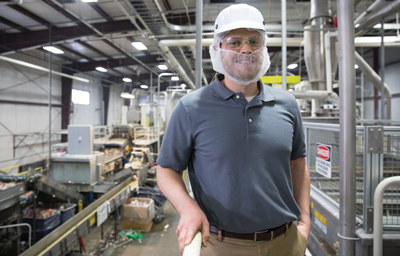
As a material development and process-engineering manager, Cody Meyer’s responsibilities seem as diverse as his employer’s products. On any given day he may be involved in new product design, thermoforming, collaborating on plastic “recipes” used in the company’s machines, or working in Placon’s in-house EcoStar recycling facility, among other duties.
Meyer, 29, joined Placon in 2014 after working on aerospace projects in Rockford, Ill., and for a wire and cable manufacturer in Indiana, where he was first introduced to plastics.
“Thermoforming was brand new to me,” Meyer admits. Now it’s almost a daily routine.
The process can be summarized in four basic steps, he explains: heating the sheeting, forming it into the desired shape, cooling it, and trimming it.
However, the collaboration leading up to that process — the design, engineering, and prototyping that goes into it — takes much, much longer.
Engineering a fix
|
Cody Meyer in a prototyping room where molds and plugs are made to the exact dimensions as approved 3D models. Plastic will then be thermoformed between the two layers. |
As engineers, Meyer and his colleagues are focused on troubleshooting. “My job is to fix problems,” he says. “As an engineer, you want the right number of problems.”
For example, when a candy manufacturer learned its candy sticks were breaking during shipment, it asked Placon to come up with a packaging solution. The new product development staff prototyped a clear plastic rack to solve the problem.
Then there’s the medical device manufacturer that realized too late that its existing packaging didn’t stack securely on shelves and asked Placon to design a better option.
“We joke here that packaging is the last thing customers think about when developing new products,” Meyer says. “Usually by the time we hear that there’s a need, the timeline is short.”
After a customer approves a 3D CAD design — a back-and-forth process that can take weeks or even years — they’ll frequently ask for a prototype. That’s when the team designs and creates a mold, or “tool,” to the exact dimensions as the 3D model.
While the company can thermoform containers up to 18” x 18” x 4”, the tools needed to shape them can weigh hundreds of pounds, depending on the materials. A tool can also be made to form one or many identical parts simultaneously. “I’ve seen at least 32 parts in one of our tools,” Meyer says, meaning, for example, 32 identical plastic cups created from one mold.
(Continued)
Dan Czerwonka, a gregarious lead toolmaker, is putting the finishing touches on one mold chiseled out of a block of aluminum. The block contains four identical impressions designed to encase a specific medical device. From start to finish, Czerwonka, who joined Placon 34 years ago, can spend days perfecting the mold, from programming a milling machine to sandblasting, polishing, and adding tiny detail work. “Thirty-four years ago something like this would take three weeks to make and it would look like hell,” he laughs.
Meanwhile, plugs, or less-detailed mating images of the mold, are created to fit inside the original. The plastic is thermoformed between the mold and the plug.
At the beginning of the thermoforming process, rolls of plastic sheeting are fed into the room-sized thermoformer and pressed between the two sides of the tool where it is heated for several seconds, cooled, and trimmed to size. “The sheet is mostly heated by radiation,” Meyer explains, adding that the temperature of the thermoforming oven varies depending on the material type, thickness, and speed.
“Most people talk in terms of temperature,” Meyer says, “but what really matters is the amount of energy in the sheet. For PET (or polyethylene terephthalate), we target a sheet temperature of 200 to 300 degrees Fahrenheit.”
It all happens quickly, from as little as 30 seconds to a few minutes from start to finish.
Around the corner, two employees collect and stack newly formed plastic containers into shipping boxes.
PET project
Meyer will often spend half his time at Placon’s EcoStar facility where the company recycles water and soda bottle containers made with PET into plastic sheeting used in thermoforming. Green Mountain Dew or 7-Up bottles, for example, are not allowed.
|
Top, inspecting a large piece of thermoformed plastic packaging that just rolled from a thermoformer machine; bottom, employees sort through plastic bottles before the PET material is recycled into sheeting for thermoforming. |
On this day, recycling is in full swing. Bales of pre-sorted PET purchased from other sources are broken into individual pieces and loaded onto a series of conveyor belts. Bottle caps and rings, made from PVC, are automatically separated out and will be sold to another company. Meanwhile, the river of discarded, crushed plastic bottles gets washed and sanitized and eventually is ground into flake. Placon can recycle 100,000 pounds of PET each day.
Based on specific recipes, the flake is mixed with regrind from the thermoforming process, and sometimes a virgin resin, as well. The mixture is proportioned as needed and fed into an extruder where it is pressed into plastic sheeting.
The sheeting receives a coat of silicone, which Meyer says helps with thermoforming and prevents parts from sticking together. The edges are trimmed and the sheeting is collected on large rolls, three at a time, each weighing as much as 2,000 pounds each. The roll stock is then stacked like wine barrels in another part of the facility, awaiting their next call to duty.
“We have three extrusion lines so we’re generating about 125,000 pounds a day of plastic sheeting,” comments Meyer.
At Placon, he thoroughly enjoys being able to utilize components like thermodynamics and engineering to solve problems, and he loves working for a company that promotes sustainability to boot.
“I think your job is what you make it,” he states. “I’m able to engage in a lot of different aspects of engineering and get to dabble in all parts of a process so there’s absolute job satisfaction. There’s always a sense of pride when we’re loading good parts in a box.”
Meyer jokes that a good day is when his shirt doesn’t get dirty from having to solve a greasy problem out on the floor.
“My shirt is already dirty today,” he smiles.
Click here to sign up for the free IB ezine — your twice-weekly resource for local business news, analysis, voices, and the names you need to know. If you are not already a subscriber to In Business magazine, be sure to sign up for our monthly print edition here.

