
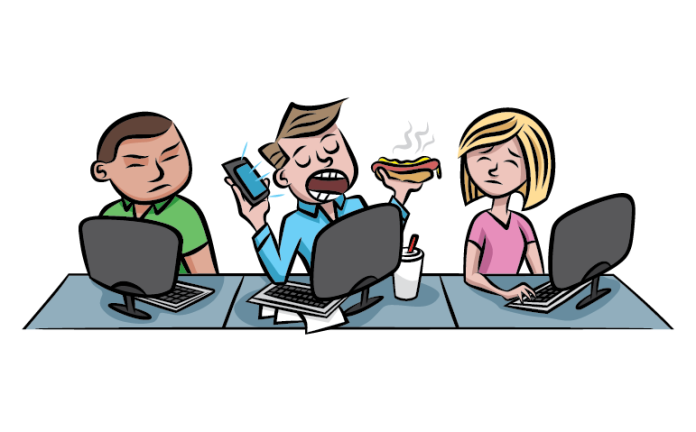

With fewer professionals working a traditional 9-to-5 workday Monday through Friday from the confines of the office, what’s considered acceptable workplace etiquette these days?
While 91 percent of senior managers surveyed by staffing firm Accountemps, a Robert Half company, said organizations are less formal than 10 years ago, certain workplace behaviors are still considered inappropriate. Among the most common are:
- Cursing or strong language (54 percent)
- Bringing pets to work (51 percent)
- Politically-motivated office décor (48 percent)
On the flip side, visible tattoos (35 percent), casual attire (34 percent), and nontraditional hair colors (34 percent) are more acceptable today than they were in the past. Respondents cited society loosening up (59 percent), companies catering to younger workers (52 percent), and the impact of tech culture (49 percent) as top reasons for the shift.
The online survey was developed by Accountemps and conducted by an independent research firm. It includes responses from more than 2,800 senior managers at companies with 20 or more employees in 28 major U.S. cities.
Additional survey findings include:
- One in three employers said having nontraditional piercings (33 percent) and using casual language or emojis in emails (30 percent) were problematic in the past but are now acceptable.
- Roughly two in five respondents reported that playing music without headphones (41 percent) and streaming sports events (39 percent) remain office no-nos.
- In addition to exhibiting political décor at work (48 percent), senior managers said streaming political events (44 percent) and talking about politics (33 percent) are inappropriate.
Jim Jeffers, metro market manager of Robert Half in Madison, offers some do’s and don’ts for modern workplace etiquette, none of which should be all that surprising:
- Don’t participate in office gossip. It’s just another distraction that can reflect badly on your character and damage others’ careers.
- Do let your personality shine through, within reason. For example, if you’re questioning whether a visible tattoo or article of clothing is too casual, it’s best to cover up or dress more formally.
- Don’t be disruptive. Streaming live events or playing music without headphones can interrupt others. Similarly, clothing or grooming choices can cause others to stop and look for the wrong reasons.
- Do communicate effectively. Avoid using foul language and evaluate the situation to determine if a casual approach and emojis are appropriate.
- Don’t engage in heated conversations over hot-button topics like politics and religion.
Jeffers notes that if workers ever have any questions about whether something is inappropriate, the best place to start seeking answers is with a review of the company handbook for official policies. It’s also a good idea to take cues from your colleagues and managers, especially if you’re fairly new to the company, he advises. “You can learn a lot by simply observing your colleagues and what goes on in the office. If something seems inappropriate for the office, it probably is.
“On the other hand, if you are job seeking and you want to evaluate a potential employer, I would advise researching through their website, social media, and review sites,” Jeffers continues. “Carefully read the job description — you’d be surprised how much info you can glean from that if you’re paying attention to the details. Additionally, you can ask others in your network — especially current and previous employees — for insight. Finally, ask questions during the interview, such as ‘What is it like to work at your company?’ or ‘What characteristics does your company value most in its employees?’”
Jeffers explains that committing an office etiquette breach could have impacts beyond just a minor disturbance — it may result in colleagues doubting your overall judgment and not taking you seriously at work.
If management or co-workers view you as less professional, you may be passed up for an important promotion or growth opportunity, Jeffers notes. “When considering people for promotions, companies tend to look for those who will make a good impression on business contacts, clients, and customers. If you’re questioning whether something’s acceptable for the workplace, it’s best to err on the safe side.”
On the flip side, Jeffers says in today’s tight hiring market where professionals have more job opportunities, recruitment and retention still need to be top of mind for Madison employers. “When an organization’s policies are too strict, it can make workers feel like they’re micromanaged and can’t be themselves at work, which can ultimately impact recruiting and morale. Professionals consider the full picture of what’s being offered at a company, and stringent policies could be driving skilled candidates into the arms of more flexible competition.”
“Workplace policies today are designed to attract and retain employees, and that often means they’re more relaxed,” adds Mike Steinitz, executive director of Accountemps. “There can also be unwritten rules of behavior or dress that are specific to a particular company or industry. Staff shouldn’t feel like they’re walking on eggshells at work, but it’s important to be respectful of others and ensure your actions don’t cause a distraction or compromise your professional reputation.”
Click here to sign up for the free IB ezine — your twice-weekly resource for local business news, analysis, voices, and the names you need to know. If you are not already a subscriber to In Business magazine, be sure to sign up for our monthly print edition here.

