
From business conferences to lavish dinners, the Monona Terrace Community and Convention Center caters 500 to 600 events a year, with more than enough food for attendees.
When the crowds disperse, there is often extra food available — and that’s when Healthy Food for All comes in.
The local food recovery organization connects with convention centers, hotels, grocery stores, caterers, farms, businesses and other groups that have excess food, collects and packages it, and distributes it to people who need it.
The demand is great. According to an April 2025 report from Public Health Madison & Dane County, nearly 1 in 10 households experience food insecurity. “This means more than 42,000 people are at risk of not knowing where their next meal will come from,” the report said.
Chris Brockel, director of food systems for the Madison Northside Planning Council, which operates Healthy Food for All, the commercial kitchens of FEED Kitchens and the FEED Bakery Training Program on the north side, said Healthy Food for All redistributes roughly 750,000 pounds of food per year, and the amount continues to grow.
The group receives funding from Dane County Extension, the David S. Bourne Foundation, community grants and individual donors.
“Not only are we feeding families in need with locally available resources, it’s also keeping food out of the landfill,” Brockel said. “Food is the No. 1 input in the Dane County landfill. There’s a whole climate change, environmental side to food recovery as well.”
Unlike most food pantries, which often focus on shelf-stable products, Healthy Food for All regularly collects items with a shorter lifespan and delivers them to groups that can use them immediately. HFFA delivers to Dryden Terrace, a low-income senior living facility; the Beacon, the daytime, drop-in homeless shelter; Bayview and the East Madison community centers, Neighborhood House and the OutReach LGBTQ+ Community Center, among others.
“We find these holes in the system,” said Fritz Kruger, a longtime Healthy Food for All volunteer who collects and delivers food in his Ford Explorer, with a license plate reading FEED EM. Rather than people having to find transportation to a food pantry, for example, Kruger and his fellow volunteers bring food directly to those in need. He said the group operates with “very high efficiency. You get a lot more bang for the buck.”
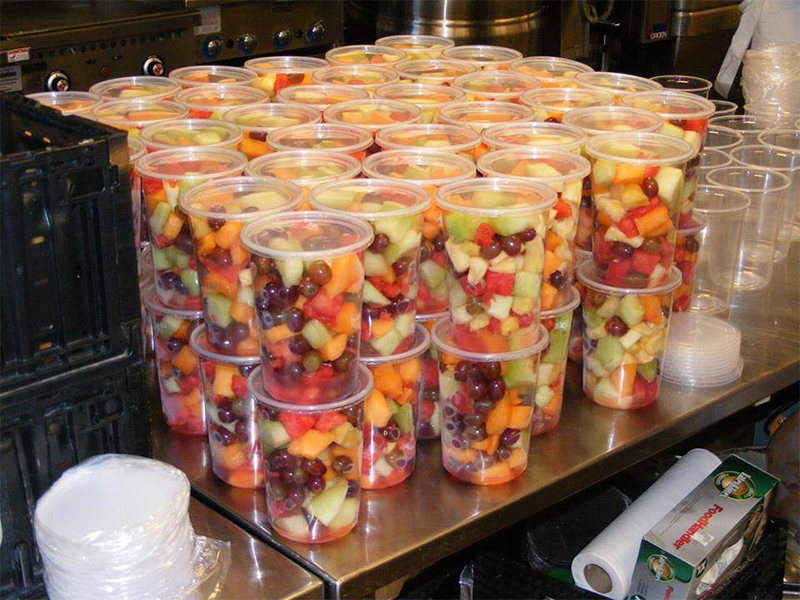
The bounty can range from mixed salad, roasted vegetables and deli meats to bakery items, cookies, yogurt cups and juices. HFFA once picked up six fully cooked turkeys from a hotel to share with those in need, Brockel said.
Shawn Schmidt, culinary director of Monona Catering at the convention center, credits the volunteers with their ability to pull together full meals from different sources on the fly, if needed.
“We might have one component,” Schmidt said. “One group might have potato salad and one group might have turkey sandwiches.”
“It really is a win-win situation for both of us,” said Wendy Brown-Haddock, general manager of Monona Catering. “We’re happy to provide for the community. It’s a really great system.”
Special events are another source for Healthy Food for All. The American Family Insurance Championship, PGA TOUR Champions, held annually in June, raises money for American Family Children’s Hospital and other charities and draws between 800 and 1,000 volunteers, in addition to legendary golfers.
Throughout the multi-day event, the tournament keeps its volunteers fueled with breakfast and lunch, including a variety of fresh fruit, sandwiches, pulled pork, hamburgers, brats and salads, among other items.
After its first year in 2016, tournament coordinator Gail Perla said they realized they had a surplus of meals. They have worked with Healthy Food for All each year since to get the extra food to people who need it.
Perla said it has been “most gratifying that 90% of the time, when (Healthy Food for All operations coordinator) Joe Mingle would take the surplus food and deliver it, it was all same day: same day use, and same day out.”
While food repurposing is another way American Family can give back to the community, Perla said, volunteers also asked what would happen to the extra food.
“They wanted to make sure it didn’t go to waste as much as the tournament did,” she said.
Healthy Food for All “is a great organization. They’re very helpful and very responsible,” Perla said. “There’s nothing better than knowing the food you’re giving is immediately going someplace … to help those in need right away.”
Roots of Healthy Food for All
Brockel has deep roots in food recovery. A member of the city of Madison Food Policy Council, he has worked for the Community Action Coalition as its food and gardens division manager and is the former director of the FairShare CSA Coalition.
In 2015, Brockel and Mingle founded Healthy Food for All. That summer, supported by a seed grant from the city of Madison, the team drove around to local farms and collected excess produce. They connected with organizations like the Stoughton Youth Center and a network of food pantry coordinators to distribute it.
At the end of the summer, Epic contacted the group, Brockel said, to see if Healthy Food for All could take the excess from its annual Users Group Meeting, which draws thousands of people to the Verona campus of the electronic medical records company.
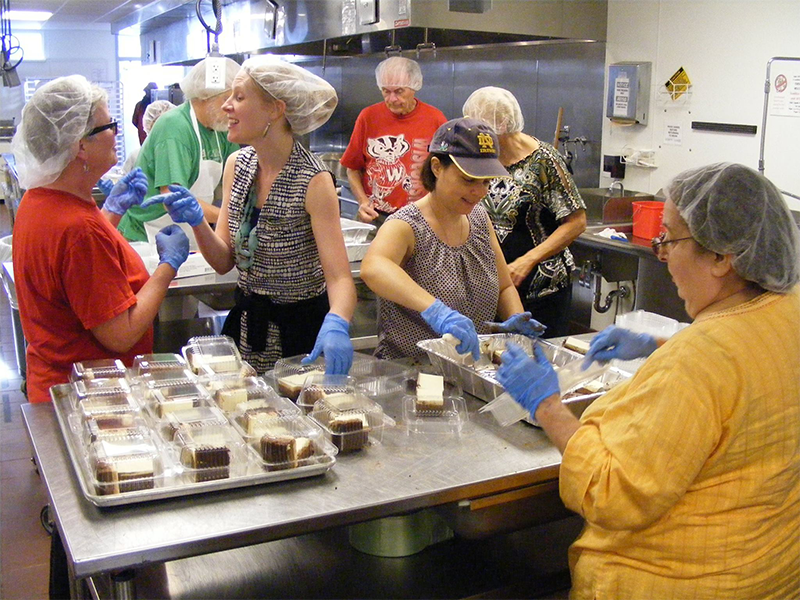
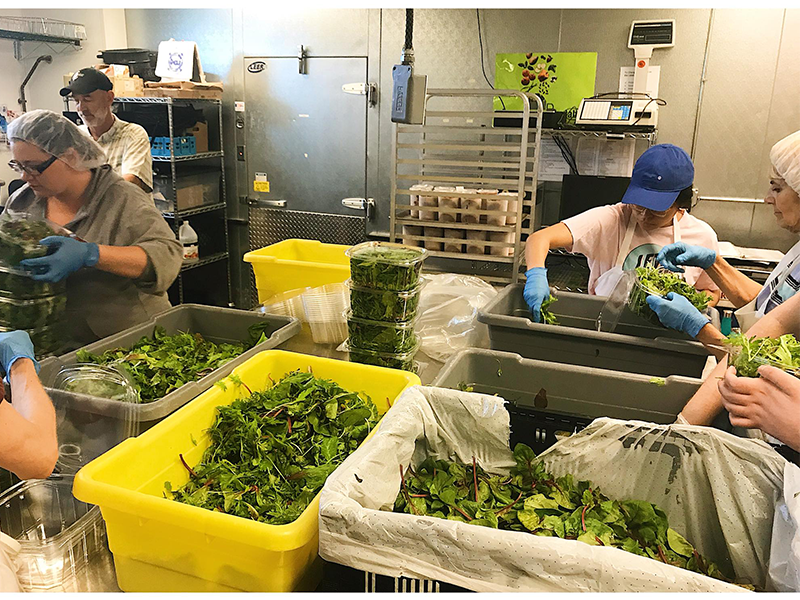
After the event, HFFA got the remaining food from Epic, worked with a group of volunteers and repackaged the food into family-sized packaging. Armed with a list of ingredients, Healthy Food for All also made labels for the food.
It was Labor Day weekend when the food was dropped off at a local organization and people were excited, Brockel said.
“I had a moment of, ‘This is fantastic! People love this! This is what we should be doing,’” he said. “It was kind of an a-ha moment.”
That connection with Epic turned into a weekly drop-off at the commercial FEED Kitchens. Volunteers would repackage prepared foods like soups and other items, and deliver it. The partnership lasted for three years. Epic now sends its excess food to Badger Prairie Needs Network in Verona, helping address food insecurity closer to its company headquarters.
The Retail Gleaners Network
About 35 volunteers take care of the pick up and delivery at places like groceries and bakeries for Healthy Food for All, a group called the Retail Gleaners Network. In 2024, the gleaners donated nearly 3,000 volunteer hours to the HFFA program, Brockel said.
“It’s up to our drivers to go to those places and triage what is there and make a determination about where the best place is for those (food) items to go,” Brockel said.
Kruger, the volunteer with the custom license place, started as a volunteer with Community Action Coalition and now volunteers for HFFA five days a week, as part of the gleaners network.
“As soon as I retired, I said, ‘I’m never working for money again but I want to give back,’” said Kruger, who owned a bill-collecting business, referring to himself as a “bill collector with heart.”
He said the work is really rewarding.
“You meet interesting people. It just makes life interesting,” Kruger said. “There’s the ‘feel-good factor’ too.”
From the farm to affordable housing
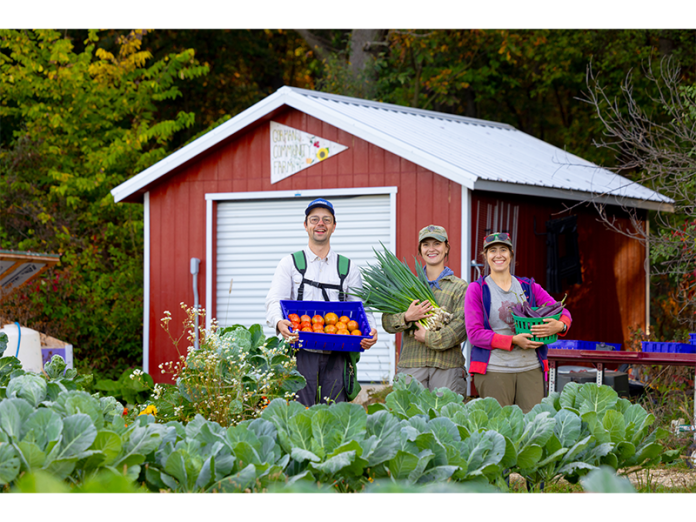
While Healthy Food for All’s focus is usually on food recovery, it also distributes fresh produce directly from Gorman Community Farm in Oregon to affordable housing developments owned by Gorman & Company.
Developer Gary Gorman, chair of the board of directors and former CEO of Gorman & Company, lives on the 240 acre farm that has been in his family since 1852. After observing residents of his properties — kids, in particular — starting their day waiting for the bus with a bag of chips, he started thinking about how he might help the residents access healthy food.
“I started growing vegetables on my farm myself but I’m not very good at it,” Gorman said. “My wife would tease me, ‘Any moron can grow zucchini,’ and that’s what I grew.”
To scale up the variety and amount of food produced, Gorman turned to Tom Bryan, who is on the teaching faculty at the University of Wisconsin-Madison’s Department of Plant & Agroecosystem Sciences, to manage the farm.
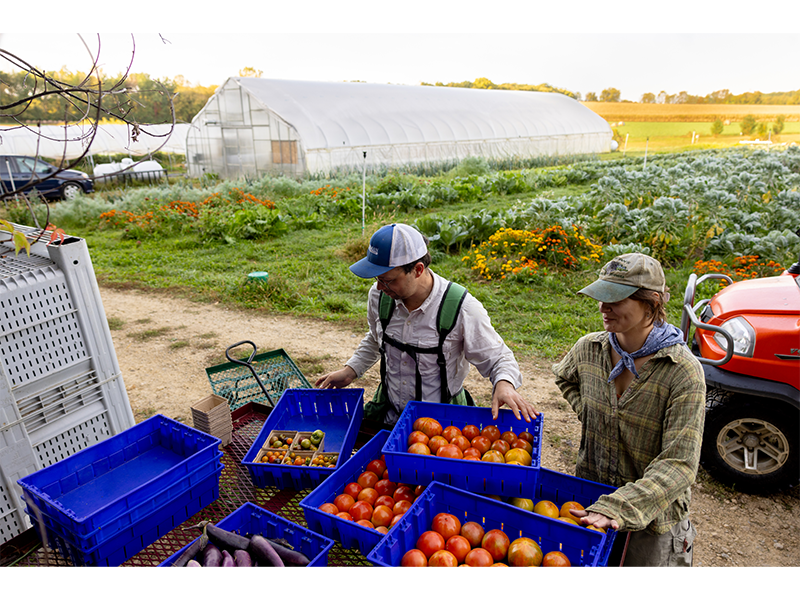
With the exception of some storage crops like garlic and potatoes, the bounty is harvested by Bryan and a team of two others, and dropped off on the same day.
“It is picked in the morning and delivered that afternoon,” Bryan said. “It makes for some exciting mornings.”
Fresh produce is now delivered once a week to three sites that serve six affordable housing units in Dane County. The developments served include Carbon at Union Corners and Valor on East Washington Avenue, a housing complex designed for veterans and their families.
The farm also donates to unaffiliated groups like the Oregon Area Food Pantry and the Salvation Army.
In 2022, Bryan’s first year, the farm donated 13,000 pounds of fresh produce. This year he expects to donate around 30,000 pounds. A typical list includes tomatoes, potatoes, collards, okra, broccoli, melons and scotch bonnet peppers.
“We generally focus on varieties that are organic and flavorful,” Bryan said, and grow varieties that can be hard-to-find, or that tend to be expensive at grocery stores.
At the Carbon drop-off site, they delivered about 100 pounds of hot peppers in the first two years, Bryan said: Scotch bonnets, serranos and habaneros.
When they learned the peppers were wildly popular, they increased production tenfold, delivering 1,000 pounds of peppers in the years that followed.
“We try to tailor what we deliver to each building based on resident demand,” Bryan said, offering healthy and culturally relevant foods. “It’s a perk of a housing unit that residents don’t have to pay for.”
The produce has been welcomed and appreciated.
“I have eaten more tomatoes in the last month than I have in the last two or three years!” said one note from a Valor resident that Bryan shared. “I remember as a kid sneaking into the neighbor’s garden and snacking on some. Now they arrive at my apartment. It really helps while living on disability and unemployment.”
“Would like to take this time to thank you and all the people who delivered our vegetables this season. We really enjoyed them and hope you all have a blessed year,” said a Carbon resident.
Gorman Community Farm teamed up with Healthy Food for All midseason in 2024 for distribution. They are the farm’s main delivery partner.
“The Healthy Food for All partnership has been a tremendous help to us keeping our farmers on the farm doing the work we’re really good at and skilled at, and enabling a fellow nonprofit to deliver these fresh, quality vegetables to the community,” Bryan said.
He said they try to deliver as much produce as they can “until we see the demand being satisfied,” he said. “The more the building eats, the more we deliver.”
Gorman farm is just one organization of many addressing food insecurity in Wisconsin’s Capital Region. Its “entire central mission is to get healthy food to people who need it in an equitable way,” Bryan said.
Local and regional food systems are really hard to build and maintain, he said, and Healthy Food for All has built a supply chain which didn’t previously exist before, calling it “incredible.”

