
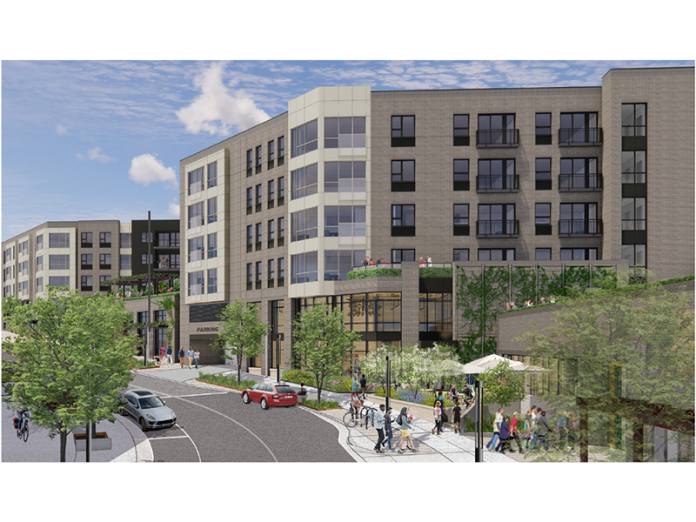

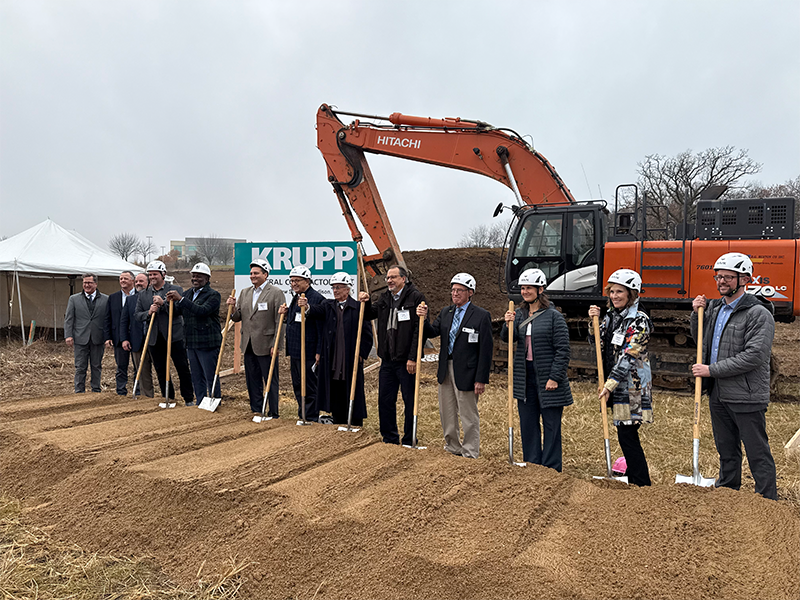
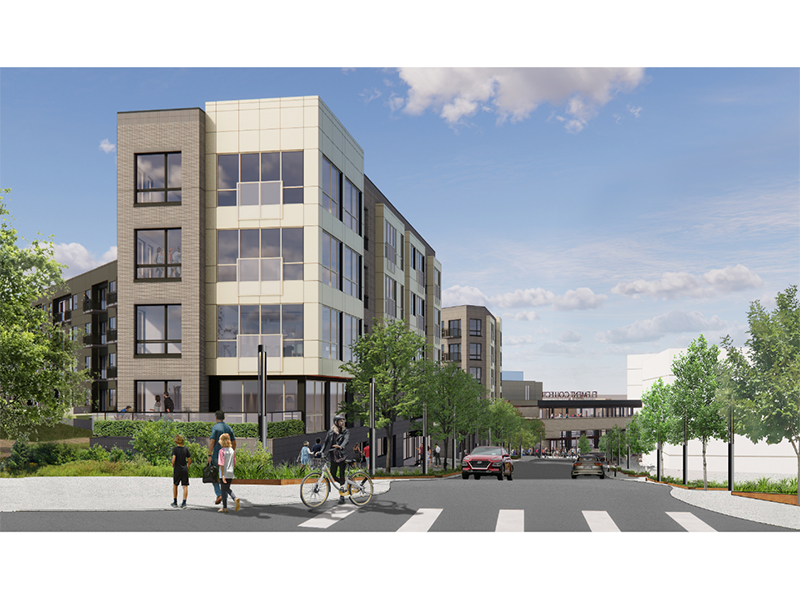
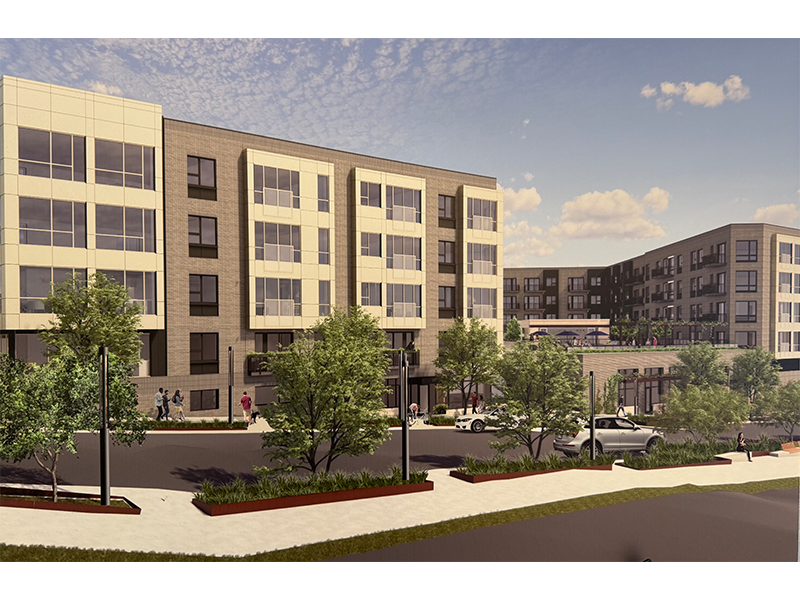
Project team members and public officials gathered Thursday afternoon to celebrate breaking ground on a 197-unit workforce housing development in University Research Park on Madison’s west side — a project six years in the making.
The $65 million development, called Element Collective, is located on Element Way along the new, east-west bus rapid transit (BRT) route and close to major employers, including Exact Sciences, Element Labs and Thermo Fisher Scientific. It’s the first ground-up development in Madison for Milwaukee-based luxury apartment developer Mandel Group. Element Collective is slated to be move-in ready by summer 2027, Mandel Group senior partner Bob Monnat told In Business Madison.
Element Collective will rent to tenants who earn between 30% and 80% of Dane County’s median household income. Rather than targeting the luxury market Mandel Group typically caters to, Monnat said, the company hopes to address the housing needs of the “missing middle” of workers, including police, firefighters, nurses and teachers.
“There’s been this huge gap between luxury and affordable apartments,” he said. “Affordable housing is for the most economically distressed, and, with the luxury market, you have to have a really good income to pay for that. So, there are all of these people who make the world go ‘round, and they can’t afford to live anywhere.”
Mandel Group announced in early November that it had completed assembling a $65 million financing package to construct Element Collective. In Business Madison previously reported that the City of Madison Department of Planning, Community and Economic Development used a public/private partnership to solidify the funding strategy.
By offering income-restricted rents, the project qualifies for tax-exempt financing and federal tax credits, issued by the Wisconsin Housing and Economic Development Authority. In addition to $930,000 awarded through the city of Madison’s conventional tax increment financing program, the city provided additional funding through a Tax Incremental Financing District (TIF), Monnat explained in an email.
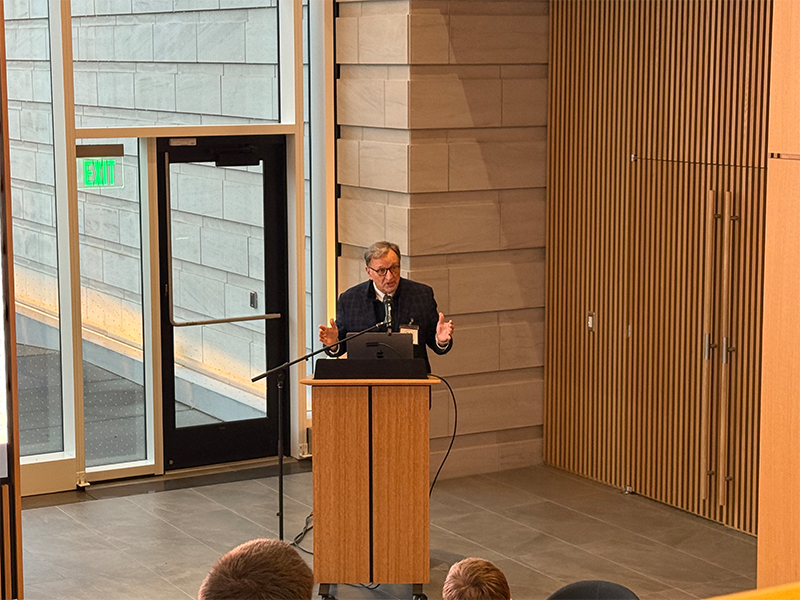
The city of Madison contributed $5.3 million in city and Community Development Authority funding, Deputy Mayor Christie Baumel said at the groundbreaking event. Under the plan, the city has the opportunity to acquire Element Collective in 15 years. WHEDA contributed about $30 million in 4% tax credits, said its CEO and executive director, Elmer Moore.
Moore called Element Collective a “complex and meaningful project. This is the ideal kind of project that we would love to see replicated across the state. … We have an affordable housing shortage on the scale of 126,000 units. If only we could do this 6,000 more times.”
Element Collective will bring ample amenities to residents and University Research Park workers, including easy public transit access and the ability to walk to work. In a 2019 survey of URP employees, 71% said “it would be great” to walk to work.
In addition to residential units, the building will feature retail space for two or three small vendors. The vendors have yet to be selected, but Monnat said his team envisions convenient services for workers — such as dry cleaning and a hair salon. The complex’s lobby will house a café accessible to the public, along with co-working and informal meeting space, he added.
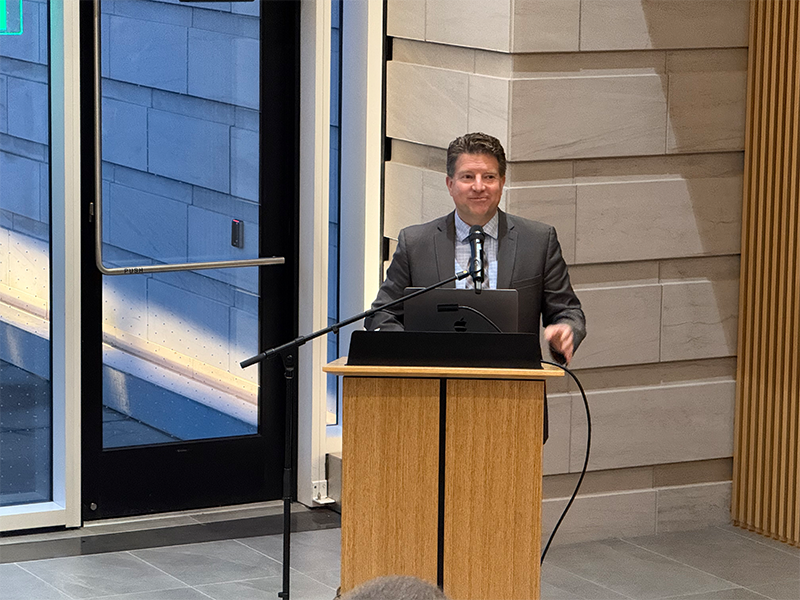
University Research Park managing director Aaron Olver said his team is “super excited” to bring the first apartment project, “but not the last,” to the research park. He said URP strives to foster innovation by creating a neighborhood and community.
“We think innovation needs a neighborhood,” Olver said. “And a neighborhood needs more than just employment. It needs housing, it needs restaurants, it needs fitness, it needs food and beverage. So, we’re trying to do what we can to promote that vision.”
A project six years in the making
Element Collective took root in early 2018, when Olver and his team began considering ways to improve the research park and attract and retain talent. Mandel Group joined the project in 2019.
Monnat said one of the first steps was surveying at least 700 of the 4,100 people who worked in the research park about what they would want there. Next, Mandel Group met with smaller focus groups and interviewed key decision makers at the research park’s employers. Yet progress stalled when COVID-19-era lockdowns left everyone wondering how many employees were going to return to in-office work.
Initially, Monnat said the project team envisioned a market-rate luxury housing development with slightly fewer units. However, in 2023, it was decided that Element Collective would be a workforce housing development.
Building the Element District
Element Collective is just part of a bigger transformation Mandel Group hopes to bring to the corner of Mineral Point Road and Whitney Way. Monnat said the ultimate goal is a “town center” for the research park known as the “Element District.”
According to plans on the University Research Park website, the Element District could eventually contain a hotel, retail space, fitness facilities like a climbing gym, a food hall and parking.
“The idea behind the Element District is to create a locus that would attract people from all the companies within the research park to come to a central place for food, beverages, entertainment, and continuing education and collaboration,” Monnat told In Business Madison. “It gives people a chance to meet those in the building that’s 500 yards away, even if right now they never see each other.”

