

The new University of Wisconsin-Madison College of Computing and Artificial Intelligence is an opportunity to shape education, the workforce and society, according to its founding dean, Remzi Arpaci-Dusseau.
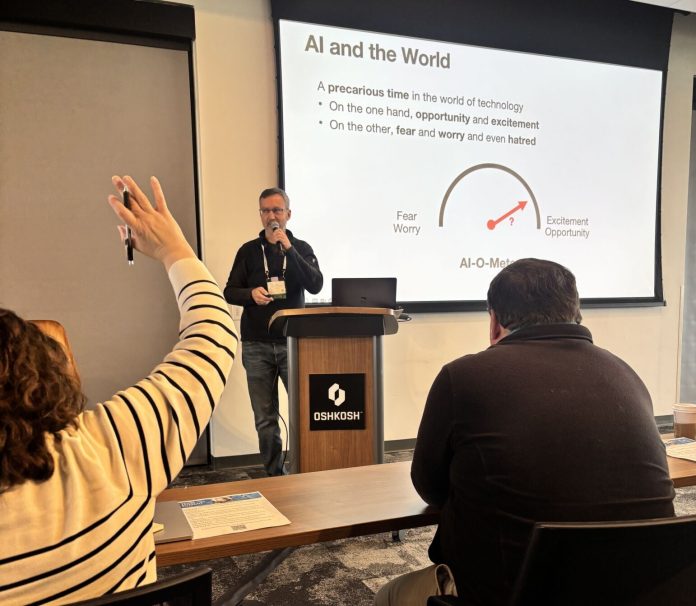
Arpaci-Dusseau was the keynote speaker at the Wisconsin Technology Council’s 2026 Wisconsin Tech Summit in Oshkosh April 30. He says there should be both excitement and fear about the future of artificial intelligence which he thinks could be more disruptive than adoption of the internet.
“About seven or eight years ago we started thinking about the computing and data wave on campus [at UW-Madison],” Arpaci-Dusseau says.
That led to the creation of the School of Computer, Data & Information Sciences. Computer science was the largest major at UW-Madison and a newly created data sciences major became the second largest major.
The School of Computer, Data, & Information Sciences and the Data Science Institute are located in Morgridge Hall. The 343,000-square-foot Morgridge Hall opened August 2025, becoming the largest privately funded building on campus.
All that laid the groundwork for the College of Computing and Artificial Intelligence which will launch July 1. It’s the first academic division created at UW–Madison in more than 40 years.
Arpaci-Dusseau says a gathering in 2023 helped catalyze a mission to create a new college that could meet the changes artificial intelligence would bring.
“This felt like a tidal wave was coming. And so, if a tidal wave is coming you’re either figuring out how to get on top of it and surf or you’re figuring out how am I going to avoid drowning,” Arpaci-Dusseau says. “I started talking about it on campus as an AI hypothesis.”
He called it a “hypothesis” to allow room for discussion about what the impacts of artificial intelligence would be without arguing over whether it would impact a particular field.
“This is a significant and transformative force. We have a chance to accelerate research and innovation … and certainly to be shaping education and the workforce,” Arpaci-Dusseau says.
Arpaci-Dusseau says the impacts of AI in science and education are obvious now and the new college will help meet them. He says people are clear-eyed about both the opportunities and the downsides including over dependency and anthropomorphizing.
“When I started this work I thought universities should play a role in this. We have to be leading in some part of this world as it is developing,” he says. “We have an opportunity and maybe a responsibility to think about how these technologies land.”

