
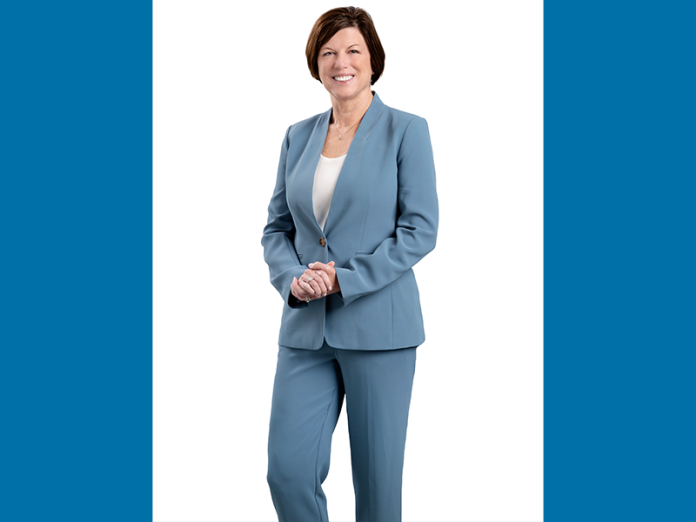

Sometimes it takes stepping back to surge forward. Such was the case with 52-year-old Wendy Perkins, who recently completed her first year as president and CEO at WPS Health Solutions.
Perkins, a Neenah, Wisconsin native, is the first female to lead the health care insurance company since its inception in 1946. Recruited out of college by Blue Cross Blue Shield of Wisconsin, her entire career was focused on federal health until job demands forced a life reset.
We recently checked in with Perkins to discuss her path to WPS, her first year, and goals for the future.
Congratulations on your first year! How has it gone?
It’s been great! I’ve really enjoyed getting to know our employees from a different perspective and working with employees who I hadn’t worked with at the company previously. I’ve lived in Madison for over 20 years and have worked for WPS since 2016, but the majority of my career was spent on the east coast.
How did you come to this role?
I was recruited out of college by Blue Cross Blue Shield of Wisconsin in Milwaukee and focused primarily within the federal government line of business. Later, the company was acquired by Wellpoint out of California, and I was spending about half of the month in the Los Angeles area running the compliance and internal audit functions. Anthem then acquired Wellpoint and I became the head of compliance for the book of federal business. My career shifted to Indianapolis, Baltimore, and Washington, D.C. I became the chief strategy officer in the federal division of the company, which was very exciting because of the opportunity it provided.
But in August 2015, I left Anthem.
Your choice?
Yes, it was completely driven by the fact that I had no work-life balance. My career took off in 2006 when Anthem acquired Wellpoint and I took on a lot of responsibility. My daughter was born in March 2007. For the first eight years of her life, I was on the road most of the workweek, leaving every Monday morning and coming home every Thursday evening. It worked because I had a supportive husband who had flexibility in his career and has always worked from home, but things got harder as our daughter got older and started to realize mom wasn’t there.
To be honest, I was bad at both jobs. When I was in Washington or Baltimore or Indianapolis, sometimes all in one week, I didn’t want to be there. And I wasn’t good at home because all I was thinking about was leaving again. It took over a year for me to transition out of the company, thinking I’d take a year off to focus on being a mom. I just needed a break.
So how did you find WPS?
I was familiar with WPS through business dealings but never thought I’d return to the industry. I wanted something new and different. One day, Mike Hamerlik — my WPS predecessor — and I were on a flight to Detroit. When I got off the plane, he was waiting for me and suggested I join WPS. I laughed it off at the time.
About three months later he called, and I ended up joining WPS in 2016. What I thought would be a year off ended up lasting five months.
What changes have you implemented in your first year as CEO?
I’ve spent a lot of time building an enterprise leadership team with a combination of leaders from WPS as well as some new team members I recruited from outside the organization to really focus WPS strategically for the future.
We’ve been putting a lot of emphasis on our culture. Starting at the top, the organization is changing, and employees need to see that. I want people to be curious, because with curiosity comes creativity; with efficiencies come innovation. Everyone needs a voice, and speaking up can be very empowering, but you don’t turn a culture around overnight. There’s a lot to be done.
I don’t think a lot of people realize that WPS is a large federal contractor. We have commercial insurance, our Medicare supplement, and federal contracting. In fact, half our business is federal, which is a different dynamic. We serve beneficiaries through either the Centers for Medicare and Medicaid or the Defense Health Agency, which is part of the Department of Defense. We also serve active-duty military members and retirees.
What will you focus on in year two?
I will be spending a lot of time in Washington, D.C. meeting with agencies, broker communities, partners, and potential partners to bring better solutions to the health care market.
But our goal is to grow and diversify this company. For example, we created a new entity called WPS Data Logistics, a print/mail/scanning operation. It is a state-of-the-art facility offering high security and high compliance because of the federal contracting that we do. We are taking that to market to help companies in Wisconsin and throughout the country lower their costs and [improve] efficiencies.
WPS is transforming, but we’re not going to change what’s working or lose our caring and compassion. I will be leading the charge to move the company forward, with our ultimate goal of figuring out how to make health care easier.
What challenges is the industry facing?
The cost of health care is astronomical and there are so many components involved. Insurance certainly is one of them because we bear the cost and the risk associated with the delivery of that care, but the shortage of providers also drives up the cost of health care. All of that puts pressure on us and the health insurance industry to offer the level of service that our members expect at a price that they can actually afford.
I was at a conference recently attended by people from health care and insurance. The sentiment there was that health care is broken. So, the challenge is coming up with solutions to make it better and affordable in the future. There’s been a little shift to self-funding, where the employer takes on more of the risk as they look to find insurance plans that serve their base of employees appropriately, and we have had to adjust to the demands of the market.
Whom do you credit for your success?
My parents provided me with a solid foundation, and I had a female leader early in my career at Blue Cross who became my role model and friend, but there’s no doubt my career would be where it is without my husband’s support.

