

At the third annual In Business Madison Real Estate & Construction Symposium on April 16, Madison development leaders shared sharp, often candid insights on everything from municipal approval frustrations to post-pandemic office trends and the intensifying pressure on industrial and lab infrastructure.
In a wide-ranging evening featuring an intimate keynote conversation with developers as well as a discussion among a panel of experts, three themes stood out: the need for local leadership in shaping growth, the demand for flexibility and community engagement, and the increasing complexity of delivering housing and innovation-ready space in a changing economy.
Local developers, local values
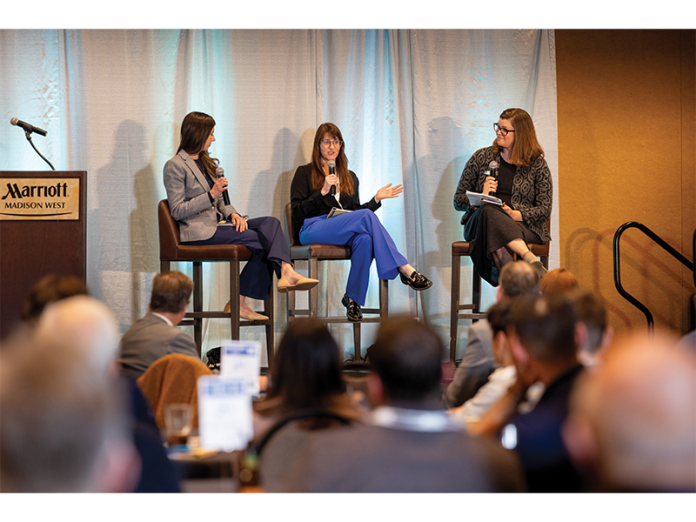
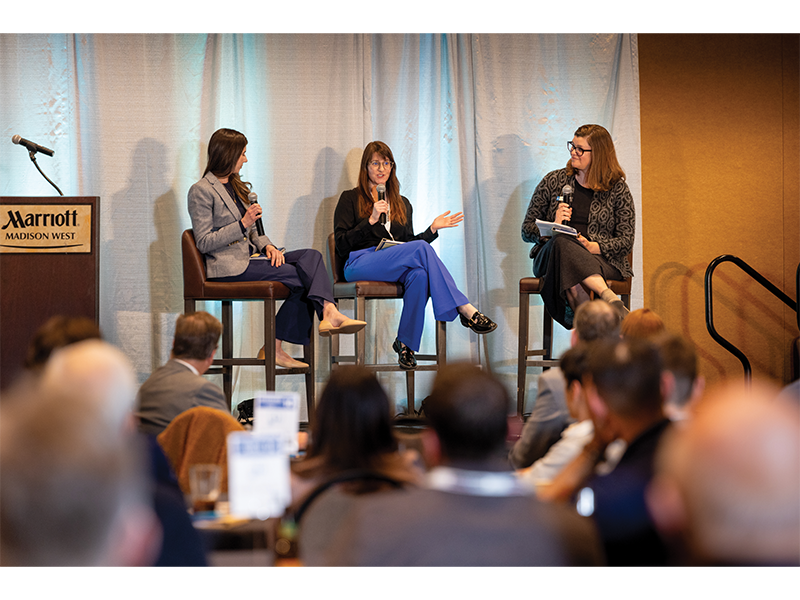
During the keynote session, sisters Anne Neujahr Morrison and Sarah Neujahr, both principals of New Year Investments, discussed their development philosophy, shaped by deep roots in Madison and a shared legacy at Urban Land Interests. Their company developed the Ella on East Washington Avenue — a vibrant mixed-use building with 135 income-restricted apartments and several local Black- and women-owned businesses — on the site
of the former Ella’s Deli.
Their approach, they explained, is grounded in long-term investment, neighborhood engagement, and design that reflects the city’s character.
“You’re going to need (strong relationships) in times when it’s rough for your tenants, but also when it’s rough for landlords,” said Neujahr Morrison, reflecting on values passed down from their father, Thomas Neujahr, the co-founder of Urban Land Interests.
Their newest undertaking is the transformation of Madison’s Triangle neighborhood in partnership with the city’s Community Development Authority, a massive redevelopment rooted in equity, sustainability and history. The first phase will replace 164 aging apartments — largely occupied by seniors and disabled folks — with modern, affordable housing, while future phases aim to build 800 additional units and better connect the neighborhood with the rest of the city.
“Why are we doing this?” Neujahr recalled a resident asking during a meeting. “These tenants are so great. … They deserve this type of housing. They deserve these types of living situations.”
Regulatory friction and the call for reform
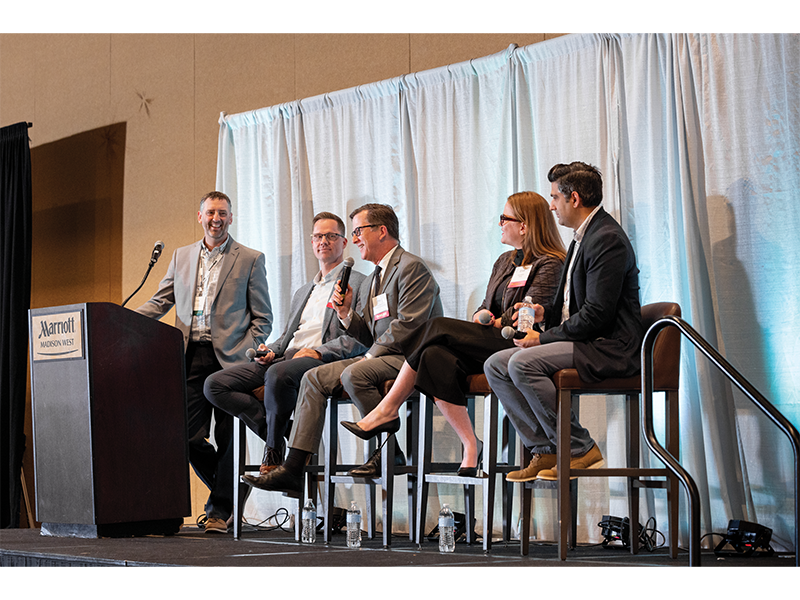
One ongoing concern expressed by the commercial development community was the challenge of navigating Madison’s approval process. A panel discussion revealed frustration over prolonged timelines and ambiguous expectations.
“It takes a long time to get through,” said Kevin Ramakrishna, a shareholder with the law firm of Reinhart Boerner Van Deuren s.c. “The way the city explains it is, ‘Well, it’s on you to figure out how to get through this process.’ Obviously, that’s really not a great plan.”
The rest of the panel included Paul Muench, associate director of University Research Park, Erica Mullins, executive vice president and principal at Strang, and Jeff Whipple, vice president with Interstate Partners. The group suggested a dedicated deputy mayor or coordinator to help manage cross-departmental approvals, and pushed for more by-right zoning classifications, citing Sun Prairie’s suburban industrial zone as a model: if a developer met a checklist, they could submit plans and apply for a permit within two weeks — without repetitive rounds of revisions and delays.
Muench said private developers are often expected to install infrastructure like streets and utilities themselves — an expectation that should be reexamined, especially in light of how tax increment financing (TIF) could support site readiness and increase the tax base.
The shift toward flexible, purpose-driven space
From life science campuses to post-COVID office environments, flexibility, efficiency and people-centered design were recurring themes.
At University Research Park, leaders are repositioning the 40-year-old campus to attract top-tier life sciences tenants. The new Element Labs building, for instance, filled a gap in the market by offering premium wet lab space for growing firms like Invenra biosciences.
“This is a building that only a nonprofit would build,” Muench said, explaining the cost and complexity of life sciences construction. “You can get very quickly overwhelmed by the quantity and cost of things. Madison isn’t there yet in terms of the rents needed to support that.”
For traditional office users, the design conversation has shifted dramatically since the pandemic.
“Every office space we’ve designed… has been totally different,” Mullins said. “Before COVID, office design was a little bit stale. Now it’s about what culture do they want to evoke.”
Mullins also described a recent project where a company with 135 employees moved into just under 10,000 square feet, including 15 workstations and eight private offices. The goal: foster collaboration and support remote-first culture while offering pockets of quiet for focused work.
Industrial growth and the limits of TIF
Madison’s booming industrial market was another focus, especially the expansion of Class A light industrial buildings — high-clearance, flex-use spaces designed for warehousing, manufacturing and logistics.
Whipple said “flexibility and functionality” are key. “You want distribution, you want warehousing, you want manufacturing — all in one building. That’s what Class A industrial can deliver.”
TIF remains an essential tool for financing these developments, particularly when it comes to extending infrastructure. But with some municipalities nearing or exceeding the state’s 12% TIF cap, panelists said the current rules are constraining local growth.
“All municipalities are using TIF. It’s their main economic development tool,” Ramakrishna said. “But if you hit the cap, you can’t create new districts. That’s a problem.”
AI, tariffs, and the market outlook
Tariffs and supply chain concerns continue to loom. Mullins said her firm is advising clients to budget for unpredictability. “We don’t have a magic eight ball,” she said. “But building materials were delayed over a year … that was real during COVID. So now, we’re always building in extra time and cost.”
Artificial intelligence, too, is becoming part of daily workflows. “AI may not take your job, but those who are using AI will,” Whipple said.
Specifically, tools like ChatGPT are now being used for design brainstorming or early-stage legal research — but caution is still needed. “We still have to be pretty careful,” Ramakrishna said. “But I think it’s going to be very helpful in the next few years.”
Despite the uncertainty, the tone across all sessions was forward-looking. Ramakrishna summed it up best: “We’re busy now … but ask me again in six months.”

