
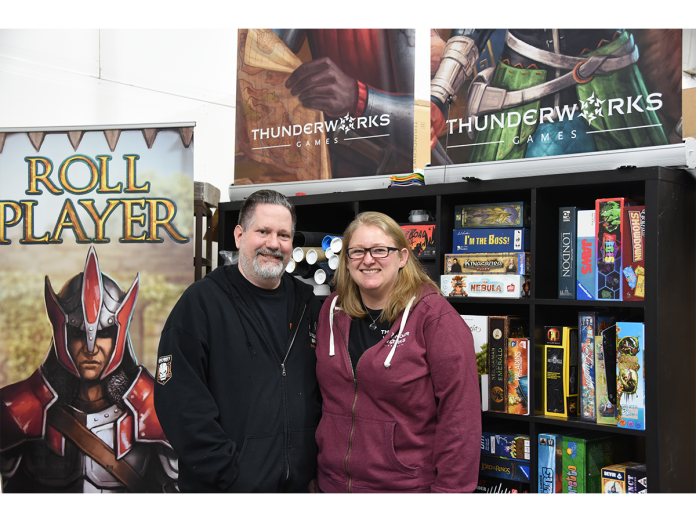

Some days, Keith Matejka is a cartographer. On another evening, he might be a knight getting equipped for battle, or a profligate gambler trying to fill his Emerald Skull with dice to make some loot while rotting away in Kulbak Prison.
He does this all from Middleton.
Most days, Matejka is sitting at his desk in an office on the west side. The nondescript building at 7182 U.S. Highway 14 Unit 402 has a tiny Thunderworks Games logo on the door. While plain, each time the tabletop game designer steps into the business, he’s entering a world of fantasy he crafts to bring joy to gamers around the world.
What’s immediately apparent in the office is that Thunderworks is global. A vitrine displays multiple versions of the games Matejka and his team have produced, with over 20 games translated in various languages.
German, Japanese, French — Thunderworks has found success at home and abroad. Its most popular game, Cartographers, has sold over 100,000 units in the U.S., and hit over a quarter of a million worldwide.
“We live on a much smaller scale in which, if you sell 10,000 units, that’s a pretty significant success,” Matejka said when comparing his industry to other ones like video games, where sales need to be much higher to garner success.
Thunderworks has sold over 800,000 board games since opening in 2013 when Matejka still worked at Middleton video game developer Raven. And while the growth in tabletop games continues — Business Wire reported in 2025 that the tabletop games market was valued at $19.5 billion in 2024 and may reach $34 billion by 2030 — the industry has been strained by tariffs and economic uncertainty.
Like its latest best-seller, FlipToons, sometimes the deck you build is a winner. But often, there are numerous cards in your way, and the developer has to see where they may fall.
Making a hit
Matejka, who runs Thunderworks with his wife Claire and three other full-time employees, said one doesn’t always know which game will take off in the tabletop industry.
FlipToons, described as a simple deck-building game that sells for $20, has already needed to be reordered multiple times. While about 70% to 80% of Thunderworks Games projects go on Kickstarter to find initial funding, usually as mostly finished products, FlipToons was one of the few where it was pitched as a straight-to-retail game.
It was announced in July 2025. The team brought the game to Gen Con, one of the world’s largest tabletop gaming conventions. The event was founded in Lake Geneva by Dungeons & Dragons co-creator Gary Gygax but is now held in Indianapolis.
FlipToons garnered interest thanks, in part, to those who received preview copies to review online. As with many markets these days, game makers work with influencers to get their name and games to an audience.
The FlipToons buzz prompted curiosity from distributors. It also sold well at Gen Con, which can be a big source of income and word of mouth for tabletop game companies.
“That’s another great way to tell distribution, ‘Hey, you should notice this game,’” said Claire Matejka, who handles distribution and localization, which means she readies games for the global market by ensuring they read properly in the culture and language. “Because there’s 3,000 titles that come out a year, you have to be able to show them this is not one of those, this is something else.”
The success of the game was huge and unexpected but coupled with the fear of tariffs and an unstable economy, it led Thunderworks to be conservative with its first printing, only releasing 6,000 units, which sold out in two weeks.
The company is already on its fourth printing of the game. The second printing was for 10,000 units, the third for 8,000 and the fourth for 30,000, which is still arriving.
That sounds like a good problem to have, but Thunderworks was out of FlipToons stock for three months over the holidays, a big season for tabletop gaming. The hope is that the game has a long lifespan and becomes an evergreen product.
“The tabletop market is a feast or famine sort of situation because you live on evergreen titles and you have to do a lot of speculation to get hits,” said JT Smith, owner of the Game Crafter, a tabletop game printer in Madison. The Game Crafter uses an online portal to allow game makers to upload their games and have them printed on a smaller scale.
And the Matejkas hope people haven’t forgotten about FlipToons. In terms of tabletop games, three months is a long time to not have a product on shelves, and leaves space for other items to become the new big thing.
But thus far, FlipToons seems to have evergreen staying power. Keith Matejka said they’ve had two such games before, Role Player and Cartographers.
“The success of an evergreen provides the bandwidth to take a chance on things that are riskier, that are a little bit more nontraditional,” he said.

Evolving into digital
At one point, tariffs were 120-145% for board game producers like Thunderworks before dropping back to 30%. Thunderworks got lucky and only paid 30%, missing the much higher added cost.
Still, Keith Matejka said such charges meant he had to raise prices for his games. In turn, that makes them less accessible, which isn’t what he wants.
A recent bill of his came in at over $6,000 for tariffs. Because of that, game prices rose almost as much as 20%. And some product just stayed in China so the company could avoid paying the fees altogether.
Also tricky to navigate is with Kickstarter, creators cannot plan a game’s pricing very well. For example, one might price a game at, say, $90, and then tariffs prompt a price hike for game-buying customers.
As a result, some Kickstarter projects were put on hold or some asked for more money from supporters.
“And other people just ate the fees,” Keith Matejka said. Added Claire, “And there were plenty of companies that folded last year.”
One way Thunderworks rallied against the tariffs was going back to its Kickstarter projects and providing more to those backing it.
They offered a digital option to play its games by providing PDFs. It was a new way to play and something extra to help push people to consider a higher Kickstarter price.
Claire said a lot of weathering the storm was brand loyalty, and Keith said they were conservative with units of FlipToons, for better or worse. But mostly worse.
“In the long run, that hurt us,” he said. “We didn’t print that many because we were nervous about what the tariffs were going to be.”
Had they been confident in pricing the games, they could have printed more, had more units over the holiday season and made more money.
“In the meantime, thousands of other games have been released,” Claire Matejka said.
The hope is that the demand is still there, but it’s hard to gauge, and the duo said there are a lot of great games coming out.
And they could not just print in the U.S. to meet demand; manufacturing in China is a must.
Overseas, there are companies that can print paper pieces next to places that can print wood pieces next to operations that can print little plastic coins for games. It is affordable, easy and all of these entities work well to put a Thunderworks game together.
In the U.S., the industry isn’t there. Especially if a game company wants something cost effective.
Madison does have a printer in the Game Crafter, which is able to print at a small scale.
Madison’s printer and gaming scene
When Thunderworks needs to print a tester unit or small order, it looks to Madison’s Game Crafter at 2609 Seiferth Road.
The company uses a web-based design system for game makers to put together their game and print it.
Ask the Matejkas and Smith, owner of the Game Crafter for the 25 years of its existence, and they say Madison’s tabletop gaming scene is pretty elite.
“The Midwest in general does really well with game design. It is more popular here than on the coasts,” Smith said.
“I don’t know if that’s due to the weather or culture or what, but yeah, the Midwest, I would say, is the home of tabletop games in the United States.”
In addition to Gen Con and Dungeons & Dragons originating here, Apples to Apples was first published in Richland Center.
“The number of board game shops and gaming shops that we have per capita is kind of ridiculous,” Keith Matejka said.
“And there are a lot of designers here, not only in Madison, but in southern Wisconsin,” Claire added.
Madison also is home to ACD Distribution, a board game distributor that is one of the largest in North America. Gamehole Con, a tabletop convention in Madison, is the fifth largest in the country.
“The largest tabletop prototype convention where people play test their games before they go to the market is here in Madison, called Protospiel Madison,” Smith said.
“And of course, the Game Crafter is here, which is one of the very few board game manufacturers in the United States.”
Roll for initiative
Tariffs and the uncertainty of FlipToons’ future might be a difficult thing to navigate for tabletop gaming and Thunderworks, but the company isn’t going to fold up shop anytime soon.
The Matejkas, in their office, which transforms into a break room with multiple tabletop gaming tables and a mini warehouse (a bigger warehouse exists on the east side of Madison), are as resilient as the knights in their games.
And for Keith — who worked at Japanese game developer juggernaut Konami at their U.S. office before moving from California for Raven and setting up his own company — he’s in the business of joy. And joy is important to him.
He gets emotional as he talks about the effect of his games not only on his team but on the community of tabletop gamers.
“Those in-person experiences help remind you why you’re doing what you’re doing,” Matejka said. “I also like having a business where I can support some local people and make their dreams come true as well.”
“I feel very fortunate to be doing what we’re doing,” Claire Matejka said. “We have really cool staff who work with us who are really excited to be doing the work they are doing.”
Keith Matejka also added that he likes to be approachable to every player. And as a small operation, he
answers customer emails. He helps when someone needs a replacement card, often mailing it out himself.
“Just doing something creative and bringing joy to people’s lives, making the world a better place — those are all important things,” he said.
“You get to kind of see the result of that impact when you have those
experiences.”
Whether he’s a thief, a knight or a studio head trying to assemble the next perfect cast of toons to star in his next feature, Matejka is a man of many worlds.
And he hopes to bring that joy to gamers — one card or one token at a time.
Thunderworks Games Snapshot:
▶ Industry: Manufacturing/publishing
▶ Revenue: $1.1M
▶ Staff size: 5
▶ Year of origin: 2013
▶ Headquarters: Middleton
▶ Number of customers/Customer base: 46,000
▶ Revenue sources: Game sales (online, retail, conventions)
▶ Business classification: S-Corp LLC