

Wisconsin’s Capital Region will be hard pressed to meet its considerable housing needs over the next 25 years without a review of costly fees and regulations and some creative approaches to foster development.
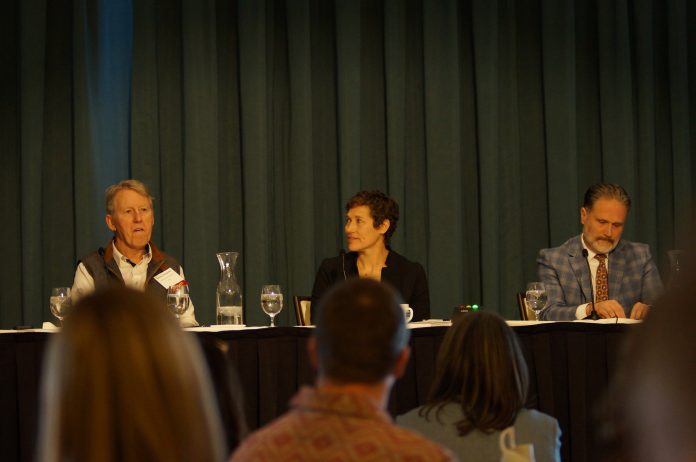
That was the assessment of panelists who took part in a housing discussion during the fourth annual In Business Madison Real Estate & Construction Symposium held Feb. 12 at the Edgewater.
Panelists included developer Randy Alexander, CEO of Torque Companies; Zach Brandon, president of the Greater Madison Chamber of Commerce; Chris Ehlers, president of Veridian Homes and Heather Stouder, administrative services manager for the city of Madison Department of Planning, Community & Economic Development. Attorney Joe Shumow, chair of Reinhart law firm’s real estate practice, served as the moderator.
Dane County is scrambling to align housing development — multifamily, single family and other forms — with the area’s projected population growth. The county still is playing catch up, having underbuilt housing during the previous 15 years. At the symposium, much of the discussion centered on how local municipalities should remove barriers and innovate if Greater Madison is going to offer enough housing for the people who choose to live here.
Daunting numbers
Shumow cited Boulder, Colorado, as an example of a similar community that has used regional planning to effectively meet its housing needs. Asked by Shumow whether planning should be done regionally — rather than municipality by municipality by communities with conflicting objectives — Brandon began by quantifying the challenge.
Brandon said the most recent projection is that Dane County’s population would grow by 325,000 people by 2050, which translates into a need for 160,000 more housing units.
In the past 10 years, he said Madison built 13,000 fewer housing units than needed, or less than half of what was required to meet the population growth that already has occurred.
Local units of government, particularly Madison, are picking up the pace, but the community is still playing catch up.
He said Dane County’s goal is to have 7,000 more housing units every year until 2050, with 3,700 of those rental units and 3,300 single-family homes. The county tallied about 5,600 total new units in the past year.
“We’re not doing well but we’re doing better,” Brandon said. “If we look at Madison specifically, this is the most pro-housing City Council that we’ve ever had.”
However, its processes and plan committee structure still create a time lag, so “speed to approval” is still not where it should be.
Instead of 13,000 units of “underperformance,” Brandon said we now have 8,500 in underperformance.
“How we’re going to make that up and get to 160,000 new units is going to require some different level of thinking,” he said.
The Greater Madison Chamber of Commerce recently assumed greater regional economic development responsibility by integrating the work of the Madison Region Economic Partnership into its own. Brandon said not every community in the region has the same housing goals, which only adds to the challenge of housing density.
“I was at a dinner a couple weeks ago sitting with local leaders who said, ‘I don’t want multifamily in my municipality. I just want big homes. That’s what we want,’” Brandon said. “I don’t know how that works but … every municipality has its own decision-making process.”
Stouder agreed that housing is more of a regional issue but said our institutions and laws would have to change tremendously to make regional planning work here.
She said there are cross-boundary relationships and collaboration at the staff level, and Dane County put together a regional housing report with an ambitious goal for 15,000 new units by 2030.
“We’re tracking that on our city’s housing tracker. We’re using that regional kind of prompt to guide what we’re trying to measure over time,” she said.
Stouder said there also is good work being done by the Capital Area Regional Planning Commission, a regional planning agency established to coordinate land use development and water quality management.
She said the commission is helping smaller communities that don’t have a staff of 30-40 people look at housing data and think through things they might do better.
“So, it’s happening a lot at the ad hoc level but again the institutional shifts that would have to happen in Wisconsin to do truly regional housing planning would be tough,” she said. “But we’re trying our best to share lessons learned, share examples, share ways of communicating data to really operate better as a region.”
Demanding demand
Ehlers of Veridian was asked what local municipalities do to help increase the supply of housing, which can bring down housing prices.
He said tax incremental financing for housing would help incentivize more building and increase the local supply. Western states such as Arizona, California and Colorado have incentivized housing development with community facilities districts.
Under these districts, he said developers get bond reimbursements to build infrastructure, allowing developers to be reimbursed over 15 to 30 years for all of the infrastructure they build to accommodate housing. Developers dedicate the infrastructure back to the municipality and in return for the cost savings, developers agree to pass along those savings to the home buyer.
“It’s been very effective out west,” Ehlers said. “That’s how California, Arizona, Colorado and Idaho have been able to navigate high housing demand and be able to still build houses that are attainable for the markets that are out there.”
Ehlers described the gauntlet of costs Wisconsin home builders face compared to developers of multifamily housing, data centers, commercial and industrial properties, all of whom get tax credits and incremental financing help that home builders don’t.
First, home builders pay full price for land. If they buy 100 acres, he said at least 30 to 40 acres must be dedicated to and built for stormwater management to protect local lakes. Developers build those ponds, seed those ponds, and get them in pristine working condition for five years.
After that, developers have to build all the infrastructure, all of the roads, do all the grading, and install all of the gas and electric utilities for the subdivision.
“We have to pay MGE, and they’re paying their subcontractors,” Ehlers said, “and by the way, their subcontractors’ costs have gone up over 50% in the last three years because it’s a seasonal job. It can only be done from May to October, and guess what’s going on in May to October? Data centers are going in and all that labor’s getting paid three times as much for the work of the data center.”
This not only affects the cost of homes, but it also reduces the availability of labor to build houses, Ehlers said.
“So, after we get through this development process, we bought the land, we filled the stormwater, we put the infrastructure in, we put the roads in, we’ve put in all the utility lines, then we can finally start building houses,” he said.
“At that point we have to build a quality house. We’re getting pressured to build a quality house that has an attainable price point — not affordable because that’s got a stigma — so we call them attainable price points for entry-level buyers with no assistance, no tax assistance, no government assistance, no finance assistance. We must build a quality house and sell that house for less than $400,000 to a first-time buyer who can barely afford the down payment or a mortgage rate that are at all-time highs right now.”
Community will
Alexander of Torque also talked about local willingness and flexibility when it comes to reducing costs, including the time and cost of getting projects approved, which include various entitlement fees.
“When you have building permits and all the other fees that are involved, they are substantial,” Alexander said, “and the community has the ability to waive a certain number of those fees. That would go directly to the bottom line and help each homeowner.”
Another example of what Alexander views as an unnecessary infrastructure cost is municipal mandates to use more expensive concrete pipes for all storm systems.
“That’s about eight times more expensive than using heavy duty PVC (polyvinyl chloride), which has been proven to easily stand up to loads, etcetera,” he said, “but in a lot of communities, the engineering department is unbending.”
To incentivize a 500-unit residential development, Alexander said Poynette — located about 20 minutes north of DeForest and Waunakee — was willing to pay 100% of the infrastructure costs through a pay-as-you-go TIF. They also had a very easy entitlement process that helped save time and money.
“What was the result? We can sell a house 20 minutes north of Dane County … for $100,000 less there than we can buy the same house in DeForest, Waunakee or Windsor,” Alexander said. “Same square footage, same general quality.”
Some of that cost savings is dictated by factors such as location, but Alexander said it gives people an idea of “how far down you can bring the price of homes for people within your community that you need here, that need to live here, that would strengthen the family a unit if you did that.”

