
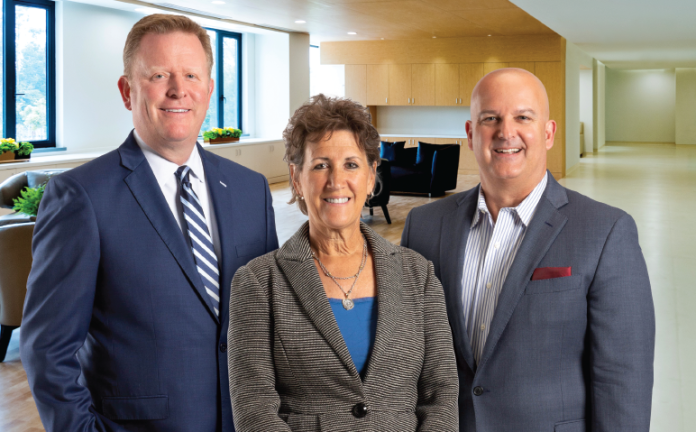
The future of health care was the topic on June 29 as IB convened a virtual roundtable panel featuring local medical and insurance executives. Panelists weighed in on several topics related to the health care industry, including how the pandemic has changed care delivery, the potential for significant upward pressure on 2022 medical insurance rates paid by employers, and COVID-19 vaccine progress.
Roundtable panelists:
Brad Niebuhr, senior account executive, regional sales lead for the Madison market, M3 Insurance
Sue Erickson, president and CEO, Unity Point Health – Meriter
Les McPhearson, president, Dean Health Plan
Moderator:
Joe Vanden Plas, editorial director, In Business magazine
Pandemic pulse
Vanden Plas: Let’s start by going over the lessons learned, or perhaps possibilities realized from the pandemic, especially adjustments that will become best practices.
Erickson: Everybody speaks about virtual care and virtual care has a permanent place and really has worked well for us in certain settings such as behavioral health and substance abuse. Folks are willing to keep appointments and stay on care plans in that setting, so we’ve seen really good adherence in that space. There are optimum places for virtual care. We continue to refine that in a primary care setting where it’s going to work well, and maybe in certain areas where it doesn’t work as well, and we’re playing in that space.
The other thing we learned in our setting is about telehealth. It really was a way for us to stretch our provider resources and things like telestroke [the use of telemedicine for stroke care] and CT [cardiothoracic] surgery consults, so it affects your eICU [electronic Intensive Care Unit] and places where you can take that scarce resource and use it effectively across more than one care setting.
One area that not a lot of people talk about, but really played out well on our campus from a learning perspective, is visitor management. We had a more open footprint, and learning to get down to a couple of entrances, monitoring people coming in, asking important questions about infection, knowing who is here, knowing where they are going, and managing our visitors in a different way has really helped us with infectivity and safety for both our patients and our staff. We’re refining it as we open up visitor policies, but we’re really refining who is on our campus, why they are here, who they are seeing, and that’s been very helpful.
And then, another one is remote work. Everybody across the country has learned that remote work can work, and we have some areas within our organization that are not involved in direct patient care and so those individuals are permanently working from home or some sort of hybrid relationship with us. That has allowed our congested environment to retool areas within the organization to manage and move other clinical areas that are more important to base on the campus.
One that really shined is our focus on disparities. If you look at information in aggregate, you don’t necessarily get the detail you may want to see about whether there are races and ethnicities that are impacted differently by different disease states — COVID-19 being one of them — and looking at the data with a disparity lens helps you home in on what might be a better way to care for certain populations.
McPhearson: Dean Health Plan has seen dramatic advancements, maturation, as well as acceptance in telehealth. It’s here to stay. It’s not going to be a replacement for necessary in-person care, but it will certainly be a complement. We’ve seen similar adoption for some kinds of intervention such as behavioral health … and also as a gateway, if you will, to preventive care and well visits when there was
a reluctance to come into the office. That has also, in our view, helped accelerate some of our work within Dean Health Plan and SSM to reach out to other communities in the area that have health disparities and challenges with accessing care or may have social-determinant barriers that were insurmountable or at least very difficult to overcome prior to the rapid advancement of telehealth. Especially here in Wisconsin, it will be advantageous for rural populations that have challenges with transportation sometimes or just access, so we’re really excited about that.
We’ve seen similar advancement in how we can serve our members, our providers, and employer clients working remotely. We’ve all worked remotely, and we’ve proven it can work. Our productivity levels remained high. Our service levels met or exceeded every metric, and our employee engagement remained high, which was really good to see given not only the work-related pressures that the pandemic created, but also the pressure on all of us personally and the risk associated with it, and the impact on loved ones in our communities. So, I’m really happy to see that we’re coming out this side of the pandemic in such a positive way and are able to serve our members, our broker partners, and our provider partners in new and innovative ways.
Niebuhr: If anything, the pandemic taught us that innovation isn’t just possible, it’s a necessity. With the work we saw in the technology space — providers ramping up their virtual capabilities, insurance carriers enhancing their worksite mobile technologies or trying newer technologies — all of us adopted something new during the pandemic. I find it shocking the amount of Zoom meetings or Microsoft Teams meetings I’m involved in on a daily basis compared to 16 months ago.
In terms of health care, one thing that we have seen, and Sue and Les mentioned it, is behavioral health going virtual and people in rural settings going virtual. I don’t think that’s going to change. When it comes to behavioral health, it’s easier to be on a laptop, your phone, an iPad … while on your couch or at your kitchen table and talking with providers. So, everybody has pivoted, it is working, and it will be interesting to see what everybody calls that new normal.
Vanden Plas: We’ve heard other health care providers say that telehealth visits have been helpful for anyone who may feel stigmatized by coming to a clinic.
McPhearson: I believe that’s true … It breaks down some of those barriers and stigmas that have historically been associated with mental and behavioral health visits. We’ve seen that improve over the years, but access through telehealth has certainly accelerated that, and I’m thrilled to see it. It makes it easier if we don’t have to carve out transportation time on each end in addition to the perceived stigmas that could be associated with it. The health care industry has been saying for years that we must help people get access to the right care, at the right time, in the right setting, and I believe this is a pretty interesting and innovative way to do that.
Erickson: I don’t know that we always understand the barriers to getting to an appointment. It could be the visibility of having to go into a building. It could be that you’ve got to get up, get dressed, and drive over, and so therefore you don’t feel engaged enough to do this. It’s too hard to do this versus sitting in the comfort of your couch or in a private area and having that conversation. Again, it speaks to that adherence to appointments that we’re seeing, and it’s just a great additional tool that folks are gravitating to. We’re getting fewer no-shows and more engagement and more adherence because we’re connecting in ways that are more tolerable.
Vaccine victories
Vanden Plas: Dane County has a high COVID-19 vaccination attainment rate thanks in part to some creativity in vaccine distribution by local health care organizations. It’s probably too early to comment on plans for booster shots because we don’t know how long the vaccine protection lasts, but how have your organizations contributed to that high attainment rate and what will you be doing to continue that as we approach fall — perhaps for any populations whose vaccination rate is lower than the general population?
McPhearson: SSM did announce that we will require all employees and contractors be vaccinated before the fall, prior to the onset of cold and flu season. We believe this is the right thing to do. We are at about 77% of our employees fully vaccinated to this point. We aspire to be a health care leader and feel like this was a necessary step with the prevalence of the Delta variant becoming so impactful. Here in Wisconsin, we’ve seen much higher vaccination rates, but in other areas where SSM serves the community, there have been lower vaccination rates. So, we feel it’s our obligation to not only our employees but to those to whom we provide care to take this important step.
In terms of vaccinations for the community, I’m really proud of what Dean Health Plan and SSM has been able to do over the past several months. We have pulled out all of the stops to make vaccines accessible to everyone, whether or not they were insured by Dean Health Plan, and we’ve partnered with some of our competitors to reach as many unvaccinated people as possible. We’ve made outbound calls to our most at-risk members to address questions and schedule vaccination appointments. We’ve worked to go in homes for home-bound people to provide vaccinations. We’re working and connecting with community-based organizations to uncover unique methods of communication or where people gather to both promote and hold mobile vaccine events. Some of those examples would include partnering with the Urban League. We’ve had attendance after Spanish mass at a local church and in Mexican restaurants. We’ve been present at local farmers markets and other community events, and we’ve promoted opportunities to get the vaccine and the importance of it through Spanish-speaking radio stations, op-ed pieces, and flyers and other communications at gathering places such as barber shops and ethnic grocery stores.
We’ve also worked very closely through our relationships with local school systems — Sun Prairie, Waunakee, and Madison, to name a few — in bringing mobile vaccination clinics to school systems to help kids get back to in-person school toward the end of the school year, and also distribute vaccines to educators and administrators to help them feel comfortable taking that step. We have gone, through our partnership with Dane County Parks, to local parks. In fact, the day the Pfizer vaccine was approved for people 12–17 coincided with the date of one of our park events, and we were able to quickly communicate through local school systems, and we were able to provide over 600 vaccines that day to people who were in the 12–17 age range. All told, we’ve held over 40 events over the past two months at employer sites, at parks, and elsewhere, and we had administered almost 18,000 doses of the vaccine through some of those efforts.
One of the things we’re doing, particularly for vulnerable populations, is utilizing data from the Wisconsin Immunization Registry and matching it with area deprivation index scores, and then overlaying that with race and ethnicity data to stratify concentrated areas where there may be people who are underserved and have a low incidence of vaccinations. That has allowed us to geotarget social media campaigns as well as direct mail and other kinds of advertising, and then we’re also going to those places. We’re deploying our mobile vaccination resources based on that data and going to where those needs are so that we can do our best to ensure that everyone who wants to get vaccinated can.
Niebuhr: Locally, we have some of the best health care around and it’s due to the integrated health care systems, and as Les just mentioned, numerous different ways in which they are able to pivot and really work with our communities. Once again, the vaccinations are just an example of those integrated health care delivery systems. They are best in class.
M3, as an organization, needs to work with our clients to make sure they know their regulatory responsibilities and understand how vaccines would be paid for in relation to their health insurance plans, and we provided them with information on the progress the medical providers were making in administering the vaccines. We did that both formally and informally to gather that information from the local medical providers and throughout the state and share that information with our sales and service teams to make sure that our teams could keep employers up to date during the rollout because it was ever-changing throughout the state. Locally, we saw higher percentages than some of the other parts of the state and, once again, it’s due to those integrated health care delivery systems.
Erickson: This is a place where Madison really shined. The health systems and public health worked together to determine outreach plans and to help avoid duplication of effort in spaces, to help develop education to have consistent messaging, and to reach out to leaders in high-risk populations to see how best to serve, whether that was going into the community or setting up a special day and time within the vaccine clinic we were running. There has been engagement in efforts to take the vaccine clinic into the neighborhoods and do education panels. There is hesitancy in this space, so a lot of dialogue, a lot of discussion, and answering questions is really important. It is very grassroots. At Mount Zion Baptist Church, there was a huge education session. We’ve done vaccination clinics at the Salvation Army — really going into the neighborhood. We have a new one at the Mallards games, partnering with the Urban League there to set up a vaccine clinic where they are going to be celebrating the Milwaukee Bears, which was an original Negro Leagues baseball team, so we’re really trying to target in a fun way.
The other thing, pivoting away from our big vaccine clinic — the [number of] folks coming to that has really dwindled — and moving it into our clinics. We’ll be open in the neighborhoods where our clinics are located with walk-ins in that space, but we’ll also allow patients who have been hesitant to have that one-on-one conversation with their provider if they haven’t gotten the vaccine. We’ll try to get their questions answered in private and work with them to move them forward with vaccines.
Cost of care
Vanden Plas: What can you tell us about the following: The extent to which care utilization is approaching pre-COVID levels; how much did deferred care from the pandemic make people’s health situations worse; and how much could that impact the cost of care and medical insurance premiums for the 2022 plan year?
McPhearson: We saw a significant decline in claims volume in March and April of 2020. Utilization was down about 45%. We’ve seen levels of utilization return to pre-COVID levels over the past several months. That’s good for a number of reasons. That decline in 2020 was accompanied by a significant decline in preventive screens such as colorectal screenings and breast-cancer screenings, and we’re seeing those return to normal levels as well, and it’s very important to identify potential issues earlier when treatment is most effective and outcomes are generally the best.
It’s a little too early to say what the specific impact of deferred care will be. However, it’s hard for me to imagine that it won’t have some kind of impact. When people are not either seeking regular care for chronic conditions or obtaining those preventive screenings and evaluations, deferred care is a problem. We’re going to see some of the impact of that. I’m just unsure what the level will be. I’m hopeful it will be somewhat moderated in the near term and things will return to normal in the next few years, but the jury is still out on that … Certainly, if that deferred care ends up having a significant long-term impact on the overall health of the population in general, we could see that playing out in the long-term cost of care.
Erickson: We looked back to review 2020 and ’21 numbers in a few areas where we wanted to see the impact. We were surprised that we didn’t see as much impact as we expected. We looked at immunizations for children and adolescents— this is really in our primary clinics — comparing 2020 and ’21 with as much information as we had through May 2021, and we saw a little dip down in immunizations for adolescents. But in general, everything is actually back up to and better than even 2019 rates. So, people are paying attention at least with those populations. As far as looking at blood pressure screenings and colorectal screenings, those actually looked better than expected. In mammography, we’re down but people are getting their appointments reset. So, there is a rebound to normal rates and people are coming in to see their physicians, but it’s a long game as far as deferred care and the implications of that.
What is maybe an indicator of the cost of care is that we saw a significant dip in our ED [emergency department] visits. There was hesitancy to come in the middle of the pandemic. People were deferring coming in, and now our numbers are higher than ever in terms of what we see coming into our ED. So, it has rebounded up to normal rates and we are actually getting some record numbers of folks coming into our emergency room over the last several months and very high rates of folks needing to stay in beds in the hospital.
In our Child and Adolescent Psychiatry Hospital, unfortunately the other thing we’ve seen there are huge wait lists. We just expanded that hospital to double the inpatient beds and we added an intensive outpatient service with two cohorts of therapies in that space, and we’re looking to add another. There are very significant wait lists or call-back lists in those areas, so we’re talking about a level of stress, a level of pressure that has been put on our society through this pandemic that is not playing out in good ways.
Niebuhr: We saw half of March 2020, most of April, and into May 2020 where claims were way down. In terms of going forward from our perspective, there is a lot of uncertainty. It’s difficult to quantify the amount of deferred care we experienced in the epidemic, and it’s going to be very difficult for insurance carriers to set premiums for the next year or two. In terms of M3, we believe internally it’s one of our roles to work with our clients, the employers, and really help their employees and family members with those preventive care visits that a lot of them haven’t done in the last 12 months. So, we are working internally to come up with communication documents based on your age and gender, what you should go in for, and when because once again we saw preventive services go down longer than that two months or 2-1/2 months, but … we have seen them come back up. A lot of members deferred that, and employers will have to communicate to their employees and family members once again that we need to get these preventive services done.
Adjusting for risk
Vanden Plas: Some insurance carriers are adding a COVID risk adjustment above the calculated rate increase. To what extent is that happening in Wisconsin?
Niebuhr: We have seen, locally and nationally, some carriers add in a COVID risk adjustment. Sometimes it’s 3% and maybe even higher depending on the geography. We don’t think we’re going to see much more of that, but once again, we have seen it locally and nationally. In terms of renewals overall, we’re seeing through 2020 and into 2021 the renewals in line with what we saw pre-COVID. Locally, in south-central Wisconsin, it’s right around a 5.1% increase. The one thing we are seeing with employers though is not a lot of them are making as many [plan] changes as pre-COVID, whether that’s out-of-pocket, deductibles, and things of that nature. We saw a lot of people, for Jan. 1, 2021, really stay the same with their insurance carrier and their insurance plans. There are some different risk groups that had to make some changes but overall, we saw less change due to the pandemic where employers did not want to make [plan] changes for their employees and their family members.
We do think there is an issue coming in 2022 and 2023 when we’re really going to see the ramifications of that deferred care. We’ve got our eyes open on that but once again, in 2022 and 2023, that’s where we are going to see the ramifications of deferred care.
McPhearson: From our standpoint, we look at multiple factors when assessing risk and setting rates and premiums. Of course, one is population health but also historical trend, historical levels of utilization, as well as any regulatory and legislative factors. To Brad’s comment, it’s never the easiest thing in the world to set rates, and that bar just got a little higher in the next few years. So, we’ll have our actuaries working overtime to figure that out, but any sort of risk adjustment is not something that we have specifically addressed or contemplated within the health plan.
I would like to add on to Brad’s comments about employer choice. We saw similar levels of sticking to the status quo for 2021, and given the pressures on the labor market, we believe that may continue for the next few years as employers try to be creative and innovative to attract and retain employees.
Nursing the workforce
Vanden Plas: Regarding the workforce challenges you face coming out of the pandemic, are your respective organizations back up to pre-COVID workforce levels? If not, what is the potential impact on care access and cost? And then, what workforce development strategies are being adopted and can you leverage the public’s admiration for the pandemic’s health care heroes to inspire the next generation to pursue careers in health care?
Erickson: Workforce for all heath care systems is a critical conversation. We happen to be in a space of growth in our inpatient bed capacity on this campus, so there is a lot of pressure on recruitment for nursing positions and all the ancillary support as we get ready to expand and open up 50 additional beds. So, near and dear to our heart, we have a critical role enhancing our workforce’s well-being, especially coming out of the pandemic. We’re using a lot of online tools. We have a tool called Wellbeats that has over 700 different applications for our staff to engage with for free. We’ve got free mental-health visits. We are seeing engagement in that space for our employees not to replace outpatient care or any other care, but provide an ability for our team to engage in a different way, to talk with counselors. We have added BIPOC — Black, Indigenous, and people of color — options in that space. We offer free park passes for our families to get out, and we do other healthy outdoor events. We have an employee engagement team that helps us talk about what would be meaningful and helpful to our team from a well-being perspective.
And then we make sure that we have a good pipeline of health care workers coming into the workforce in general. Workforce development and recruitment are really important. We adopted a school here in Madison back in 2017. We work with James Madison Memorial High School in many capacities, but we focus on helping them with students who might be interested in health care roles. Not just the traditional nursing and physicians but all health care roles pre-pandemic and now post-pandemic, bringing them on-site, having team members in different areas engage with them, talk about what they do, and show and tell to get them excited. Then, we have ongoing interactions with those cohorts of students in that high school as a mechanism to get local engagement and continue to excite folks about the workforce.
We also started something that we’re pretty proud of. It’s a Gloria Jones-Bey scholarship program on our campus where we actively go after our diverse population of staff who might be interested in career development in the CNA (certified nursing assistant) space. We give them a scholarship, reimburse them for their wages while they train in that profession, and then get them certified through an exam, and once they are certified they are guaranteed a job in that space on our campus. We are on our second cohort of six, and we continue to open that up to more populations.
Vanden Plas: The question assumed pandemic-related staff erosion. Did you have staff erosion that you needed to rebuild?
Erickson: We did see some retirements and I wouldn’t say early or planned, but we did see some retirements in certain areas as folks opted to move more quickly out of the workforce. We haven’t seen necessarily a higher turnover rate in our nursing, which is the one we monitor.
McPhearson: Dean Health Plan is fortunate that we’ve been able to maintain our workforce levels to meet the needs of our members despite the challenges of the pandemic. We felt that during the course of the pandemic, it was even more important to continue to do what we do for our employees and also to look for innovative ways to appeal and attract diverse talent. One example is we shined a light on some of our employees who exemplified the mission and values of Dean Health Plan with what we call our Health Care Hero awards this spring. I was able to recognize five incredibly talented, committed individuals within Dean Health Plan, and we did similar things across SSM Health. We’ve also hosted and participated in a number of virtual job fairs that included events, specifically with various community organizations across south-central Wisconsin, including the Urban League of Greater Madison, the state Department of Veterans Affairs, the state Department of Workforce Development, and Chrysalis, which is an interesting organization that provides employment support services for individuals with disabilities.
We continue to build partnerships with local area community organizations, universities, vocational schools, and local high schools, and we’re building on our hybrid strategies while utilizing both in-person and virtual events to align to the ease of connectivity with our communities.
Niebuhr: We all developed an admiration for people our society deemed essential, with health care providers at the top of that list. M3 has been a very generous organization in the locations and communities we serve, and I don’t see that changing, whether it’s the United Way, the Boys & Girls Club, etc. M3, as an organization, was very fortunate to enter the pandemic as a very mobile workforce. We all had the ability to either work from home or the office pre-pandemic, and we don’t think the challenge is getting back to normal, but rather creating a new normal that creates an appeal for talented people to want to join us.
Although not in health care, a lot of our clients, whether it’s in manufacturing or construction, we’re seeing that they cannot hire people. They want to do sign-on bonuses. If you’re there after 90 days, you get another bonus, but obviously not just in health care, but a lot of our clients are having issues hiring quality employees.
Burn rate
Vanden Plas: With respect to your own staffs, how are your organizations helping employees cope with burnout, stress, and mental/behavioral health issues that intensified during the pandemic?
McPhearson: Burnout and stress are serious issues. They have been serious issues and they’ve only become more significant as a result of the pandemic … We regularly talk with our employees and listen closely to understand how they are affected by everyday stress and then concerns that have been compounded by the pandemic. In 2021, we launched and conducted a quarterly well-being assessment for our entire organization. We used the results to help individuals see where they are and how their levels of stress and burnout are changing over time, but more importantly, the results are used confidentially by the individual to identify and customize wellness resources and programs that are available to help those employees where they are, given the time of that well-being assessment. We send out regular information via a virtual care package to all of our Dean Health Plan employees. It includes tips for addressing all aspects of well-being, including moving with a doctor, book clubs, webinars, healthy eating and cooking, and financial health.
Niebuhr: This is really a cultural issue for all employers. The past 16 months have been difficult on all of us. Our organization has done a good job of reminding our teams to refine their work-life balance, take time when you need it, tap into an EAP [employee assistance program], and have your peers around when you need help. Our organization is about culture and collaboration and our goal is to offer a positive workplace experience for all of our employees.
Erickson: We share numbers related to usage of some of those programs so that people don’t feel alone, and that encourages people to engage with a confidential mental health app and share that information in a transparent way to destigmatize it and say these are tools and they are here for you to use. We do a ton of leadership listening sessions to get boots on the ground and from there, try to feed our information into solutions. We have an employee engagement team that we meet with from all walks of the organization to help us put together what we think is most meaningful, and then we have a lot of system strategies. We have a nursing well-being team at our system level, and physician well-being that we’re engaged with, and we’re rolling out different solutions in that space.
Another group that has been impacted is the middle-management team. We put in place well over nine months ago a tool used at one of our other sites at UnityPoint Health that really spread as a best practice, and that is a couple of times a week, there is a 50-minute session that is called Soft Side of Hard Stuff. A management team can come in and they have time to talk with each other about anything and everything they are going through and have that camaraderie of solutions and the ability to talk about stuff. That has been very well received and highly utilized by that group.
Remote medicine
Vanden Plas: Finally, we’ve reported about how different the commercial office of the future will look, but what about the health care facilities of the future? How different will hospitals and clinics look and what impact will telehealth have on your future real estate footprint as leases expire?
Erickson: The pandemic has definitely impacted how care will be delivered in certain settings. Certainly, in our clinics, there will be a rearrangement of clinic space to include a place for virtual care, which looks a little bit different, and a place for physicians to engage differently with the population. As you move more into virtual care, the need for all the clinics and all of that real estate may shift and change, and all of that is being somewhat refined. Certainly, the remote care allows us to take permanent workspace that was used by those team members who were working on-site that are now working from home and retool it to reuse it for clinicians that need to be closer to the care. We were short of space going into this and so it’s nice to have a little breath of space to retool into other ways to deliver care. There is the possibility that we won’t need some of the facilities that we have going forward. All of that is being analyzed.
McPhearson: On the Dean Health Plan side of things, our real-estate footprint is going to get smaller over time. While I don’t foresee ever being a 100% remote workforce, we are not going to bring 100% back under one metaphorical roof. That’s going to take some time, but our long-term, real-estate footprint will be smaller. We will need more collaborative space, the ability to host meeting and interactions that include both in-person and virtual attendees … I came into this role at the onset of the pandemic and until about a month ago, 99.9% of my interactions were virtual. That makes it more challenging to get to know people, to assess teams and leadership capability, and talent and performance, and some hybrid model of that is going to continue. So, we’re looking at the impact of that on culture with one thing being that we’re emphasizing video. It brings a greater personal connection than someone who is just on audio.
Niebuhr: Due to the pandemic, all employers are going to have the opportunity to reimagine how they think about their workforce and their workspace. It’s rethinking whether a certain employee needs to be in the office five days a week, or do they want to ‘hotel’ where they just come in one day a week, there is a spot for them, and it’s a random spot. Each employer will have to make the right business decision and business model. Internally at M3, our team is looking to reimagine our office space for all seven of our offices. It will take some work and some time, but hopefully we’ll get it right because for best-in-class employers, it’s about culture and collaboration. If everybody is not in the office and you don’t see one another, I don’t know how you grow and maintain that culture and that collaboration. So, once again, all employers are going to take the time to reimagine their office space and their workforce so they can have that culture and collaboration.
Click here to sign up for the free IB Ezine — your twice-weekly resource for local business news, analysis, voices, and the names you need to know. If you are not already a subscriber to In Business magazine, be sure to sign up for our monthly print edition here.

