
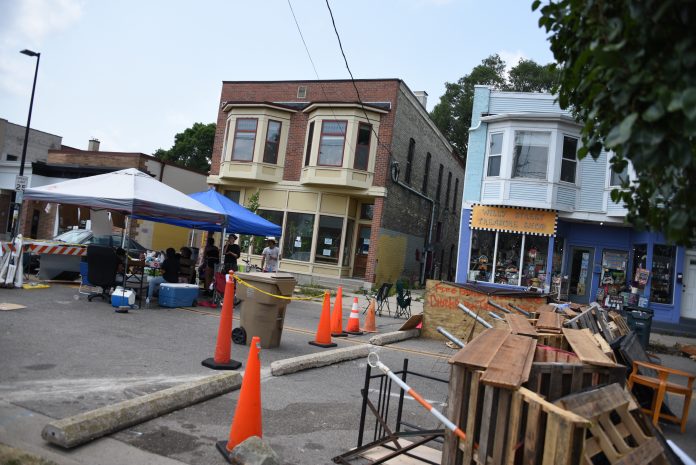
City of Madison crews removed the protest encampment at the intersection of Baldwin and Williamson streets early Tuesday morning.
In a statement explaining the decision for the removal, Madison Mayor Satya Rhodes-Conway decried the lack of focus on the original subject of the protest — Corey Ruiz, the 38-year-old Madison man who was fatally shot by a Madison police officer — and said an “illegal occupation” of the streets is not the way to solve complex systemic issues.
In an Aug. 3 letter to the community, Rhodes-Conway said she is “deeply troubled” that Ruiz is no longer at the center of the current crisis the city faces.
“We’ve provided the time and space to allow the community to grieve Corey and the loss of other community members by police hands in the Marquette neighborhood,” she wrote. “We hope to work with Corey’s family and the community to continue to have a space for people to visit a memorial.
“Plans for a permanent memorial cannot be made until the occupation ends.”
Ruiz was fatally shot on July 22 during an attempted arrest at the intersection. As the protest unfolded, complaints by residents and businesses mounted, and with public health and safety being undermined, the situation became unsustainable, the mayor contends.
An investigation into whether the officer was justified in using deadly force continues at the state and local levels.
The full text of Rhodes-Conway’s Aug. 3 letter to the community is as follows:
“For almost two weeks now, City of Madison staff and elected leaders have been on the ground and communicating to and through community leaders to peacefully resolve extremely complex, emotionally fraught circumstances that started with the police taking the life of Corey Ruiz.
Countless efforts have been made to convince people that the occupation of Williamson Street and Baldwin Street is counterproductive. A huge amount of patience has been given because the last thing Madison needs is a large-scale police operation. That’s why those occupying the area need to leave immediately.
I’m deeply troubled that Corey is largely no longer at the center of the current crisis our city faces. We’ve provided the time and space to allow the community to grieve Corey and the loss of other community members by police hands in the Marquette neighborhood. We hope to work with Corey’s family and the community to continue to have a space for people to visit a memorial. Plans for a permanent memorial cannot be made until the occupation ends.
There are too many residents and local businesses suffering because of the occupation, and it’s become increasingly clear that unsheltered people are being used as leverage for demands that, frankly, the City of Madison cannot deliver because we do not have the power to deliver them. As we and others have repeatedly explained, the City cannot make an arrest or bring criminal charges — that authority rests with the Dane County District Attorney following an independent investigation by the Wisconsin Department of Justice. The City does not control this timeline.
I’m increasingly alarmed that those supporting the occupation at the intersection of Williamson Street and Baldwin Street are either purposefully ignoring the harm being done, or deliberately hoping that the situation spirals further out of control.
The City has already issued tow notices to vehicles blocking the intersection, and citations and impoundment will follow. At no point did the City pay for porta-potties, and the company that supplied them has been asked to remove them or risk being cited and fined.
For those concerned for our unsheltered neighbors and friends, enabling the illegal occupation of city streets is not helping.
The City cannot — alone — solve our nation’s failure to provide for people’s basic needs. The faith community, nonprofits already engaged in this work, and individual community members can help the City and the County combat homelessness.
But it is naive to think such a systemic problem can be solved overnight, or that maintaining an encampment in the middle of a street will do anything to hasten a solution. As we have outlined in past messages, efforts to provide services to the unsheltered currently at the site are being made by outreach workers and Community Development Division staff.
Those suggesting this is a safe location for a homeless encampment are wrong and are actively inviting more trauma and harm.
Please join us in finding long-term solutions. That starts with removing the barricades, taking down the tents, and ending the occupation.”

