
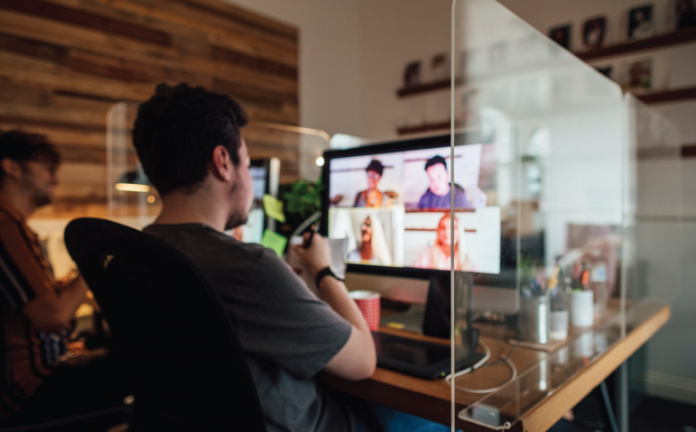

Throughout the country, employers are developing return-to-the-office plans that envision what the office of the post-pandemic world will look like. As more people are vaccinated against COVID-19, people will return to the office to discover their work environments have changed — ideally, with some input from them — and they will change not only because the virus can still infect people, but because many people have become accustomed to (and prefer) remote work.
When the COVID-19 pandemic was declared 16 months ago, many employers had no choice but to rapidly deploy remote technology so that nearly 100% of their employees could work from home. It was done to slow the spread of the virus while medical supplies and equipment were replenished, but since that time remote work has transitioned from a necessity to a more trusted (from the standpoint of management) alternative to the office.
That’s because workers made it work, and now that it’s safer to return, corporate leaders envision a new workplace that features a complete return to office for some while others alternate between home and office. Some will work entirely from home, especially for employers that take advantage of the fact that geographic limitations have been further reduced when hiring people who live in other states.
While remote work results in too much isolation for some, it offers enough convenience for others that major employers are reevaluating their real estate plans. WPS Health Solutions, a Madison-based benefits administrator and health insurer, expects up to 60% of its workforce to be remote after the pandemic, and as result the company is reducing office space. In March, WPS signed a letter of intent with One City Schools for purchase of the Nordby Building on its Monona campus, and leased office space has been reduced or consolidated at other WPS locations.
None of this is a one-size-fits-all proposition. Many employers will return as part of a phased process in which specific target dates have been set. Employee surveying and discussions between workers and their supervisors on matters such as work schedule, location, and equipment needs — a step-one best practice — have already begun or taken place.
Upon your return, be prepared for offices with even fewer cubicles, a variety of collaborative spaces, and “hoteling” arrangements for remote workers who no longer need their own dedicated space. And, yes, adherence to COVID-19 protocols will continue to be part of the bargain.
One more thing — get fully vaccinated. Even people who work from home on a full-time basis should get vaccinated as soon as possible because you never know when you might be called to work in an office on a temporary basis, and you owe it to your co-workers to make the return as safe as possible for everyone.
Office design to get a post-pandemic makeover
When people return to the office, they will realize the extent to which the events of the past 16 months have affected office design. The task of licensed design professionals is to work with clients to understand what’s going on in their client businesses, what’s happening in the world of work, and marry that data and information to create office solutions.
Many internal workforce and work-related questions must be answered, and for some answers to these questions, we spoke to the following local experts: Stephanie Anderson, executive vice president and cofounder of Creative Business Interiors, and Verna Shavlik, director of design services for CBI. For a look at whether the return to office will bring an even more relaxed dress code, we spoke to Moira Kloss, senior vice president of human resources for WPS Health Solutions, and Antonia Turnquist, a talent program manager for American Family Insurance.
Surveying best practice
The best place to start is by surveying and conversing with employees about their work schedules, location, and equipment needs. The pertinent questions include: What are the business drivers? How is work done? What resources and tools do you use when you’re in the office? What’s going to bring you back into the office?
Anderson notes that while understanding employee attitudes toward the hybrid work model is important, it’s also important to emphasize that businesses are struggling with the concept of going hybrid, and one of the first things they need to figure out is the trust issue. If a manager or supervisor or the people who own the business aren’t comfortable that employees are working efficiently and effectively, the hybrid-remote work system is likely to break down. “Working through the whole understanding of trust, both on the part of the company and in conjunction with the staff, and what trust means and what the elements of trust are that need to be dealt with and lived by, is an important piece to setting up a hybrid work model, or allowing people to work remotely,” Anderson states. “That would be my starting point.”
The ability to work remotely should be a reflection of what an employee does for the organization, Shavlik adds. “Not every job can be successful remotely,” she states. “Collaboration remotely … we’ve made this work but that doesn’t necessarily mean it’s been successful. Understanding your role and what you need to do to be successful in that role is key. In addition, the culture of the organization also thrives a little bit on what they are willing to tolerate or what their management style is on requiring people to be physically present versus being virtually present.”
The office hotel
With the increase in remote work forcing employers to reevaluate their space needs, remote workers should no longer expect to have dedicated office space at the office. According to Anderson, this is a question of whether an organization feels it’s important for people to have individual dedicated space, and it’s going to be an issue of whether they can afford to maintain that space if it’s not going to be in use full time.
“There is going to be competitive pressure between firms as to what you offer someone, even if they are not in the office full time, as far as keeping employees or attracting and retaining employees,” Anderson states. “There is no easy answer to that. In a lot of cases, there is going to be shared workspaces, but we’ve got a client now who is keeping largely individual workspaces. They are doing some hoteling but it’s pretty limited.”
Hoteling is another term for an unassigned workspace. It’s where a variety of different people come into office and land at a spot because they are there one day a week or one day in a given month. They don’t have a dedicated space to work, but there is a dedicated area for them.
Much like a conventional hotel room, Shavlik believes that office “hotels” are workspaces that employees could reserve on a mobile device or by logging into a company’s system and reserving not just rooms, but where they want to work on a given day.
Collab space
When it comes to changing how companies design their offices, the decline in cubicles goes back to the conversation about shared spaces and collaboration, according to Anderson. Whatever the arrangement, the reason people will come into the office is for that in-person collaboration. “It’s really hard to develop a substantial working relationship virtually,” Anderson states. “That’s a very challenging thing. To have things be fluid and collaborative, people will come to the office and companies will want the space to be an attraction so that people want to come in for those kinds of activities.
“So, yes, all indications are that collaborative space is going to increase, and perhaps the number of workplaces for individuals will be reduced.”
Thinking about space differently still requires supporting what people are there to do. “When we look at the office moving forward,” Shavlik adds, “we have to build in an infrastructure that supports what people need to do when they are in the office, whether they are in the office full time or they are coming in for a connection, whether it’s connection with a team or group or whether it’s a connection with the organization.”
They might need head-down workspace because they are coming in to focus on what they are doing, but that doesn’t necessarily mean it has to be a workstation. “We’ve all seen that we’ve been successful working at our kitchen table or in our living room or bedroom,” Shavlik notes. “It could be a ‘phone booth,’ or it could be a collaborative space, but it might need to have different components to it. Maybe they are coming in for just a Zoom call, so there are lots of different ways we need to think about space, but really a fundamental understanding of what’s going to bring them in is most important.”
The look of collaboration spaces won’t resemble the socially distant circles people used in the parks last summer, but there will be a variety of collaborative spaces. According to Shavlik, they are going to look like soft seating in your living room and they are going to look like the high-top tables in your kitchen or bar areas. “They are going to have a lot of flexibility. They are not all going to be the same because people, depending on your age, depending on your demographic or your comfort level, are going to gravitate to different types of spaces. So, you want to make sure there is a variety of them.”
Maintenance is going to become more of an issue than it ever has before, Anderson notes. People will want surfaces and materials that are easily cleaned, and they will demand a sense of cleanliness in the materials. Sanitation stations will continue to be provided but in the hybrid world, more employees will bring their own materials and equipment with them. “You’re bringing your computer, your keyboard, and your mouse, so shared materials will become less necessary,” Shavlik predicts. “You’re not going to walk into a conference room necessarily and log onto a shared computer. You’ll want to log your computer onto a shared display device.”
Mod pods
For individual work, workspaces will not necessarily be predicated on the health concerns of individual employees. For example, they will not be based on whether the employee is a young and healthy 30-something professional with a strong immune system, nor will they be determined by whether the employee is a 60-something, near-retirement person who has a preexisting respiratory condition such as asthma.
“It’s going to be about choice and the ability to choose and select and know ahead of time where you’re going to be,” Anderson says. “That’s going to be very important. There is going to be, and there is already, a ton of talk about rooms within a room, so smaller spaces within larger spaces that are opportunities for people to go in an individual way, or perhaps in a small group.
“It’s going to be more about the individual being able to choose where they are in the space rather than something dedicated to one type of individual versus another type.”
Everyone is not going to work in the same way, so expect furnishings that are mobile and flexible. The ability to partition office space utilizing some easily reconfigured components is where a space can be multiple things for multiple users in multiple ways.
“Fixed construction is really, in my opinion, an archaic approach,” Shavlik says. “The modular construction approach really enables one conference room that was originally a 10- or 12-person conference room to be easily reconfigured to a two-person room or a four-person room or two four-person rooms, so we’re infusing flexibility not just with furniture but with construction as well.”
Such spaces can be built very fast, but their affordability depends on the number of options added. “Within a space, we definitely want to consider and maintain the fundamentals — acoustics, access to natural light, and all of those details up to different materials and different ways of treating walls and furniture,” Shavlik says. “So, we really want to think that through. We don’t want to create another problem as we provide one solution.”
Premanufactured materials require fewer tradespeople in the space and allow for a condensed schedule, but given the time you need on the front end to hammer out all the details, they don’t bring substantial time savings. “There is a bit of a premium to it,” Anderson adds. “It can be quite a bit more expensive to use modular or premanufactured materials as opposed to conventional construction, but typically you end up with something that can be reimagined and reconfigured pretty easily as opposed to dealing with a complete demo [demolition] and all the drywall dust, etc. There is definitely an advantage to that premium.”
Homey offices
For people who will work primarily at home and want to be well appointed when doing so, perhaps in a dedicated room that’s never been used for a home office, they have many options in terms of manufacturers, furnishings, and products. They are very high quality and many of them are cost sensitive, including height-adjustable desks, a variety of different kinds of storage, and an endless world of task chairs
“There is a myriad of manufacturers who have products that are geared toward home that are very much office products,” Anderson notes. “There are a lot of preestablished configurations and ways for people to be able to see what they would end up with, and they are able to order directly online, as opposed to having someone in the middle.”
According to Shavlik, office workers have had the luxury “of some very nice, ergonomic, healthy elements within their workspace,” and then everyone went home during the pandemic and didn’t have those luxuries. Moving forward, their home office should reflect height adjustability, ergonomics, and good lighting. “You really need to consider all of the components that we’ve had in the office being addressed elsewhere,” she advises. “I feel strongly that outfitting your home office with the appropriate lighting, with the appropriate keyboards and monitors, the chairs, and the height adjustability.That’s going to continue to produce an environment that will support the health of the user.”
“Employers are going to want to be concerned about this because of workplace injury,” adds Anderson. “They are going to be concerned about people having the right kind of set up at home if they are allowing the hybrid model or the remote model on a long-term basis. It was one thing when we were all thrust into this because of the pandemic, but if they have made the conscious decision going forward, that’s a very important consideration.”
No alterations for the post-pandemic dress code
During the pandemic, many of us got into the habit of relaxed dress while working at home, and maybe we put on a few pounds in the process. While our pants may fit tighter as we return to the office, our employers’ expectations for “presentation,” especially on client-facing days, have not changed, according to a human resource executive at WPS Health Solutions and a talent program manager at American Family Insurance.
That’s not to say some flexibility wasn’t already built in, notes Moira Klos (WPS) and Antonia Turnquist (AmFam). Prior to the pandemic, both companies implemented a practice called Dress for Your Day, which empowers workers to dress in a manner appropriate to their individual workdays while also meeting the needs of the business. Within certain parameters — clean attire in good condition and nothing overly casual (tank tops or flip-flops) — employees could dress casually. The same rules apply to supervisors who might be having interactions with customers, going out into the community, or meeting with the board of directors, all situations when formal business attire is appropriate.
WPS Health Solutions started Dress for Your Day as a pilot, and it became permanent. “We asked them to consider where will you be? Who will you be working with and what will you be doing?” Klos notes.
Turnquist cited a trust factor with American Family’s Dress for Your Day policy. “The way the policy is written, we really trust our employees to take into account where they will be working, who they will be meeting with on any given day, and dress accordingly,” she states. “At this point, our current policy fits the culture that we want to foster and drive at our organization.
“So, if you are client facing, you might dress like a polished professional. If you have a back-office day, you might choose to work from home or if you come into the office, you might dress a little bit more casually. We don’t over prescribe exactly how people need to look or dress in any given situation.”
At both organizations, the policy has worked well, and simple reminders have been enough to address any transgressions. Some employees don’t need reminders to dress well because after more than a year of remote work at home, some wish to break the casual pattern. “Yes,” affirms Klos, “I’ve talked to people who are looking forward to dressing up again.”

