
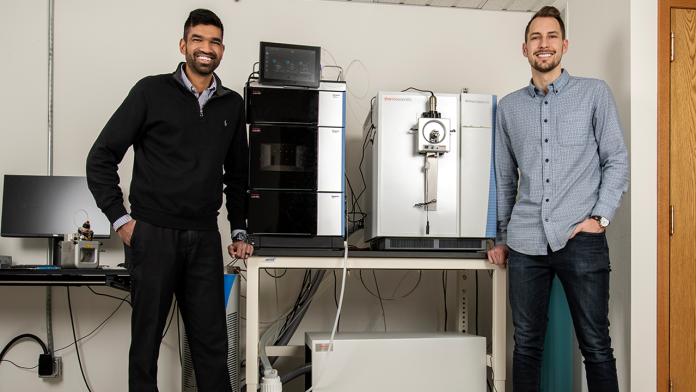
Nathan Zukas brewed beer at the Great Dane Pub & Brewing Company for a decade — five of those as head brewer — and worked in alcohol distribution sales after that.
Returning to school for his MBA, he found the Wisconsin Applied Ventures Entrepreneurship course, or WAVE, offered at the Weinert Center for Entrepreneurship at the Wisconsin School of Business, has broadened his ideas of what is possible in his career.
“It was in the top three experiences at the Wisconsin School of Business, for sure,” said Zukas, who graduated this spring with his MBA in marketing with a certificate in entrepreneurship. “It offers an incredibly applicable set of skills and ways of looking at things and frameworks.”
For more than 25 years, the WAVE course has welcomed students of any background in any field of study looking to pursue their own business. At its core it teaches students in teams. The teams work on one of the teammates’ ideas, specifically focusing on the early stage of customer market discovery and product fit.
This spring was the first time the course was offered to undergraduates. Its popularity made it necessary.
“When I started here, we were working with 200 students a year, and they were all business students,” said Dan Olszewski, director of the Weinert Center for Entrepreneurship. “Now we’re up to over 2,000 a year, and a majority are from outside the business school.”
The goal, he said, “is to teach them how to be an entrepreneur. It’s hard to have a really great idea. That’s not an easy task.
“We want the students, when they do get that bright idea, and it could be five years from now, 10 years from now… they can convert that idea into some action and move it forward and be more likely to be successful.”

A rising tide of entrepreneurs
Olszewski has been teaching entrepreneurship for 20 years. His own business background is vast: He was CEO of Parts Now, a distributor of imaging parts, and Katun, an office equipment company. He has also held positions with IBM and he serves on the boards of First Business Bank and Sub-Zero Group.
In 2024, he was awarded the Wisconsin Technology Council’s Excellence in Entrepreneurial Education award.
“There are a lot of ideas, that’s the beauty of being 21 or 25,” Olszewski said. “They come at things in a very different way. I’m just amazed at how every year is different because the students come up with different ideas each year.”
Students work with an idea and run it through a disciplined process, answering key questions like: Who is the target customer? What is the value proposition? Does it solve a real problem? And through what channel do customers want to be reached?
It can open students’ eyes to what works — or doesn’t work — as they explore customer feedback. Students can get a real-world boost in their ambitions.
“At the end of the semester we have them present to our advisory board and get feedback on the ideas,” Olszewski said. “And if the students are really serious about launching the business… we have a small venture fund that we can invest in the startups that come out of the class.”
Faraz Choudhury, CEO of Immuto Scientific, a biotechnology and contract research organization, was one of Olszewski’s students. Choudhury chose to take the course instead of pursuing a traditional MBA — and has no regrets.
“Dan Olszewski did a phenomenal job in putting the coursework together in a way that’s very practical and useful without trying to pack too many things in there,” Choudhury said. “Everything that we learned has been very useful in my real-life experience in running a business.”
For students, it can be the ideal solution for those in a different department seeking business knowledge.
“The WAVE program seemed like the perfect package, and it was the perfect package,” Choudhury said. “It took the entrepreneurship-related courses and knowledge that goes into an MBA program and packaged it up in a way that is possible for someone getting a degree from a different department to be able to access that, take the classes, go through the program and learn all the necessary skills and components required to start a company.”
Immuto Scientific was one of the companies WAVE invested in. Proceeds from these investments go back into the fund that supports future student startups.
“That’s very valuable,” Choudhury said of the funding. “It also gives the students coming out of the class the opportunity to pitch to WAVE and get feedback and understand whether they’re a fundable company or not.”
In addition to its WAVE funding, Immuto Scientific received $2.3 million in initial seed funding in 2021, and in September 2025, the company raised $8 million in a second round of seed funding.
The company has collaborated with health care company Daiichi Sankyo US on drug discovery, and teamed with the University of Wisconsin-Madison in January to explore a novel cancer target discovery.
But while Choudhury had the idea for Immuto Scientific when he was in class pursuing his doctorate in electrical engineering, others took the class with no specific business in mind, like Zukas.
From brews to biotech
For Zukas, WAVE helped him explore other industries like health care. He interned at Boston Scientific in interventional oncology. He has also interned at a Madison biotechnology startup.
He is applying for jobs focused on brand management in the alcohol industry and the health care industry, and he has some business ideas in the back of his mind.
“I came away from it (thinking) that you need to have an extremely open mind when it comes to the concept or idea that you’re pursuing, and you really need to take all the feedback that you hear because you get so isolated, or you get blinders,” Zukas said.
The course was crucial to shaping his thinking.
“I think there’s a way to apply this at every sort of scale of organization, whether you are in the midst of a startup, if you’re at a midsize company, if you’re at a very large company,” he said. “Having that ability to respond to market data is so important.”
These pivots and realizations aren’t uncommon, Olszewski said, and they’re good for students to have.
And when they finish the course, they are often greeted with a new view and appreciation of entrepreneurship.
“It really embodies the Wisconsin Idea,” Zukas said of WAVE. “You’re supposed to take the knowledge and education that we have gained and bring it to the state and bring it to society as a whole.
“One of the things that the Weinert Center does is it really helps build entrepreneurial mindsets here in the state of Wisconsin.”

