
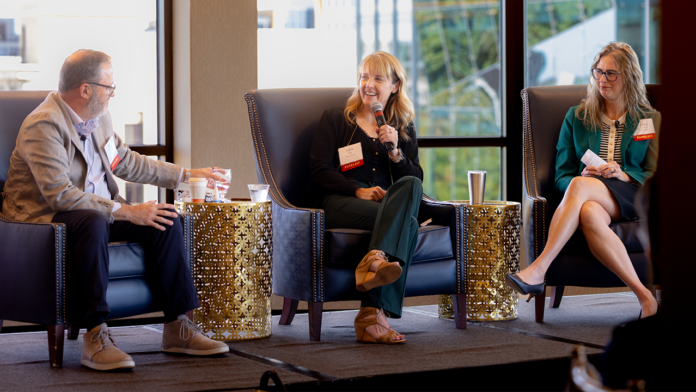

Madison might never be Silicon Valley, Boston or even Austin, Texas, but that doesn’t mean it can’t become a unique technology hub on its own terms, according to biohealth panelists at the 2026 In Business Madison Healthcare Summit.
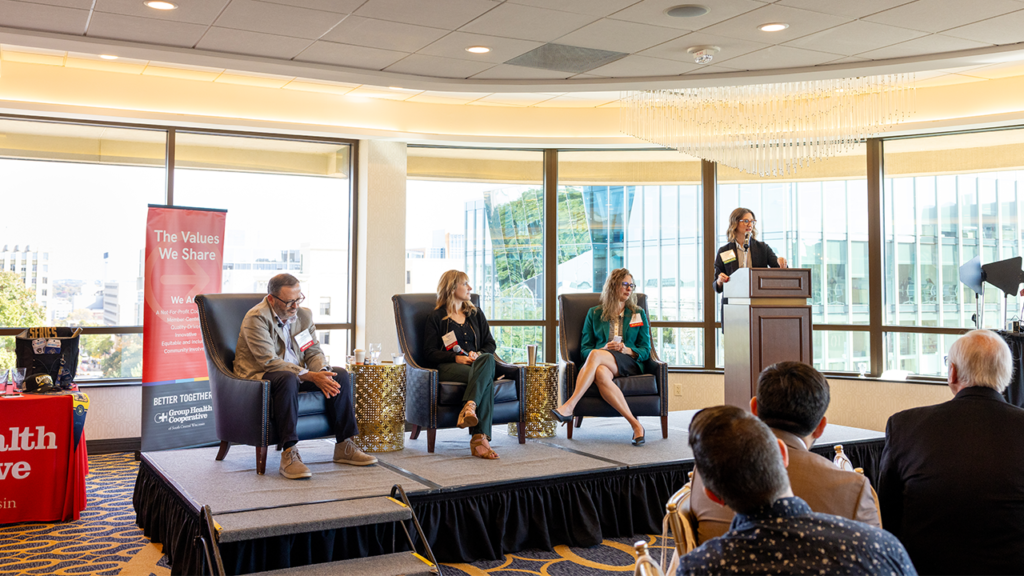
The Healthcare Summit, held Oct. 30 at the Park Hotel in downtown Madison, featured panel discussions on AI in healthcare and the local health tech startup ecosystem.
The startup panel, moderated by Maggie Brickerman, president of the Wisconsin Technology Council, featured Max Duckworth, a director of Abington Health USA, a subsidiary of the UK-based global diagnostics company, and co-founder and director of FAR Biotech, a quantum AI technology company; Jessica Martin Eckerly, CEO and co-founder of Forward Biolabs, a life science incubator; and Laura Hilty, principal with HealthX Ventures, a venture capital firm that invests in early-stage healthcare companies.
In a wide-ranging conversation, they discussed industry strengths, the gaps that still must be addressed and how Madison fares in retaining top talent.
Opportunity knocks
Brickerman said Madison is perhaps best known as a biotech hub thanks to technology developed at the University of Wisconsin-Madison, and companies such as Epic (electronic health records), Exact Sciences (cancer screening) and Promega (life science research tools), but labels might not tell the whole story.
“I think it’s useful to put more character around that as you think about the companies that are getting started, that are rooted here, that are growing here, that are getting acquired here,” Brickerman said. “What do we really mean by those words?
“I think it’s useful for the audience to understand what we’re seeing, where we’ve been and what are the opportunities you’re excited about?”
Hilty said UW-Madison (where stem cell science was developed) and Epic (now the largest EHR company in terms of market share) help shape Madison’s technology character.
“To your point, I think there’s a lot that’s coming out of the university on biotech on that side, and then we see from our digital health perspective … we see a lot of entrepreneurs coming out of the Epic ecosystem,” Hilty said. “There’s kind of a knowledge base of not only Epic but of healthcare in general because of what that ecosystem provides. So, I’d say both of those things are unique to Madison.”
Eckerly said what she’s observed in talking with people in other tech ecosystems is that Madison benefits from world-class talent coming out of the university, a strong manufacturing supply chain in Wisconsin and what she called “the big three” — continual discoveries and new technologies from the university; a continuum of small but growing businesses such as Elephas Laboratories; and homegrown giants and others that continually make investments in Wisconsin such as MilliporeSigma, Arrowhead Pharmaceuticals and Fujifilm, which acquired Cellular Dynamics in 2015 and recently expanded here.
“This is very unique to have all of this in one state, centered in Madison,” Eckerly said. “It’s really special.”
Duckworth, who described himself as a “recovering physicist,” quoted Albert Einstein, who famously said genius is 99% perspiration and 1% inspiration.
“I don’t know what the right ratio is, but when I think of this (Madison) biotech hub, there’s clearly a lot of inspiration,” Duckworth said.
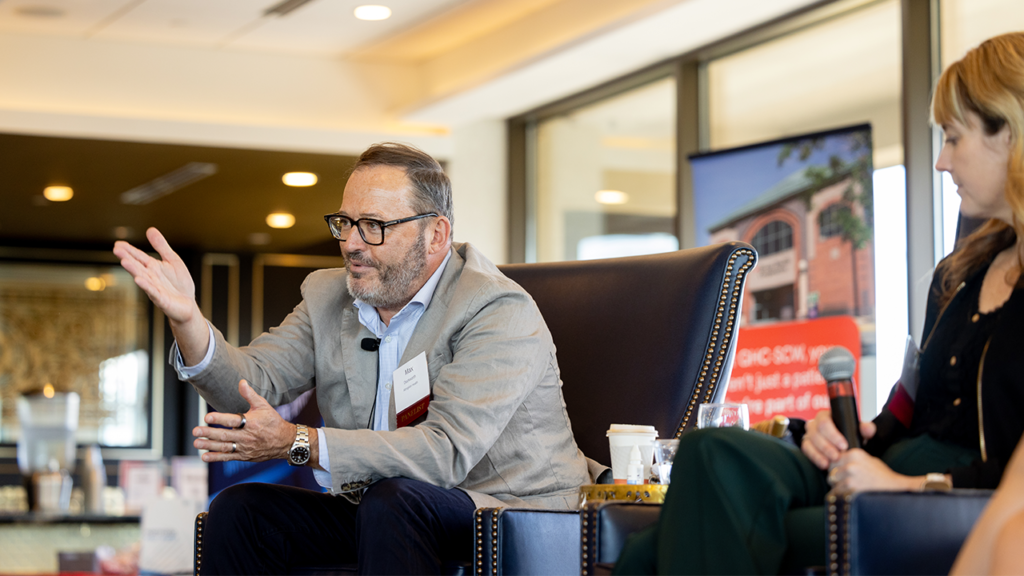
The third leg of the stool in Madison, Duckworth said, is the sense of community and cohesiveness in the local tech hub, especially compared to other hubs where he has lived.
Duckworth said the networking effect here, which was touted by Greater Madison Chamber of Commerce President Zach Brandon at the Chamber’s annual dinner, is particularly strong.
“If everybody is intentional about networking and connecting, that can really help.” Duckworth said. “So, I think it’s really just the fact that there are a lot of really inspired people … but that missing element (elsewhere) is really the fact that we’re all trying to work with each other, for each other, and trying to raise up the whole community.”
Duckworth also said Madison benefits from a critical mass of biotech, life sciences and healthcare.
“I think that we attract talent from the surrounding area, and we have the kind of gravitas or standing nationally to be able to communicate and interface with other hubs,” he said.
Capital gaps
Brickerman asked panelists about the gaps that still exist here and the discussion was dominated by the ongoing challenge with venture capital.
Duckworth said it’s a nuanced conversation because in fairness to Madison and Wisconsin, there have been some great investments from the very beginning. He referred to work by organizations such as Wisconsin Investment Partners, a network of angel investors, but said while Wisconsin has more capital “further along the progression,” what’s missing are the very large investors.
“Even if you find a Wisconsin investor to fund your Series A, which is generally the first institutional round, typically that investor will need either help in due diligence or additional capital to help write the total check for your funding round, and that investor will probably be out of state I would guess,” Duckworth said.
“And then as you progress through to B, C and D rounds or whatever, depending on what your strategy is, it’s not clear that very large investors are here and I think they should be,” he said.
Hilty said investors expect a good amount of revenue, whether the investment is placed in software companies or biohealth businesses.
“What I see from the investor perspective is two things — one, I completely agree with the customer side because when we’re putting in a check, especially for a Series A, usually we’re expecting a decent amount of revenue,” she said. “Sometimes seed (round) comes before that from a software perspective.
“Either way, we are looking for proof-of-product market fit and not just an idea or a technology that’s spun out,” Hilty said. “And so, access to customers (is important) and ideally there’s two or three. So, it’s not just an out of one, and we’re willing to actually put them first and actually be a design partner and development partner.”
Without that, Hilty said capital is limited.
“Startups are hard, and so we’re constantly looking at the risks in it, and you de-risk it so much even if they’re not paying money — if they’re committed to future money — and having those initial customers is huge.”
On a more controversial note, Hilty said many Wisconsin-based companies don’t understand venture investor expectations.
“When you’re coming for VC capital, we’re expecting a hockey stick up into the right,” she said. “Like when you sign up for institutional capital … we’re expecting it to be a rocket ship and have that huge total addressable market.
“I see a lot of mentality (here) of building a good solid business, which can make a huge impact in healthcare, but without the rigor and high bar of a Silicon Valley (venture firm),” she said. “They’re always thinking, how can I make this into a $5 billion company? And I just don’t see that same mentality come from Wisconsin-based companies.”
Eckerly said another challenge is that gaps keep shifting, but she has a more upbeat view of wooing large investors.
“If we talked about this 10 or 15 years ago, we would have a different answer because Generator hadn’t been started, and Forward Biolabs wasn’t here,” she said. “I think the gaps that a community and an ecosystem experience change over time as new things come online to fill the gaps.”
There are now more angel investors here than ever before, Eckerly said, and now local companies can talk about the need for deeper-pocketed capital here.
“How we attract them is by having great opportunities to invest, providing people an opportunity to get out to the coast because like Laura said, when you get into medical devices and pharma, we haven’t got the money for that here,” Eckerly said. “People have to be networking on the coast, but we have great technology, great scientific talent, and that’s meaningful to some investors. Their dollars go further here.”
The gaps not only change over time, but they can differ by business type, Eckerly said.
“They’re also pretty specific to the company because with a clinical startup or a digital startup, what their gaps are can be different from what a research tools or medical device company’s gaps can be,” Eckerly said. “Gaps are also different in what stage the company is in.”
There have never been more entities working to fill those gaps, she said.
“A big difference that I’ve observed in the last 10 years, even five years, is there’s much more recognition of the value you have and the potential that we could be bringing to fruition if we’re putting a little more effort into supporting entrepreneurs and founders. … We’ve come a long way and we’re going to go a lot farther.”
Duckworth said the state missed an opportunity to boost investment in Wisconsin by making an adjustment to a state’s Qualified New Business Venture program.
The program offers a 25% tax credit for certain qualifying investments in early-stage Wisconsin businesses, but Duckworth and Brickerman believe it should be modified to amend the definition of a qualified company.
“I was fortunate to be able to testify to the Assembly Subcommittee to remove this constraint, this requirement that a majority of your W2 employees be Wisconsin based,” Duckworth said. “I’m not sure it would stop companies from leaving necessarily, but it would certainly catalyze more investment on the front end by making the investments in such companies WEDC compliant.”
Brickerman said the proposal to amend the program passed in the state Assembly but it was not scheduled for a vote in the state Senate, but not due to a lack of merit.
She pledged to try again in the new legislative session that begins in January.
“This incentive that was intended to sort of catalyze early investment ends up really hamstringing companies who want to make a really great hire, just not in Wisconsin,” Brickerman said. “So, then they’re figuring out if I need to spend silly money over here to make my ratio correct. That’s not the point.”
Staying power
The panel conversation later turned to what attracts people to Madison and makes them stay here.
Brickerman said more direct flights would help, and Duckworth cited the value of partial reimbursement “for the lift that it takes to bring in out-of-state talent.”
“We better hope that it’s more than just the company that they’ve agreed to join, especially when moving a family,” he said.
Brickerman also asked the panelists whether they are seeing people leave Madison because that could also affect business location decisions.
Eckerly said she doesn’t think the draw of Boston and San Francisco will ever change.
“The pockets are so deep there, but I don’t think any of us aspire for Madison to be Boston or San Francisco,” she said. “It’s not who we are, and that’s OK, but what we can do here is be connectable to those deep pockets and bring it back here and that is what I see working.”
She said Maneesh Arora, founder and CEO of Elephas Laboratories and former COO at Exact Sciences, is a good example.
Elephas’ corporate headquarters is located at 1 Erdman Pl. in Madison and the company uses shared space at Forward Biolabs.
“He’s not raising capital here, but he’s got his team here,” she said. “We have several examples of that where there’s even a CEO in California … and they’re building their research team here because this is where they have the expertise and the talent. This is where the cost is lower. This is where their people want to work, especially if they’re already here.
“That’s part of why I love Forward Biolabs,” she said. “If you can get a company that wants to start here, we’ve got plenty of those. We can enable them to hire those people here. You think about moving yourself across the country, think about moving a whole team across the country — nobody wants to do that.”
Hilty said a lot of software collaboration can be done remotely, a trend that intensified during the COVID-19 pandemic.
“A lot of times in-person is just the best way to do it,” she said, “but then as you scale … you’ve hired people outside of the location. It does make the most sense in a lot of the software cases.”