
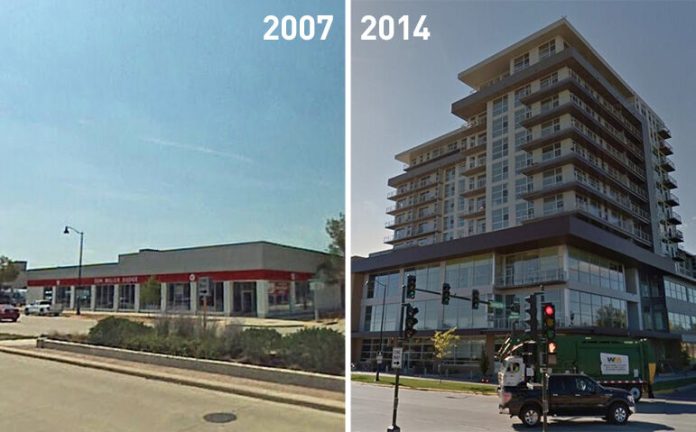

The changes to Madison’s cityscape may not always be immediately obvious when you’re seeing them occur in real time. For all the attention the pace of downtown development has generated since the “Great Recession,” it’s still surprising to see just how far multifamily residential, hotel, and commercial properties in the city have really come compared to what stood in their place before.
Taking note of Madison’s developmental rise is RENTCafé, a nationwide internet listing service (ILS) that enables renters to easily find apartments and houses for rent throughout the United States, including in Madison.
Change has swept through Madison in recent times, with resort-style apartment buildings, stunning hotels, and sparkling office towers bringing new life to once lackluster streets across the city, notes Amalia Otet, marketing communications specialist for RENTCafé. “As it sometimes helps to look back to realize just how far we’ve come, [RENTCafé] decided to take a peek at the recent past — the last nine years or so — to pinpoint some of the biggest developments that helped reshape whole neighborhoods.”
As part of its effort to look at the changing face of Madison, RENTCafé collaborated with Google Street View to produce a visual tour of some of the developments that have altered Madison’s skyline. Images of the 11 projects that RENTCafé examined are throughout this article. On each image, simply click on the arrow and slide it across to see the changes.
The (literal) rise of Madison
With the tech sector acting as an engine of growth, Madison seems to be following the same trend that is revitalizing urban landscapes all across the country, Otet says. As demand for apartment living has grown, developers have amped up their game and started delivering more rental options to those seeking more relaxed lifestyles — millennials and baby boomers alike.
229 Lakelawn, State-Langdon neighborhood — Completed: 2012
“In the largest construction boom we’ve seen over the last decade, approximately 320,000 new apartments in 50-plus unit buildings alone are expected to come online in the U.S. in 2016,” says Otet. “That’s a [more than] 50% increase from 2015 when approximately 200,000 units hit the market.”
Hampton Inn & Suites, State-Langdon neighborhood — Completed: 2013
According to Otet, high-end, lifestyle-oriented apartment communities seem to be the new norm in urban living, and Madison is keeping up with this trend. In addition to classy interiors, high-profile rental buildings such as 229 Lakelawn and Hub Madison come with some noteworthy amenities, including rooftop pools and steam spas, recording studios, yoga studios, fitness centers — and prices to match, naturally.
Hub Madison, State-Langdon neighborhood — Completed: 2015
Chazen Museum of Art, State-Langdon neighborhood — Completed: 2011
(Continued)
Data provided by Doug Ressler, senior analyst with Yardi Matrix, an apartment market intelligence source and RENTCafé’s sister company, shows renting is not cheap in Madison. The average rent for Madison apartments now sits somewhere around $1,115. However, Madison rents are still more affordable than other in-demand cities such as Chicago ($1,755) and Minneapolis ($1,396). The average rent in Madison is actually lower than the national average, which reached $1,219 in September.
Domain Madison, Capitol — Completed: 2014
But it’s not just housing that’s been getting a revamp, Otet explains. Madison’s cityscape is growing bolder and more varied as new hotels, research facilities, and businesses move in.
Ovation 309, Capitol — Completed: 2015
Edgewater Hotel Wisconsin Tower, Capitol — Completed: 2014
Aside from their architectural impact, progressive projects such as Hub Madison, the Edgewater Hotel Wisconsin Tower, and The Constellation also spurred more development and construction in their corner of the city, setting the stage for a new Madison, bustling with fresh, urban flair.
The Ideal, Greenbush — Completed: 2013
“Generally, building up has helped cities respond to the ever-growing demand for urban living,” says Otet. “Renters prefer living in a city’s urban core where there’s more activity, whether that means jobs, shops, or entertainment. Many infill locations are being repurposed for needed housing, which entails cleaning up properties that were abandoned and/or in need of environmental remediation. Meanwhile, crime has dropped considerably. All in all, it’s a good thing and businesses can only benefit from the influx of new residents moving in.”
Brownlofts, Regent — Completed: 2012
The Discovery Building, South Campus — Completed: 2010
Otet also notes that high demand indicates Madison’s development boom won’t end any time soon. “Occupancy is really high in Madison and is expected to stay that way in the coming future.”
The Constellation (Google Office), Tenney-Lapham — Completed: 2013
Click here to sign up for the free IB ezine – your twice-weekly resource for local business news, analysis, voices, and the names you need to know. If you are not already a subscriber to In Business magazine, be sure to sign up for our monthly print edition here.

