

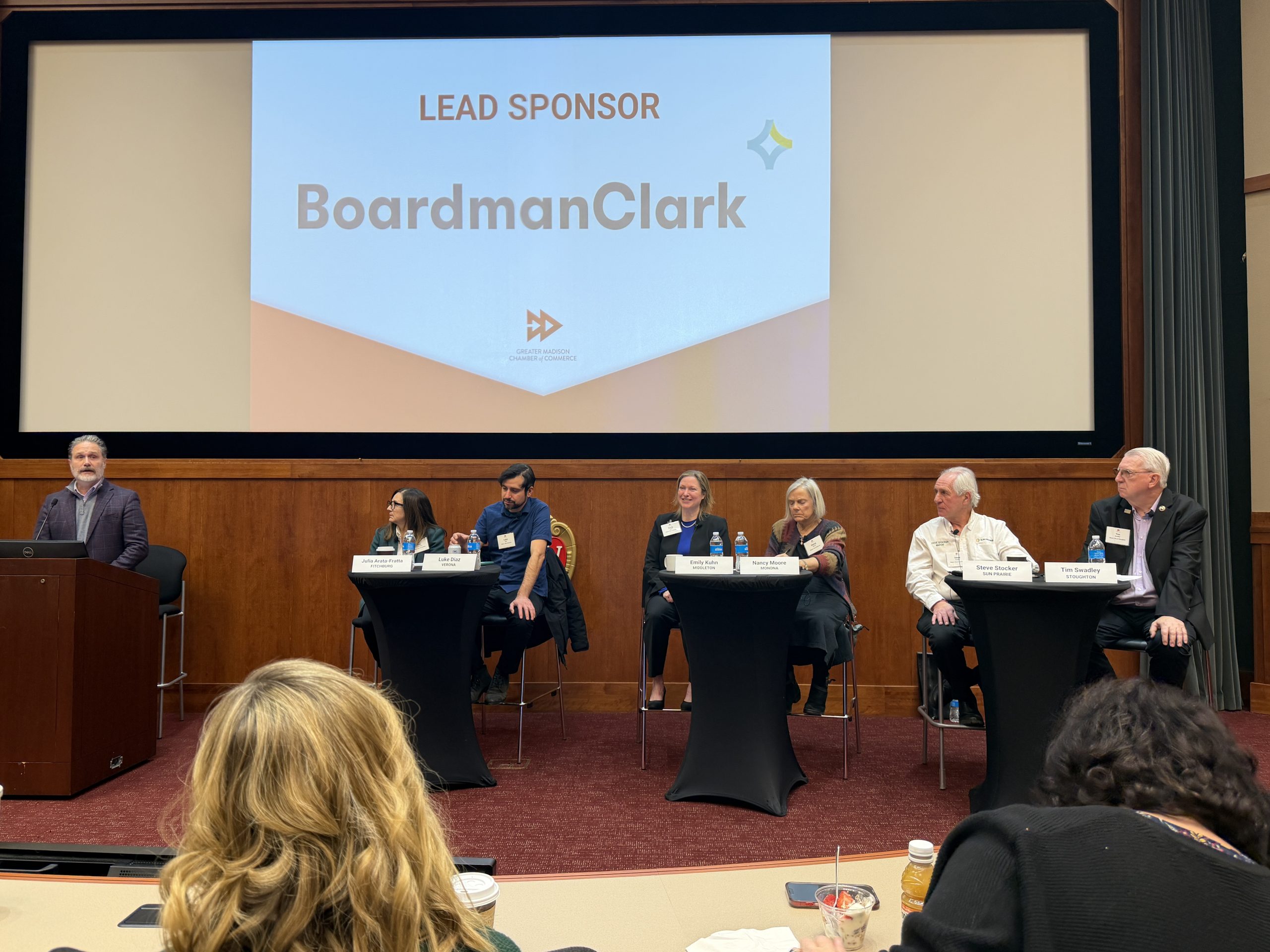
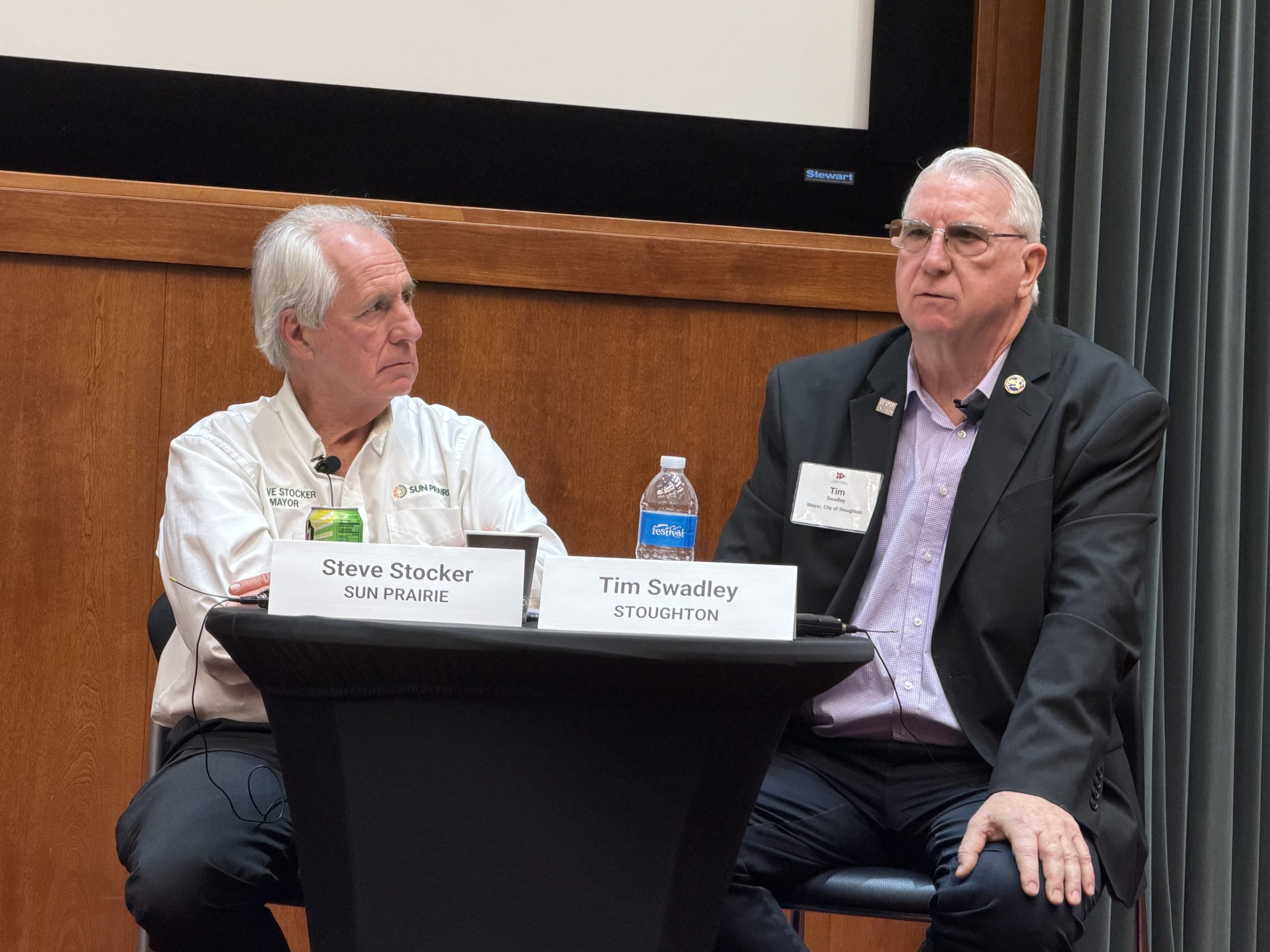
The Greater Madison Chamber of Commerce hosted an Advocacy in the A.M. Mayoral Panel on Tuesday to explore Madison’s population explosion. The city’s population is expected to grow to about 385,269 residents through 2050, bringing a host of challenges and opportunities.
This not only means challenges for Madison proper, but also to Fitchburg, Verona, Middleton, Monona, Sun Prairie and Stoughton, with each mayor on hand to deliver their thoughts and solutions. (Madison mayor Satya Rhodes-Conway could not make the panel as she was in New York.)
While transportation and retaining young professionals was a large part of the presentation, housing and the specific needs of each community were at the forefront.
As far as housing goes, it’s a continuing challenge.
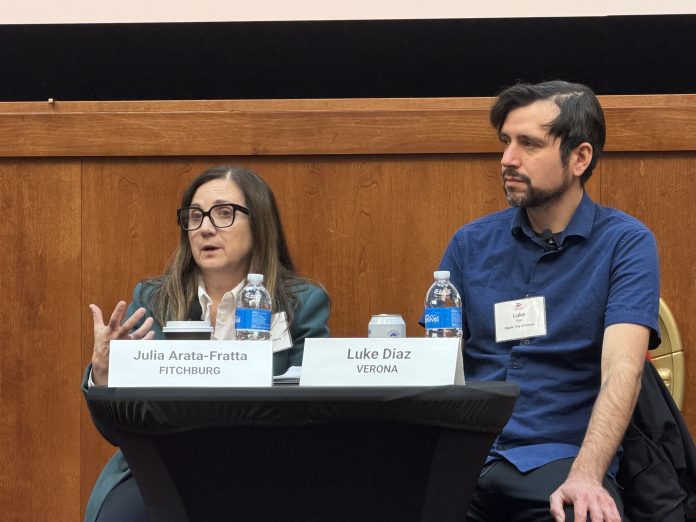
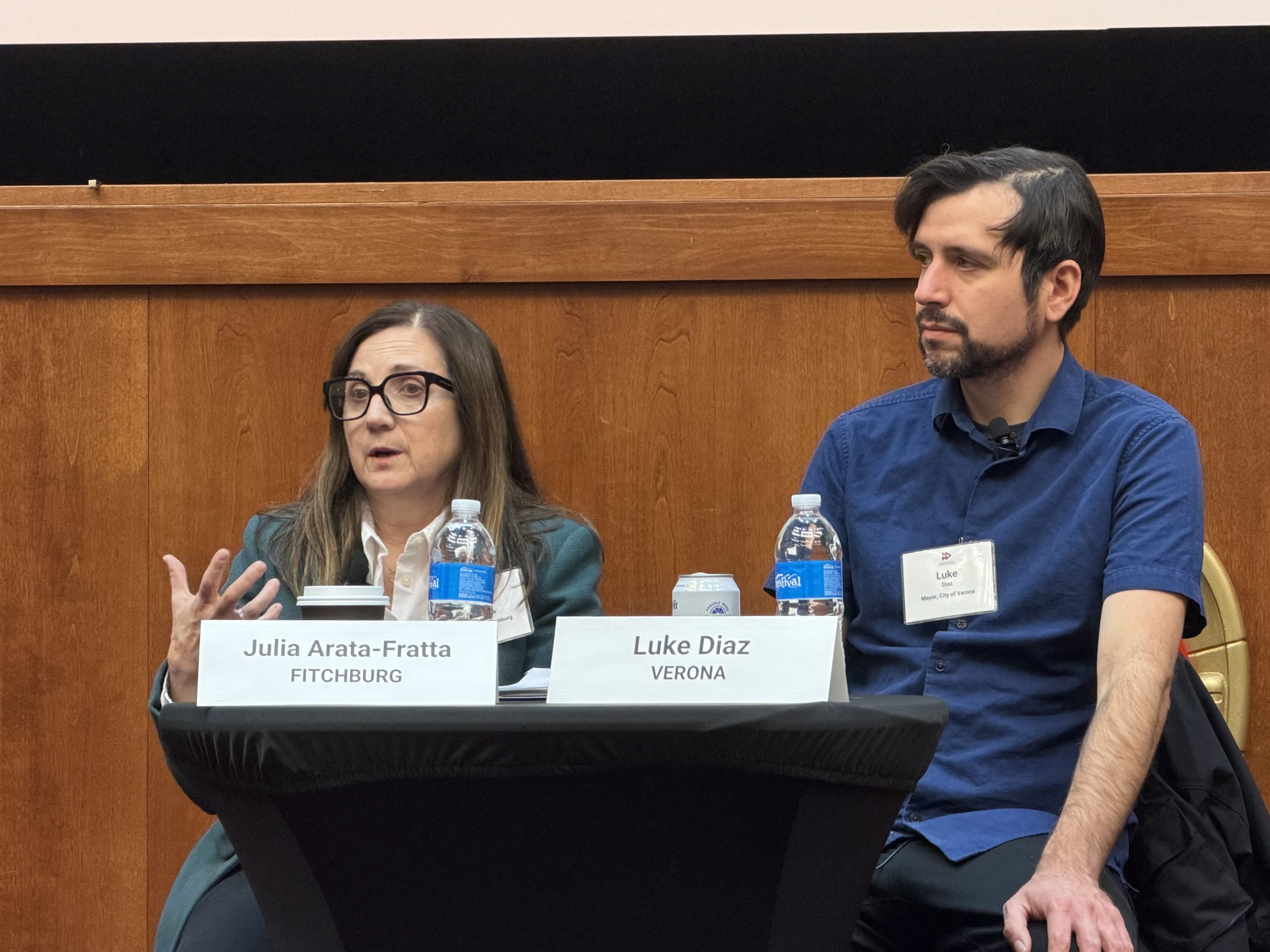
Fitchburg mayor Julia Arata-Fratta said the city has grown by 1,000 in the last year.
On top of housing concerns, there is a challenge on how to prepare the city and its infrastructure, and will be an issue for the next decade.
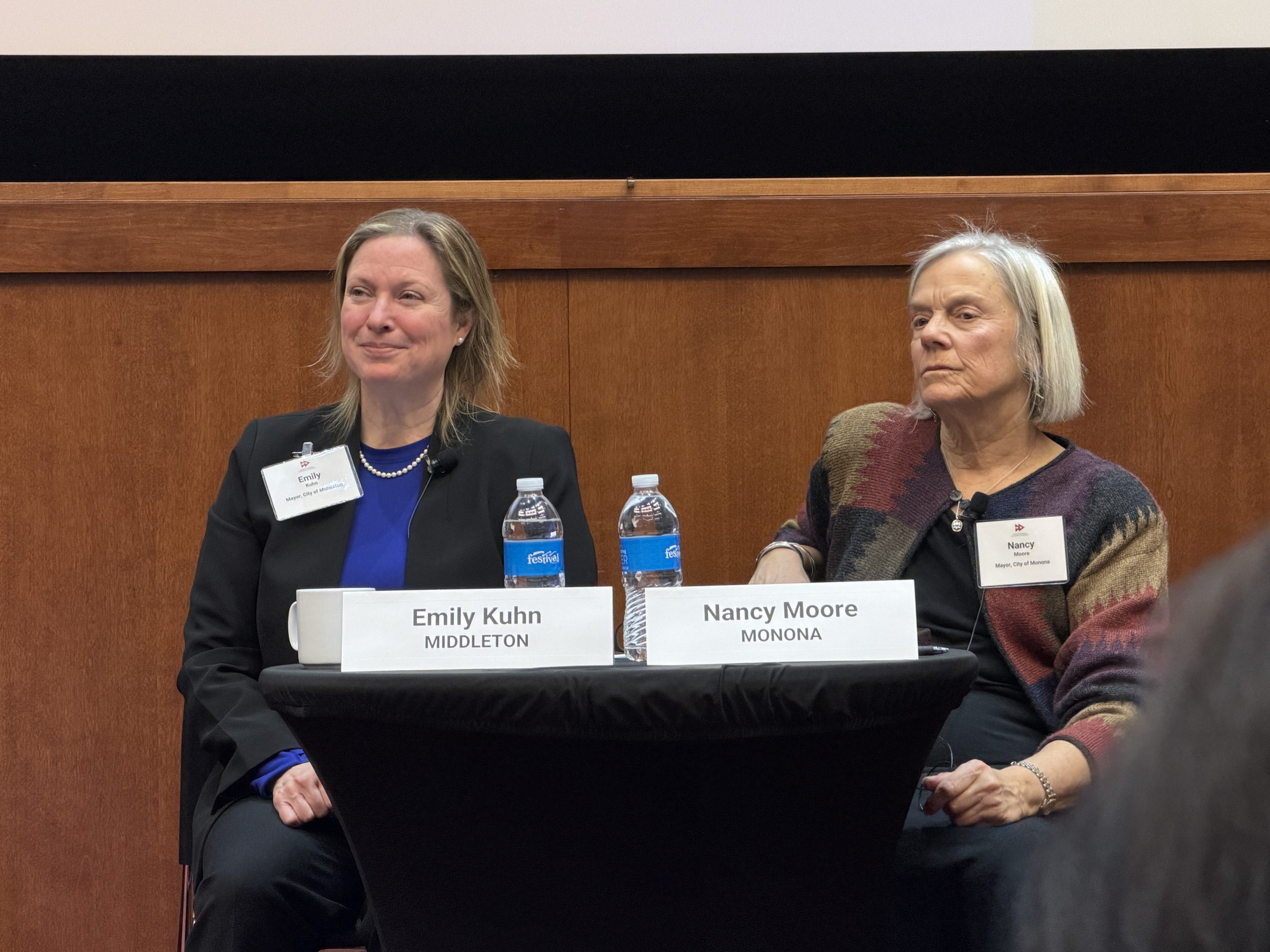
Middleton mayor Emily Kuhn said even if there is an opportunity to add housing, it can be a challenge to find where to put it. Kuhn said Middleton struggles as a “maturing” city on three sides. It runs into other towns and building new apartments or homes isn’t easy, she said.
From 2015 to 2022, Middletown was focused on building apartments before pivoting back to housing to provide single-family homes, which is what Middleton residents and future residents seemed to favor..
Kuhn said that an average of 10 single family homes were built per year over five years under prior leadership. Now, over 200 houses will be built a year for the next five years under her leadership.
“That will take up that (open) space very quickly,” Kuhn said.
Kuhn focuses on building housing densely along mass transit lines for bus access. She said people expect density there, but the growth needs to be smart.
Monona faces the same challenges with growth, choosing to grow up rather than out.
“Whatever (population) projection you subscribe to, either way it’s robust,” Monona mayor Nancy Moore said. “In my view, we probably shouldn’t go any faster than we’re going because it’s important that as we grow, we’re being cognizant of our stress and strain on infrastructure, city services, civic services.”
While capital improvement program plans reach five years into the future, Moore said the annual process needs to begin thinking a decade ahead so capital planning and comprehensive takes longer range information and direction into account.
Affordable housing
Kuhn said Middleton just released TIF funding, resulting in $10 million, with some of that going toward affordable housing.
Sun Prairie Mayor Steve Stocker said about $5.3 million from the delayed closure of some TIDs will go into an affordable housing plan. With the suburb only 13 square miles, they’ll look at smaller home lots, accessory dwelling units, townhomes and more to fill in housing. Much of that development will begin next year.
Meanwhile, Tim Swadley, mayor of Stoughton, said the suburb has set records for net next construction three out of the previous four years. But he sees issues with the state as a barrier, as more alternative funding sources and more local control are needed to enhance projects and communities.
“Wisconsin is at a point where we either pull together and move forward together or we will fall behind together,” Swadley said. “That’s on the state to figure out.”
An example he used is how state law prevents certain trails from being connected throughout the community, which helps with transportation, rideability and walkability. It seems small, but is a boon for building an attractive community, he said.
And a much larger issue brought up by Moore and the mayors: property taxes. According to the Wisconsin Policy Forum, a nonpartisan policy group, Wisconsin pays the seventh highest property taxes in the entire country.
“And has an incredible overreliance on property taxes to fund everything,” Moore said.
“A lot of people are very aware that our school systems are pinched by the state legislature, but less are aware that our municipalities are more than pinched by the same policies at the municipal level,” Moore said.
She said those property tax formulas need to change to help generate revenues as it has become more difficult to pay for a police officer and a library budget, and municipalities shouldn’t have to make choices between two important community assets.
Monona passed an operating referendum to make life easier and maintain services at a current level, but the property tax issue was one the mayors agreed needs to be figured out at the state level.
“Just an inflation increase,” Kuhn said, would help. “We’re not asking for change the formula to what it was decades ago. Just the inflation rate, like 2 or 3% growth.”
Current local issues
While the population growth rate presents many challenges ahead, the suburban mayors said there are numerous current issues affecting their constituents.
Verona mayor Luke Diaz pointed to expenses and tariffs.
“(It’s) frustrating to run a business,” he said. “To have the federal government basically act as a saboteur is very frustrating.”
As Verona has grown, it has built retail and commercial spaces, but since they’re new, they’re expensive.
“You do need some mid-grade or not expensive locations if people don’t have a ton of money,” Diaz said.
In Middleton, the business park doesn’t have any openings, and Kuhn knows of a business owner who has looked to buy a space for six years and come up empty handed. She said the suburb is looking to build a second business park.
Middleton also needs more hangars for planes at its airport.
“CEOs want to live within a short distance of the business and an airport,” Kuhn said. “We haven’t built hangers in decades.”
Moore said Madison has been lucky to have a diverse economy to insulate itself from any one specific woe compared to other cities who may only have a manufacturing piece. Madison has health care, technology and much more.
But she has still seen the loss of some small businesses as the economy worsens.
Uncertainty is another factor, according to Stocker. “The market is definitely hard to gauge,” he said. “Should we hire, not hire? Lots of outstanding, outside of the community factors. Labor costs are high. Cost of building is high.”
He said with tariffs, immigration and government shutdowns, it’s hard to tell how 2026 and future years will shake out.
Regardless, the mayors still seem upbeat. They get together once a month to discuss a lot of these issues and share ideas, challenges and solutions. The last meeting was at Kuhn’s home, where they had lunch, and tried to figure out how best to lead their suburbs.
And Stocker said they’re a resilient bunch, just like Madison.
“Regardless of what’s thrown at us, we will survive and continue to thrive,” he said.

