
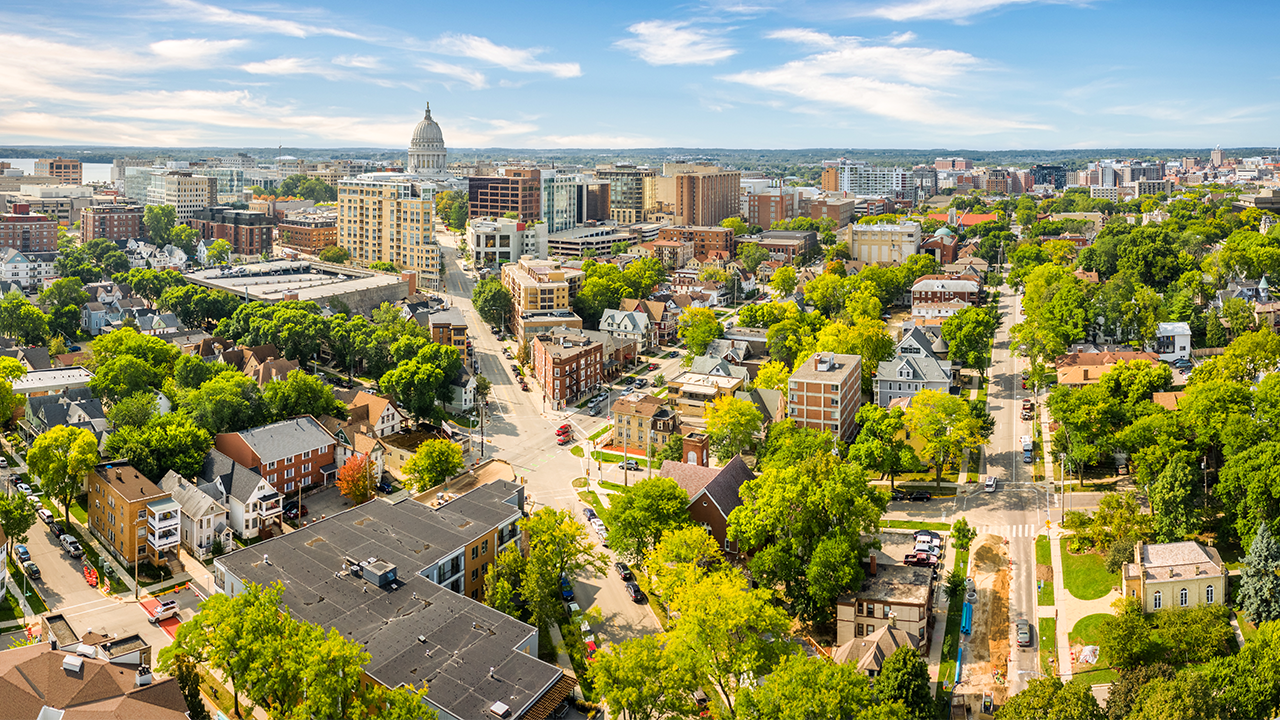
It’s no secret that Madison is changing. And so are its spaces. Whether it’s housing, office, retail, life science or industrial, as the city and its surrounding towns attract more people and grow, real estate is evolving alongside it, too.
Commercial real estate doesn’t often make headlines until something goes wrong: a major development is approved, an office building sits empty or a housing debate dominates a city council meeting. But behind nearly every conversation about Madison’s future is a quieter question: Where will people work, live and build next?
Those decisions are reshaping south central Wisconsin.
Whether it’s new life science labs, Class A industrial buildings, mixed-use developments, hospitality-inspired offices or the steady push for more apartment complexes, commercial real estate has become one of the region’s most important economic indicators.
It doesn’t simply respond to growth. More and more in the Madison area, it determines where that growth happens next.
How? Industrial buildings are competing on amenities and efficiency. Multifamily developments are expected to support broader workforce needs. Retail increasingly depends on creating experiences rather than simply transactions. Even older office buildings are finding new life as laboratories, medical facilities or apartments.
Commercial real estate isn’t simply where companies work anymore. Madison’s steady and diverse market is following industry clusters, not just available land. And the people shaping that market aren’t just building more space; they’re designing, financing and managing places around how people live.
In Business Madison spoke with architects, developers, brokers, economic development leaders, academics and property managers across the region to better understand where commercial real estate is headed.
While each sees the market from a different perspective, they consistently point to the same themes: population growth, industry-driven development, changing workplace expectations, a shortage of industrial land and increasing pressure to build communities, not just buildings.
Here’s what you need to know.
How is population growth reshaping commercial real estate?
Commercial real estate can mean many different things to different people. But it can be defined, according to Craig Stanley, founder and CEO of Broadwing Advisors, a local real estate consulting firm.
Anything greater than a five-unit apartment building is considered commercial, though Stanley puts residential and retail in their own subcategories. That leaves office, life science and industrial as the three major players in Madison’s market.
For Kevin Little, vice president of the Greater Madison Chamber of Commerce, nearly every conversation about commercial real estate starts with one thing: People.
Economic indicators across the region remain strong, Little said, fueled by continued population growth and a considerably diverse economy. Madison continues to attract employers in software publishing, biotechnology, pharmaceutical manufacturing, scientific research and advanced manufacvturing, industries that, in turn, generate demand for office space, laboratories, facilities and housing.
The challenge isn’t whether the region will continue growing. It’s whether infrastructure can keep pace.
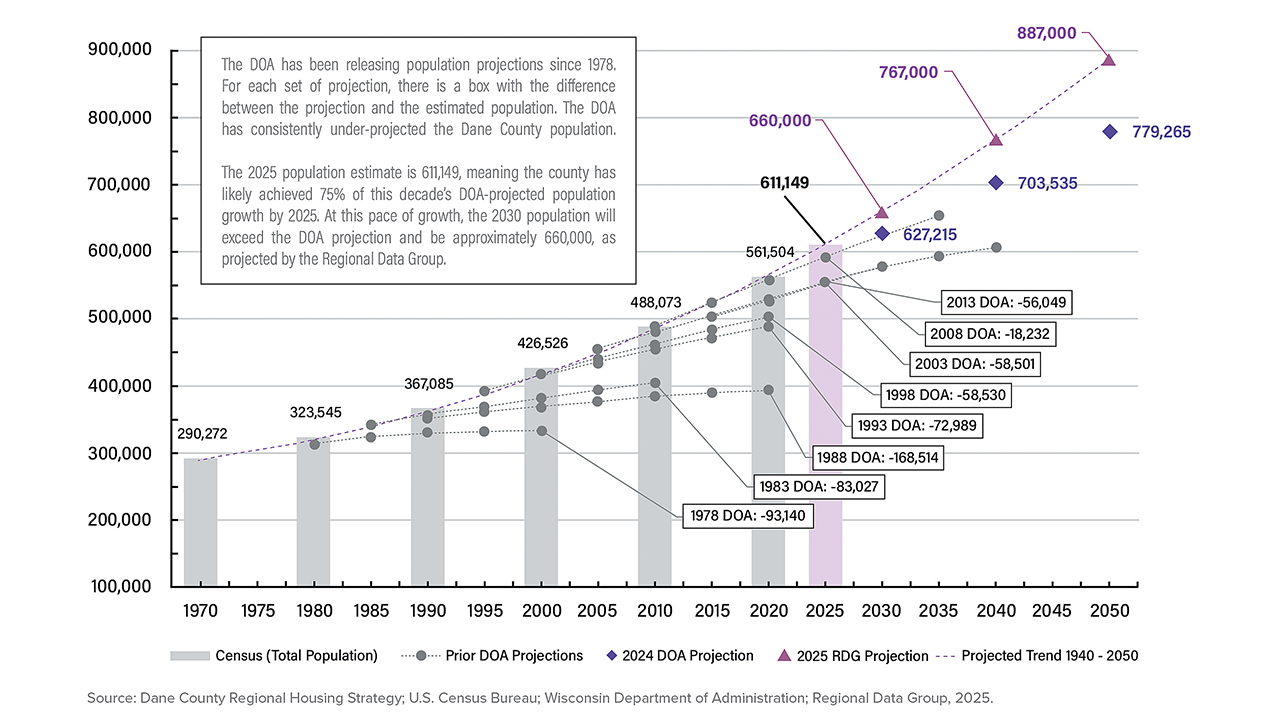
“From a local planning perspective, it becomes hard,” Little said. “If you know that these population numbers are under projected year over year, how can you actually create the right level of infrastructure?”
That concern is reinforced by new long-range projections from the Regional Data Group, a coalition of local planners, demographers and researchers. The group’s 2025 forecast projects Dane County will reach roughly 887,000 residents by 2050 — more than 325,000 additional residents compared with the 2020 Census and more than 100,000 higher than the Wisconsin Department of Administration’s current forecast.
Unlike the state’s demographic model, which relies primarily on age-based population trends, the Regional Data Group incorporates local housing development, employment growth and regional planning data into its projections.
Those numbers carry implications far beyond housing. It means finding more room for more people to work, research, manufacture goods and innovate.
That task is becoming increasingly difficult.
Industrial developers are pushing into communities like DeForest, Sun Prairie and Cottage Grove as available land inside Madison becomes scarce. At the same time, local governments face competing priorities over whether undeveloped land should become housing, commercial corridors or industrial parks. Over the past five years, data centers have become a larger part of that conversation, too.
Chase Brieman, senior vice president at commercial real estate services firm CBRE, has seen Madison’s market evolve for nearly 25 years. As a broker, he believes Madison’s market has been on a steady upward trend. He doesn’t anticipate that stopping anytime soon.
“Looking at the past several years, the outlook is positive. I don’t see Madison crashing,” Brieman said. “It’s been pretty much on a solid upward trend.”
So much so that his office is getting multiple calls every week from new clients looking for land to build on. The greatest obstacle is finding space.
“It’s been a challenge for a lot of those groups — they end up leasing a building from a developer who has the land, or doing nothing, or they go elsewhere,” Brieman said.
“There’s just not enough space that meets their needs.”
Why is Madison outperforming other markets?
Commercial real estate rarely operates in isolation. Office demand depends on employment. Industrial growth follows manufacturing and logistics. Retail succeeds when new neighborhoods fill with residents. Together, those sectors help explain why Madison has weathered economic shifts better than many peer cities.
“It’s healthiest to have a mix of commercial, industrial and housing,” said Chris Caulum, vice president of commercial brokerage at Oakbrook Corporation. “If you have all housing, then the tax base is concentrated on homeowners. If you spread it to retail, office and industrial, it really helps everybody.”
That balance has become one of Madison’s biggest competitive advantages.
Unlike many metropolitan areas that rely heavily on one dominant industry, Madison’s economy is supported by a broad mix of employers, including state and federal government, the University of Wisconsin–Madison, health care systems, insurance companies, agriculture, manufacturing and a growing technology sector.
“We are very lucky in the diversity of our economy, and that’s why we’ve done so well,” said Stanley at Broadwing.
That diversity has helped insulate the region from the sharp swings experienced elsewhere.
San Francisco’s office market is heavily dependent on tech and took a hit when employees moved to a hybrid model, Stanley said. That’s common in coastal cities — “their downs are really down, but their ups come back fast,” he continued.
“We’ve been much more stable and secure,” Stanley said.
Industrial real estate continues to be one of the region’s healthiest property types, driven by steady business expansion and tight available inventory. That limited vacancy has created competition for both existing buildings and development sites, prompting developers to expand business parks toward communities surrounding Madison as available land inside the city becomes increasingly scarce.
Life science tells a different story. Madison remains one of the Midwest’s leading biotechnology hubs, but recent growth has been constrained less by demand than by financing.
“Life science has been really capital driven,” Stanley said. “And capital markets have been very quiet the last 24 months.”
As venture capital funding slowed nationally, many smaller biotechnology companies delayed expansion plans or struggled to raise investment, even as larger, established firms continued moving projects forward.
Retail, meanwhile, continues to follow population growth.
That relationship has become increasingly visible across Dane County, where new housing developments have been accompanied by grocery stores, restaurants and neighborhood services designed to support expanding communities.
Taken together, those sectors create a market that does not depend on any single industry to carry the region through economic uncertainty. When one segment slows, another often continues growing, helping stabilize investment and attract outside capital.
“Having one of the most industry sector diverse economies in the country helps protect you from major economic swings — we’re seeing that reflected in where growth is occurring,” Little, with the Chamber of Commerce, said.
Is the office market making a comeback?
Nationally, many downtowns continue to grapple with high vacancy rates as employers embrace hybrid work schedules and reassess their real estate footprints. Madison, however, has largely bucked that trend.
While office demand dipped during the pandemic, the local market has steadily recovered, according to Brieman. But the market is fundamentally different than it was before COVID.
“Everyone thinks the office market is dead, but it’s not,” he said. “Madison’s doing, frankly, really well. It’s outpacing a lot of the peers, especially the Midwest.”
Compared to life science and industrial spaces, however, Stanley with Broadwing Advisors said office space is “continuing to struggle” post-pandemic. That’s because 15% of workers are no longer in the office at all.
Stanley summed up the moment as “a weird, weird time” in Madison’s market.
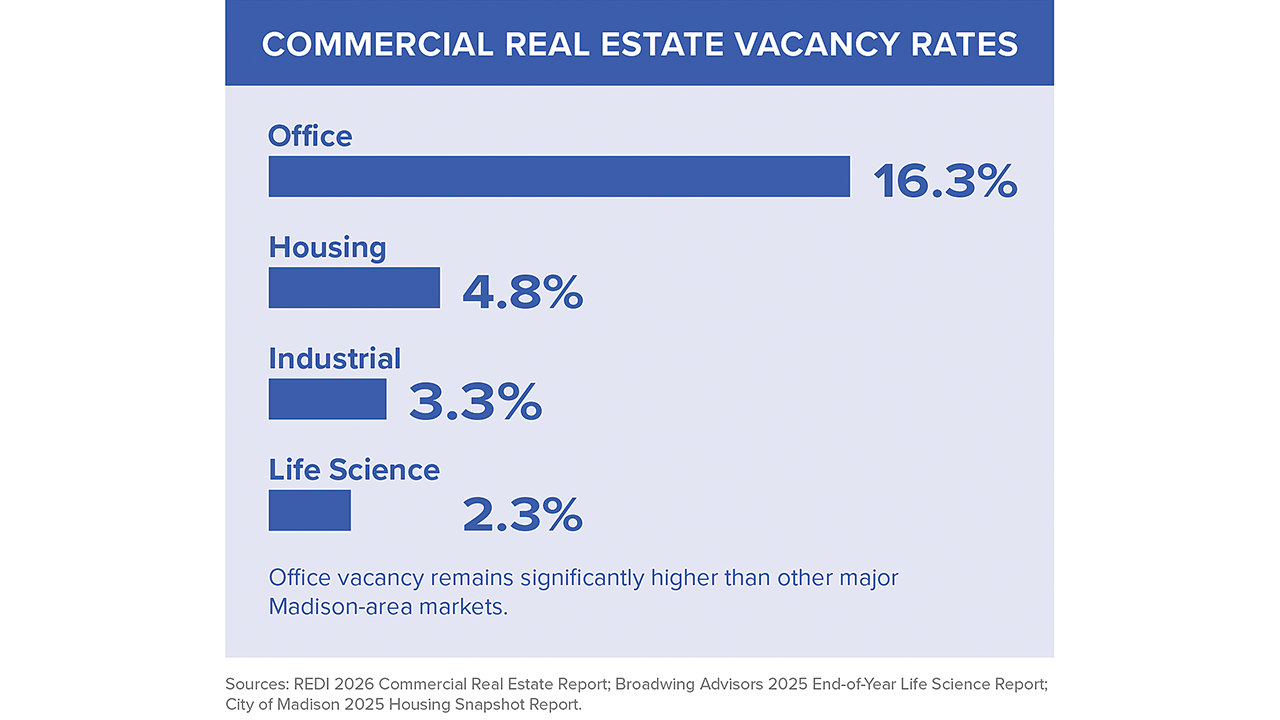
While he previously anticipated the office market would recover from COVID by 2027, meaning the vacancy rate is stabilized between 10% and 12%, as of August 2026, it sat at 16.3%. There has been some improvement since the start of 2026, but the market is still contracting as the city continues to draw new talent.
“I’ve been doing this for 32 years and I’ve never seen it like this,” Stanley said. “This downturn in the office market is the first downturn of office real estate when the economy still grew.”
Stanley contended it could be another five years before the market fully recovers, adding there is actually 800,000 fewer square feet of office space available today than Broadwing had tracked 8 years ago. And yet, jobs are growing.
“We’ve torn down a bunch of office buildings that were beyond their useful life. The market has actually contracted and we’ve had greater vacancy,” Stanley explained. “The question is: Will we continue to see the size of the market go down?”
Post-pandemic recovery hasn’t meant companies are returning to business as usual.
“It’s not like office goes away,” Stanley said. “It just gets recalibrated in different ways. The needs are changing.”
Instead of leasing larger offices, many employers are occupying smaller spaces while investing more heavily in quality.
Across the market, brokers describe a consistent shift as tenants move from older Class B buildings into newer or renovated Class A offices featuring collaborative workspaces, natural light and employee amenities.
Building owners have responded by adding conference centers, fitness facilities, golf simulators, coffee bars and other perks designed to encourage employees back into the office. Rather than viewing office space simply as a place to put desks, employers increasingly see it as a recruiting and retention tool.
Potter Lawson is Madison’s oldest architecture and interior design firm and has helped shape many of the city’s most recognizable landmarks, from Monona Terrace to Overture Center and University Square.
Those city-defining projects only come along once a decade or so, though, according to president and CEO Rebecca Prochaska. In between, Potter Lawson specializes in community-focused architecture.
“We live and work here, so our social pressure is different from our passion for design,” Prochaska said. “Right now, our biggest markets are in science and tech work, a lot of urban infill multifamily housing — and the office market is also actually bubbling back up.”
Instead of asking only how much space they need, companies are evaluating how offices help attract talent in an increasingly competitive labor market.
“If you watch the news the headlines say the office is dead. For a while, we were wondering if that was really true,” Prochaska said. “What we’re seeing in the last year or two is actually a shift in the importance of the office. We’re helping clients earn the commute of staff.”
That shift has fundamentally changed how companies approach workplace design. Instead of rows of assigned desks, new offices increasingly feature a wide range of tech-rich collaboration and meeting spaces, as well as work cafes that offer a different design vibe from workspaces.
“You need to have the spaces be more special than someone just sitting at home.” Prochaska said. “There’s so much capital trying to be invested in the market here and it’s manifesting for us in really exciting and creative projects.”
That doesn’t mean every office building has found new life.
Older buildings with outdated layouts and fewer amenities continue to struggle, particularly those that require significant renovations to remain competitive.
“We’re seeing more people buying office buildings that are empty, knocking them down and building a new apartment building on that site,” Brieman said. “There’s probably been over a million square feet of buildings that have been taken down in the last couple years.”
Those demolitions have helped stabilize the office market by reducing its overall inventory. As older buildings leave the market, vacancy rates remain relatively healthy despite hybrid work continuing across many industries.
Brieman recently worked with a California software company that opened its first Wisconsin office — not because executives relocated, but because the company had hired so many remote employees living in Madison that they wanted a shared workplace.
To Brieman, it reflects a broader shift in how companies think about offices. Rather than abandoning physical workplaces altogether, many organizations are reimagining what those spaces should accomplish.
Why is industrial real estate leading the market?
If office space has adapted to changing work habits, industrial real estate has experienced the opposite challenge: not enough space to meet demand.
Nearly every commercial real estate professional interviewed for this guide pointed to industrial as Madison’s strongest-performing property sector. Vacancy rates remain among the lowest in the Midwest, hovering around 3% to 4%, even as developers continue adding new buildings.
“It’s a very, very tight market,” Caulum, with Oakbrook, said. “There’s just not many options.”
Industrial users include manufacturers, warehouses, logistics companies, distributors and businesses that require production or storage facilities. With Madison pushing up against its limits on available industrial-zoned properties, Caulum said he is seeing more and more of those buildings moving to the farther-out suburbs, specifically DeForest, Cottage Grove and Sun Prairie.
Other communities like Middleton and Fitchburg are not as willing to grow their industrial footprint, Caulum said. Some of that resistance is physical — not all land sites are suited to industrial. The ground must be fairly flat without ridges or elevation change.
Other times, resistance comes from the community.
“Very few of these municipalities seem to be planning for new industrial…and they should be,” Caulum said. “If you have a single-family neighborhood and then you plan for industrial development right next to it, there can be a lot of resistance. McFarland went through that recently.”
As Madison’s economy has diversified, both new and old companies have continued expanding, creating sustained demand for industrial buildings of nearly every size. Speculative developments — projects built before tenants are secured — have become increasingly common, particularly for larger Class A facilities. Those buildings feature higher ceilings, larger loading docks, improved energy efficiency and flexible layouts that accommodate modern manufacturing and logistics operations.
Although they command higher rents than older industrial properties, brokers say demand has remained strong.
“There are at least three new buildings starting this year,” Brieman said. “Generally, within 12 months, the buildings are full.”
Not every business, however, needs or can afford a new Class A building. Older Class B industrial properties continue attracting smaller manufacturers and local businesses seeking functional space at lower costs. But even those buildings are increasingly difficult to find. Many of the remaining vacancies consist of obsolete facilities that no longer meet modern business needs.
“Office buildings themselves are being torn down in favor of other uses, or as they lose tenants, they’re becoming less valuable,” Caulum said. “To counter that, communities should look at planning for more industrial.”
For growing companies, finding available space has become something of a waiting game.
Rather than responding only to buildings currently on the market, brokers increasingly monitor businesses’ future expansion plans, anticipating which properties may become available months before they’re formally listed.
“It’s sort of like musical chairs,” Brieman said. “Somebody moves, somebody else takes their space.”
When no existing building meets a company’s needs, businesses face difficult decisions.
Some continue leasing until an ownership opportunity becomes available. Others pursue greenfield developments, constructing facilities from the ground up despite rising construction costs.
Stanley calls this phenomenon the capital gap, and he says it is one of the market’s most significant challenges.
Tenants who are leasing space are spending more money on their real estate than they ever have. Then, more costs are pushed onto them to retrofit a space that may need to be upgraded to today’s standard or to what employees expect.
“It kills deals,” Stanley said. “People go out and look for real estate and say, ‘I want to move, I want to move,’ and they get the price tag and go, ‘I’m not moving.’ That capital gap of moving and relocation and retrofitting an existing space is the biggest challenge users see today.”
Is life science the next commercial real estate powerhouse?
For more than 50 years, the commercial real estate industry has been dominated by what Jacques Gordon, director of the Graaskamp Center for Real Estate at UW–Madison, calls the “four food groups”: office buildings, shopping centers, industrial properties and rental apartments.
Those categories still make up the bulk of the market. But over the past decade, Gordon has watched a growing number of specialized sectors emerge alongside them — including life science and data centers.
Gordon calls these sectors nontraditional real estate. He doesn’t expect it to stay that way for long.
“The niches have grown so big that you can’t use the word niche anymore,” he said.
Life science is one example. Data centers are another. Both have become increasingly attractive to investors as demand for specialized facilities grows.
Little, with the Greater Madison Chamber of Commerce, points to the region’s concentration of companies and research institutions working across health care, technology and manufacturing. Among the area’s growing industries are medical diagnostic laboratories, pharmaceutical and medicine manufacturing, scientific research and development and software publishing.
Madison has the highest concentration of software publishing jobs in the country, Little said, while the region’s broader biohealth ecosystem brings together health care providers, researchers, manufacturers and technology companies.
“We’ve long said that if you are working to solve a problem in healthcare, there’s no better place to be,” Little said.
Brieman said funding constraints have caused some companies to pull back on expansion and new facilities in recent years. But he sees signs that the market is beginning to turn.
“There’s very little vacancy, like almost none, for life sciences,” he said.
That shortage is pushing companies to look beyond purpose-built laboratory space. In Madison, some life science users are moving into former office and industrial buildings, gutting and converting them into laboratories.
For companies racing to bring a product to market or begin research, the economics can make sense even when the upfront investment is substantial.
“They’re more willing to spend a lot of money on an existing building than they are to totally start from scratch,” Brieman said.
Little pointed to the conversion of former office and warehouse space into laboratory space, including a Fujifilm project, as one example of how Madison’s real estate stock is adapting to the needs of emerging industries.
The trend illustrates a broader shift in commercial real estate: Growth in specialized industries doesn’t necessarily mean more ground-up construction. It can mean finding new uses for the buildings already in the market.
“These specialized areas are where a lot of capital is flowing and a lot of demand is,” Gordon said. “These are huge industries now that together attract as much capital as the traditional food groups combined.”
What’s next for commercial real estate?
If there is one lesson the Madison commercial real estate market has learned over time, Gordon says, it is that fundamentals still matter.
“When the industry takes its eye off of supply and demand, it makes big mistakes and it misallocates capital,” he said. “As a fundamental practice, remember that supply and demand tend to win out. Maybe not on a year basis, but over a 10-year basis.”
For Madison, that long-term perspective has translated into a relatively measured approach to growth.
“We are a conservative community that doesn’t get out over our skis,” said Stanley of Broadwing Advisors. “We don’t get out over our skis, so we don’t tumble.”
That restraint can frustrate businesses looking for more space or developers hoping to move quickly. But Stanley said Madison’s tendency to avoid overbuilding has also helped the market weather downturns.
Looking ahead, Stanley expects that measured growth to continue across much of the commercial real estate market. Industrial properties, he said, should see steady expansion, with periods of stronger activity followed by plateaus rather than dramatic surges.
“We’re not a community that goes gangbusters on anything,” he said.
He expects the office market to improve gradually as well, supported by Madison’s broader economic strength. Life science may take longer to rebound, particularly until capital markets become more favorable, although larger companies are likely to continue expanding.
That growth will bring another challenge — making sure Madison has places for workers to live.
Madison is changing quickly, said Potter Lawson’s Prochaska, and as new development reshapes the city, growth needs to be accompanied by housing that is thoughtfully designed and accessible. Ultimately, she believes successful development has to account for the people who will occupy the spaces being built.
“With all the innovation happening here, you do have to match it with housing so they can get here and live,” she said. “We love the excitement around Madison, but we also have to do it right. That piece is tricky.”

