
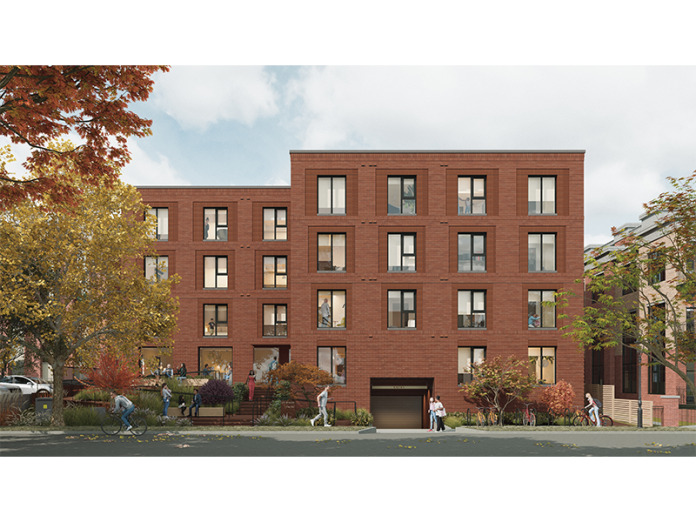

In the heart of downtown Madison, a new construction project is challenging conventional building methods while addressing urban housing needs. Madison native Nate Helbach, co-founder and CEO of Neutral and not yet 30 years old, is spearheading the adoption of mass timber construction with his 517 W. Main St. project.
“This project is a rare example of ‘middle housing’ bringing gentle infill density to the urban downtown,” Helbach said in an email interview. “Historically, urban zoning in the United States prioritized either high-rise apartment developments or single-family home zones,” rather than focusing on medium-density housing.
The 517 W. Main St. development will include 33 rental apartments, ranging from studios to two-bedroom units, to downtown Madison’s housing inventory. The four-story building includes underground parking and will feature a café on the ground floor. Construction began in fall 2024 after the property was acquired earlier that year, and is expected to be finished in August.
Despite recent zoning changes across many U.S. cities aimed at promoting smaller multi-dwelling projects, few developers pursue these opportunities due to their complexity relative to their size, Helbach noted.
“Neutral’s approach is unique because it’s designing a scalable model to streamline the development process of middle housing,” Helbach wrote, “with 517 W. Main St. being the first example of this approach.”
The mass timber advantage
At the heart of this project’s innovation is the use of mass timber — a construction material that’s gaining momentum across the United States for its structural strength and environmental benefits.
“Mass timber refers to various engineered wood products made by laminating, gluing, nailing or doweling multiple layers of solid wood together to create exceptionally strong, precise and lasting building components,” Helbach said. “This technology enables the use of timber in tall buildings, making it a viable or even superior alternative to less sustainable structural materials like steel and concrete.”
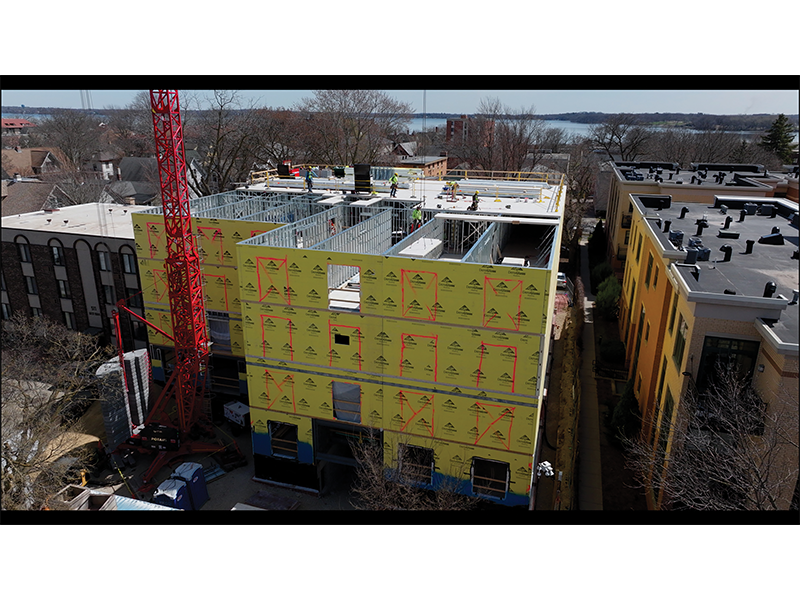
Mass timber construction was only recently adopted into the 2021 International Building Code under Type 4 construction. For the Madison project, Neutral is using cross-laminated timber (CLT) for floor slabs.
“Mass timber is known for its sustainability, as most manufacturers utilize wood from sustainably managed forests,” said Helbach. “It’s also gaining popularity in mid-rise and high-rise buildings, offering a high fire resistance level due to wood charring at a predictable burn rate.”
Helbach’s company was also involved in another local — and much larger — project that used mass timber. The 14-story Bakers Place, which includes 206 luxury apartments as well as retail space on Madison’s near east side, is now leasing
Standardizing development
What makes Neutral’s implementation particularly innovative is its uniform approach to design and construction.
“Neutral is standardizing the design of the floor layouts in order to balance the quality of the environment with repeatable dimensions and building components,” Helbach said, “reducing the complexity of the structure and allowing (us) to streamline the design, procurement and construction process.”
This standardization involves using mass timber panels with consistent dimensions alongside prefabricated steel walls. The components are manufactured in controlled factory settings and delivered to the construction site ready for installation.
Versatile construction material
Rather than entirely replacing conventional construction methods, mass timber is an option within the developer’s toolkit.
“Mass timber is a novel, yet rapidly growing in popularity construction material in the United States,” Helbach said. “It may be used together with conventional building materials or (as) a substitute.”
The versatility of mass timber extends beyond just residential applications. While the 517 W. Main St. project uses CLT panels for floor slabs with steel prefabricated walls, other Neutral projects take different approaches.
“In other projects, like Neutral 1005 N. Edison St. in Milwaukee, both floors and structural columns are made from mass timber with only a thin concrete topping,” Helbach said.
This adaptability makes mass timber suitable for various building types, including office, educational, public, airports and even industrial buildings.
Environmental and practical benefits
Perhaps the most compelling benefit of mass timber construction is its environmental impact. Wood is a renewable resource that, when harvested responsibly, can help reduce atmospheric carbon. As trees grow, they sequester carbon dioxide; when that wood is used in construction, the carbon remains locked within the building structure rather than being released into the atmosphere.
Additionally, the manufacturing process for mass timber products generally requires less energy than producing concrete or steel, reducing the building’s carbon footprint. The standardized approach also yields practical benefits. By designing repeatable floor layouts and using consistent component dimensions, Neutral can reduce construction complexity while maintaining high-quality living environments.
As Madison and other Wisconsin cities address housing shortages and sustainability goals, Neutral’s approach to mass timber “middle housing” offers a potential path forward. By combining sustainable materials with efficient, standardized construction methods, developments like 517 W. Main St. can provide a blueprint for how cities can grow responsibly.
With construction underway and completion expected later this summer, Madison’s downtown will soon showcase how traditional building materials and contemporary construction techniques can come together to create housing that serves community needs and environmental goals.

