
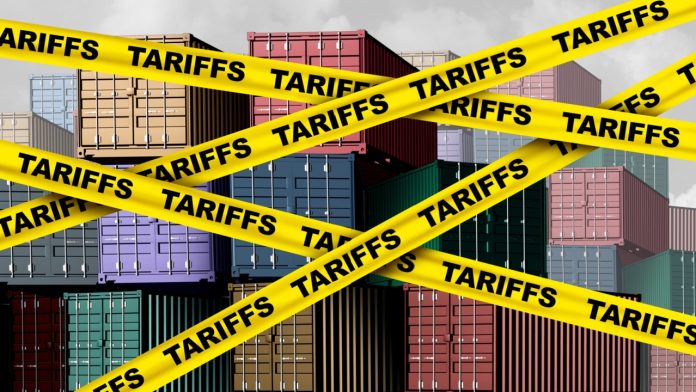

As President Donald Trump carries out his plans for a 20% tariff on China — and levies on steel and aluminum in Canada, Mexico, and European countries ignite trade war talk — local businesses in Madison and Dane County are bracing for the fallout.
These tariffs, which function as taxes on imported goods from abroad, will likely saddle both businesses and consumers with higher prices, despite Trump’s claims that foreign countries will shoulder the burden.
The effects could be felt in a range of industries, from fruit in the grocery store to phones made in China or home improvement supplies like Canadian lumber. Nearly every field will be affected to some degree, according to Kurt Bauer, president of Wisconsin Manufacturers & Commerce, the state’s chamber of commerce and largest business trade association.
“It is fair to say that most businesses are concerned with the unknowns of ‘tariffing’ Canada and Mexico, Wisconsin’s one and two largest trading partners,” Bauer said. “There will be unforeseen consequences.”
Unlike previous tariffs by the last Trump administration, this round is likely to affect consumer goods directly, including smartphones, home appliances, and even toys, according to Jon Pevehouse, an international relations professor at the University of Wisconsin–Madison.
“It’s going to be across the board — everything. That makes it a much higher probability that the average consumer and the average business is going to feel those tariffs much more directly,” Pevehouse said.
He highlighted that businesses will ultimately face a choice: Pass increased costs onto shoppers or choose to eat the tariff, potentially hurting their bottom line or the rate at which they can hire or retain employees.
And businesses that rely on agricultural imports could face real trouble, because unlike toys or consumer goods, there are few alternatives.
“For people who are directly dependent on those level one consumer goods, like agriculture products, they’re going to face direct increases, potentially no other supply and so that is really going to eat into their profits or they’re just going to pass those costs on,” Pevehouse said. “Certainly those types of businesses are going to be on the front lines of this.”
Which industries will be most affected?
Businesses across various industries are preparing for higher costs, especially those reliant on international goods, like manufacturers using precision parts from China and construction firms that depend on Canadian lumber. Trump announced sweeping tariffs on foreign steel and aluminum in early February, imposing a 25% tax from all countries.
Additional tariffs on imports from Canada and Mexico will go into effect on March 4, Trump announced Thursday, and China will face an extra 10% tariff on top of the 10% imposed earlier in the month.
In the aftermath, targeted countries have threatened to retaliate, fueling concerns of inflated economic markets and strained relations with major U.S. allies. The cost of groceries and gasoline is already on the rise nationally, with the consumer price index spiking 3% in January from a year ago, a Labor Department report states.
If fully implemented, tariffs could cost the average American household approximately $1,200 per year, according to a report from the Petersen Institute for International Economics.
Here at home, retailers are also preparing for potential price hikes.
“Two-thirds of vegetables consumed in the United States come from Mexico, and (tariffs on) those are going to go up 25%,” Pevehouse said. “A lot of gasoline is made from Canadian oil, and (when) tariffs go into effect, those costs could be passed directly onto consumers.”
The auto industry, which heavily integrates supply chains across the U.S., Canada, and Mexico, could also face serious disruptions, experts warn. If tariffs make it more expensive to source parts from abroad, vehicle prices may climb, hitting both consumers and auto manufacturers in the region.
WMC’s Bauer warned that supply chains are particularly vulnerable now, with manufacturers that rely on foreign components or raw materials looking at more significant disruptions. Increased costs may force businesses to seek new suppliers, though finding viable alternatives can be time-consuming and costly, if possible at all.
Local businesses are responding in different ways, and not all are against tariffs.
According to a recent WMC survey, 86% of Wisconsin business leaders support tariffs on China, citing concerns over unfair trade practices. However, the support weakens when it comes to tariffs on Canada and Mexico, with 56% opposing steep 25% tariffs on imports from America’s neighbors.
“Wisconsin is a manufacturing and agricultural state,” Bauer said. “We make, grow and process things and we want to sell them around the world. But business leaders are saying that we need our trading partners to play by the rules.”
Businesses navigate uncertainty
In Dane County, small businesses are feeling the uncertainty and instability of the economic landscape.
Anthology, an arts and crafts store on State Street, is not yet seeing any effects of tariffs but hastened delivery on a handful of orders from Canadian artists and Chinese vendors in order to get them before tariff prices took hold. For the goods from China, co-owner Laura Komai said the store may have to put a hold on any future orders.
“It’s a little too early for us to tell what the effects will be. Although most of our goods come from the U.S., the global market is such that some of our artists may get supplies from countries affected by tariffs and we might see price increases because of that,” Komai said.
Ken Monteleone, owner of Fromagination, a specialty cheese shop on Madison’s Capitol Square, is remaining focused on Wisconsin business. He said his business won’t be immediately affected since he primarily sources from Wisconsin and the Midwest. However, he noted that tariffs could eventually affect the availability and cost of imported cheeses from Canada, Italy, and France.
“I always go back to what we can do in our community to make sure that we are taking care of things without having to become heavily reliant on what this administration might do,” Monteleone said.
Before Fromagination, Monteleone was a shoe buyer for national brands. If he was still in that line of work, he would “really be concerned,” he said.
UW’s Pevehouse suggested that Trump’s tariff strategy may be more about political leverage than trade policy, a broader negotiation tactic aimed at immigration and border security rather than strictly economic issues.
“Ultimately, I really do think this is a bargaining game with Trump,” he said. “He campaigned on bringing inflation down, and this is going to do the exact opposite.”
As businesses and consumers in Dane County navigate the uncertainty surrounding tariffs, one thing is clear: the economic landscape is shifting.
“Things are changing,” Monteleone said. “There is so much chaos being created right now. You don’t know what to believe and how to respond at this point.”

