

If the COVID-19 pandemic has you wishing you could get as far away from 2020 as possible, you’re probably not alone. But while no one can make time go faster, there is a new opportunity to put miles between yourself and whatever’s passing for life these days on earth by taking to the skies.
Traditionally, there are two ways of becoming a commercial pilot — the first is the military and the second is attending a four-year flight school like Embry Riddle. That’s changing this fall, as Madison College and Wisconsin Aviation are teaming up to offer a new fast-track program to become a professional pilot in just 21 months. The flexible program is meant for everyone, whether you’re in school, working, or thinking about a new career opportunity.
Dr. Chris Johnson, the program architect for Madison College’s new Professional Aeronautics Certificate (PAC), notes Wisconsin Aviation has been trying to partner with Madison College for many years, but the right people needed to be put in place to design the program, which was built to incorporate the structure of a traditional two-year collegiate program with the flexibility to allow students to pursue any degree they choose and/or maintain part-time jobs while in school.
“Time to employment is a critical factor for anyone seeking to become a professional pilot,” says Johnson. “Military pilots typically spend a couple of years in training, then stay in the military for about four to six years total before getting into civil aviation. Likewise, traditional collegiate programs require two or four years of full-time commitment, while ours is only 21 months of half-time commitment. That is attractive to many students, and it allows us to be very competitive on price, as well.”
In fact, the most significant limitations to becoming a professional pilot are cost — both time and money — and aptitude, explains Johnson. Not everyone has the cognitive aptitude, discipline, and/or determination to become a professional pilot. Likewise, it costs a lot of money to operate aircraft, so financial stability is a must. The Madison College/Wisconsin Aviation program is estimated to cost $65,000 over 21 months, which is considerably less expensive than some of the most competitive academies and two- and four-year programs that cost well over $100,000.
After graduation, Johnson says professional pilots without military experience typically work at flight schools training other students while gaining the flight experience required to meet minimum qualifications for the Airline Transport Pilot (ATP) rating, an FAA requirement for scheduled air carrier pilots and corporate aviation departments operating jet aircraft.
The Wisconsin Aviation Flight School will look to retain a good percentage of its graduates for training subsequent classes of student pilots enrolled in the program, notes Johnson. Based on national averages, flight instructors can expect to earn between $30,000–$35,000 per year plus benefits. Once employed with a regional carrier as a first officer, one can expect to make $60,000–$65,000 per year and $80,000-plus upon advancing to captain. Pilots working for major air carriers like American, Delta, United, and Southwest can expect to earn over $100,000 per year, with senior captains earning well in excess of $200,000 annually.
Those aren’t hollow numbers either. Students completing the PAC program can expect to have jobs waiting for them on the other side. Before COVID-19 shut just about everything down and severely limited air travel, there was a pilot shortage crisis in 2019 and previous years. As baby boomer pilots have retired, there hasn’t been as rapid an influx on new pilots to replace them, even as there has been an overall increase in global demand for air travel to support a global economy. That demand is expected to return by 2022, explains Johnson, just six to 12 months before Wisconsin Aviation Flight School graduates will be eligible to be hired by professional flight organizations. The timing couldn’t be better.
“The PAC program is a 21-month, 20-hour per week commitment that includes ground courses and flight training for private pilot certification, instrument flight rating, commercial pilot certification, and instructor ratings that set them up for a professional flight career,” Johnson says. “Taking only one course per semester for two academic years (21 months) allows students to do whatever they want for the remainder of their 20- to 40-hour work week, and this is the key differentiator, especially in light of the COVID-19 pandemic that has virtualized a lot of work and education.
“Graduates will be able to begin their career a full two years before graduates of competing four-year programs,” Johnson continues, “and students will spend far less money on their training and roughly one-fourth of the amount of time in school before getting hired, which is attractive to most students. Our goal is to build a fleet of 50 aircraft in the next five years, which will support flight training for about 300 students simultaneously.”
Program highlights
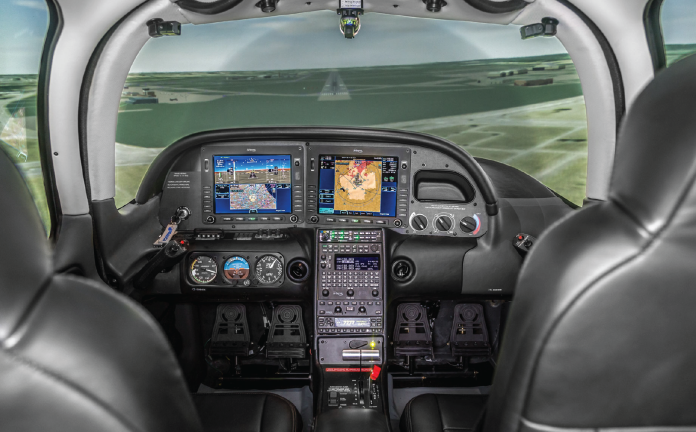
Ground school will be virtual through Madison College until COVID-19 restrictions are lifted, allowing for classroom attendance. Flight school will be conducted in person at Wisconsin Aviation in Cirrus SR20 aircraft.
According to Johnson, the SR20 is one of the most advanced trainers on the market, originally built in Wisconsin. “Flight training is an essential business to maintain our global economy. In fact, Wisconsin Aviation has been actively training pilots throughout the pandemic without a single reported case of COVID-19, and this is because they incorporate proper social-distancing and disinfecting protocols.”
Wisconsin Aviation Flight School graduates will earn the same FAA licenses and log the same amount of flight hours as students in other collegiate flight programs. Johnson says the active seasonal weather in Wisconsin produces challenges and quality flight hours that can’t be experienced by students learning to fly in places like Arizona, making students here better prepared upon graduation.
The program operates on a fast track, but that doesn’t mean it’s less safe than competing programs, notes Johnson. “Considering the fact that military pilots are routinely certified in some of the most advanced fighter jets in about two years, we feel that the 21-month, two academic-year timeline is just right. In fact, some flight schools run six- to 12-month academies, which is quite an aggressive timeline for earning all of the licenses required to be a professional pilot.
“We are teaching the same material to the same federal standard that all professional pilot programs in the United States are required to teach according to the federal aviation regulations,” continues Johnson. “Our pilots will be licensed by the Federal Aviation Administration just like the graduates of competing programs. There is no difference. All pilots begin as private pilots before moving on to earn instrument ratings to fly in the clouds and low visibility weather conditions. A commercial license involves learning about more advanced aircraft systems and procedures, and instructor pilots are required to learn how to teach while flying from the right seat. We’ve simply implemented a known training model that has been successfully deployed across the country for many decades, and we built ours to incorporate advanced trainer aircraft that will make our graduates highly sought after.”
Currently, the Wisconsin Aviation Flight School program is being capped at 30 students, so people who are interested should sign up as soon as possible. More information on the program is available at wisconsinaviation.com/professional-aeronautics-certificate.
Click here to sign up for the free IB Ezine — your twice-weekly resource for local business news, analysis, voices, and the names you need to know. If you are not already a subscriber to In Business magazine, be sure to sign up for our monthly print edition here.

