

Glossary
| Cacao | Raw and less processed (at a lower heat), cacao beans are turned into cocoa and then chocolate. Cacao provides more health benefits due to being less processed.
|
| Cocoa | When cacao is processed, often into a powder, it is cocoa. It has more sugar and is not as bitter as cacao, but loses some of its health benefits.
|
| Cacao nibs
|
Pieces of crushed cacao seeds in their natural form.
|
| Chocolatier
|
An artisan who creates and sells chocolate and chocolate confections like truffles or turtles.
|
| Ganache
|
Chocolate and hot cream combined, ganache is used in truffles and as a glaze, frosting or filling.
|
| Turtles | Chocolate confections made with pecans and caramel. |
Paul Beloungy of Paul’s Chocolates in Sauk City considers himself a little bit lucky in the chocolate business.
He doesn’t have a storefront and only makes truffles, caramels and turtles. He hires three people for contract labor for a few hours a week when he needs it.
But even he isn’t immune to the cost of cacao and cocoa.
In September, Beloungy purchased his regular 11-pound block of Swedish chocolate to use in his products. It had cost him $67 for a long time.
Then suddenly it was $120, nearly doubling in price.
“That’s the frustrating part,” Beloungy said. “You don’t know until you go to order something. Almost every element of our business right now is just constantly an increase. You don’t have a warning.”
Cacao costs have a history of being volatile thanks to limited growing regions. A recent drought in West Africa and the effect of tariffs have led to a ripple effect where local businesses have had to raise prices more often than in years past.
Despite this, the Madison area’s sweet tooth remains. Shoppers are buying enough chocolate to not only keep chocolate purveyors in business, but prompt record sales.
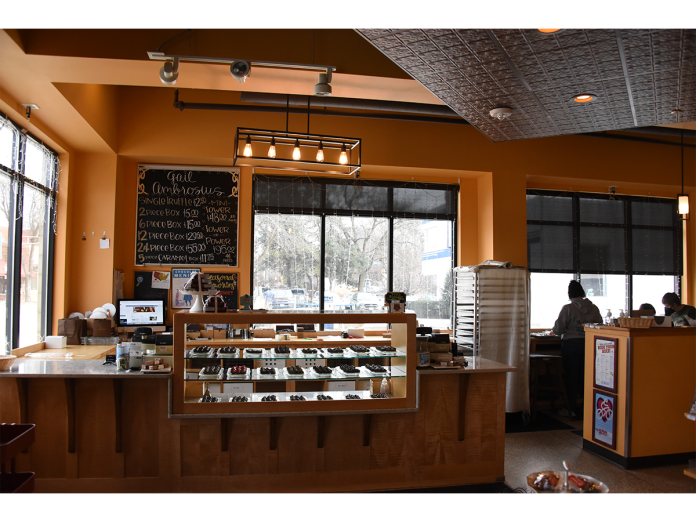
Isaac May, co-owner and general manager of Gail Ambrosius Chocolatier in Madison’s Atwood neighborhood began seeing a line item for tariffs tacked on to chocolate orders in April 2025, bringing the price of chocolate up $1,000-$3,000 on orders already costing five figures.
Infusion Chocolates at 2503 Monroe St. experienced a 20-40% increase in chocolate in July of 2024, and another 20-30% increase in July 2025 across the board for chocolate from its supplier. The company’s drinking chocolate has risen from $140 for a five kilogram tub to just over $200, leading to an increase from $9.95 to $12.95 for a bag.
Meanwhile, Candinas Chocolatier in downtown Madison reported a 20% increase in raw material costs last year, in addition to having to pay 39% tariffs on chocolate from Switzerland.
Although tariffs were removed for cacao in November, they still affect items like gift boxes. Plus, with droughts in parts of the world like Africa where cacao is grown, each chocolate maker expects prices to stay high, or continue to grow.
Truffle kerfuffle
Cocoa beans need a tropical climate to grow, making it infeasible for the U.S. to grow them at a commercial scale.
Places like Africa, Central America and South America provide much of the world’s chocolate. Ivory Coast and Ghana provide over half of the world’s cacao beans, according to Statista market research.
The year 2023 is cited as a big turning point for cacao prices when heavy rainfall was followed by a severe drought in West Africa, affecting Ivory Coast’s and Ghana’s production.
Though Gail Ambrosius Chocolatier only uses Central American and South American cacao beans, there was a ripple effect on the supply chain.
“It led Mars and Nestle to buy chocolate from other suppliers, and it sent them to Central and South America, which is where all of our chocolate comes from, and it just drove prices up like crazy across the board,” May said. “So we were seeing increases as high as double in per pound cost.”
Much like coffee, May said these unpredictable growing seasons were “thrown out of whack” from climate change and they lead to steep increases in costs. May recalls orders that would normally cost around $12,000 jumping to $20,000.
That volatility is standard for the chocolate business, but it weighs on chocolate makers.
Infusion Chocolates president Bob Caspersen said that is the most frustrating part of the chocolate business: there is no way to know what’s coming for price increases — not how much or when. Planning ahead is difficult.
“No one can really say, ‘Hey, plan for a 20% increase,’” Caspersen said. “I got a heads up (on cacao and cocoa prices) like three weeks before.”
One approach Caspersen said has helped was purchasing items like chocolate boxes before tariffs hit so prices didn’t need to increase.
Caspersen said Infusion Chocolates gets its boxes from overseas and made the switch from sourcing in China to South Korea. Still, the business is waiting on some inventory. Infusion has run out of four-piece boxes until they arrive from South Korea, but making it work.
Beloungy of Paul’s Chocolates has navigated challenges like suppliers unexpectedly shutting down. He works with Vanilla Bean, a Madison baking supply store, and it stopped selling two chocolate molds he had used for several years. Vanilla Bean told him the company that made the molds simply went out of business.
He’s also run into supplier issues with boxes for chocolates.
Yet even with the constant need to seek out new materials, not knowing when prices will increase and climate change challenges, chocolate makers in the area say sales continue to be strong.
Too popular not to sell
Americans eat nearly 3 billion pounds of chocolate per year, according to the Wells Fargo Agri-Food Institute.
Sales were up last year for Infusion Chocolates, which only raised its prices in September. Caspersen is unsure if that trend will continue with the rise in prices, but area chocolate purveyors interviewed said they haven’t seen a dip in sales from price and cost increases.
It could be due to the fact that chocolate makers seldom raise their prices, finding other ways to try and cut costs.
Paul’s has only raised its prices once in five years, raising them in 2025.
“All of our customers were extremely understanding,” Beloungy said, adding that when he finally sat down to look at rising costs, he realized, “Well, we’re almost doing this for free.”
May said Gail Ambrosius raised prices twice, once in 2023 and in November 2024, while also cutting back in areas like advertising and packaging.
Prices have gone up less than 10% overall there, but the shop’s flagship box of 12 pieces of chocolate rose 18% from $25 to $29.50.
May expects prices to stabilize this year with tariffs being removed. And he said customers wouldn’t see huge spikes in prices even if the cost of cacao continues to increase.
“We obviously can’t double our prices when the price of chocolate doubles,” May said. “It’s a slight price increase and just kind of tweaking our budget elsewhere.”
Even with the increases, May said Gail Ambrosius had some of its best years sales-wise recently.
“Despite the challenges, the support that we feel in the Madison business community has been incredible,” May said.
People want to support local businesses, and the chocolate companies have felt that.
“Things are going well despite it all, and you know, I hope that that doesn’t change,” Caspersen said.
What the future could hold for chocolate
Markus Candinas, founder of Candinas Chocolatier, takes a historical and philosophical approach when musing what chocolate might look like this year and in the future.
He said some popular chocolate items aren’t all chocolate, like Dubai chocolate, which is having a moment in the spotlight. Dubai chocolate pieces are made with chocolate, pistachios (which are also a pricier item), tahini and knafeh pastry.
He wonders if chocolate might move more toward creations like that, where other ingredients make up the sweet treat to account for increased cacao and cocoa bills.
“Chocolate’s expensive; Dubai-style chocolate is substantially not chocolate,” Candinas said. “So it’s a pretty attractive product to start promoting. It’s a great confection. And it’s a great alternative to chocolate.”
And Candinas wonders what will happen to chocolate as other markets in countries across the world mature, like China, which has seen a boom in its chocolate market. With cacao so limited and desired, he sees the business of chocolate continuing to be unpredictable and difficult.
Candinas has been in the chocolate business since the 1990s, which is around the time that the Chinese chocolate market began to take root, and he said he has seen numerous challenges over the years.
“We can’t just assume that we’re the only ones that are going to consume this product that has a limit to how much can be produced or is being produced,” he said.
But despite the challenges, chocolate is a popular commodity, making it a pretty conservative, stable business. It just seems as though the road bumps are arriving a little bit more than in most years.
“You have to always be thinking forward and be innovative and do something that others are not,” Candinas said.
And for others like Beloungy, the joy of making chocolate will keep him at it, even if he can’t find his favorite molds.
“I enjoy it as long as I can do it and still make a little money,” he said. “I’m going to keep doing it.”