
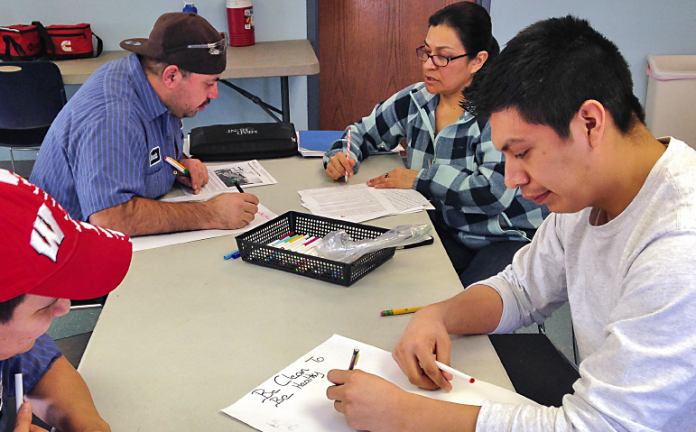

Native English speakers take their understanding of the English language for granted. They don’t often think about the doors that would be closed to them if speaking and writing English didn’t come naturally.
It’s a barrier to personal economic growth and prosperity that many non-native English speakers face when they come to Madison, but the Literacy Network of Dane County is helping workers overcome it through its workplace literacy program.
While the Literacy Network also assists native English speakers with low literacy levels improve their skills, Jeff Burkhart, the organization’s executive director, says about 80% of its work is with non-native speakers.
The Literacy Network works exclusively with adults and over the past several years has helped more than 1,000 individuals each year improve their understanding of the English language. Among the local employers it contracts with are the Residence Inn and Marriott, along with the UW Health system.
Its workplace literacy program is unique because, while individuals can connect with the Literacy Network right off the street to improve their English skills for a wide variety of personal reasons — to feel more confident, to speak to their children’s teachers, to fill out health insurance or any other complex series of forms — students in the workplace program are specifically learning English skills to help them communicate better at their particular job and advance their station, not to mention bolster the company’s bottom line.
“When we’re working with employers we always make sure we have a very clear assessment of what their needs are, both from a management side and from the staff side,” explains Burkhart. We create very authentic curriculum based on the real needs of the employees. We’ve seen many employees grow in their responsibilities at work. Some of them have supervisory responsibility now and, of course, that means more pay, as well as more stable hours. This is a key to helping provide more security for these families and getting many people out of poverty.”
On-the-job training
According to the Literacy Network, one in seven adults in Dane County struggles with low literacy, though Burkhart notes that statistic is from 2003 and the current situation is probably worse. The challenge is real and it’s growing.
“I think if you ask employers what the biggest challenges are that they face moving forward, most employers will say finding the right people for the right jobs and literacy is definitely a component of that,” Burkhart says. “We need to make sure we have a workforce that’s prepared, trained, and supported in their goals in order to help the company meet its financial goals.”
The Literacy Network’s workplace program is designed to be much more than just a rote grammar class, Burkhart says.
“We have very experiential activities. A teacher might draw a grid of a city and we’ll say that my house is to the left of Juan’s house, and then have the students move a car on the board from one location to the next by following instructions in English. We also have the students perform particular tasks that they need to do on the job using real materials.”
(Conrtinued)
One of the companies the Literacy Network has worked with is Future Foam in Middleton, which recycles foam materials and puts them into new products. Burkhart says in classes for workers at Future Foam, instructors will incorporate the actual foam that the students use in the workplace and manipulate it using English language instructions.
“We’re not just teaching you English grammar, but we’re teaching you the basic skills you need to function on the job tomorrow,” Burkhart explains. “Students are learning the names of tools or procedures that they use on the job, so we’re very focused on the English language for that purpose.”
Burkhart notes the Literacy Network has worked with about 30 native Spanish speakers who wanted improve their English skills so they could be better staff members at Future Foam. In three years a number of those workers have moved into more supervisory roles and Future Foam received a statewide literacy improvement award.
That’s just one of many success stories.
Burkhart also notes a mechanic, a native Spanish speaker who owns his own business, who came to the Literacy Network because he wanted to learn all the parts of a transmission in English, in addition to working on his skills talking on the phone and writing an invoice in English, because almost all of his customers were Spanish speakers.
“He learned those basic skills in three different areas over the course of about a year, Burkhart recalls, “and he started to get more English speaking customers, he had to hire more people at his business, and he’s more busy than he’s ever been just because he worked on those three core skills.”
Win-win scenario
The Literacy Network’s workplace program is free to students, though it costs employers based on hours of instruction. They payoff is worth it for both parties, says Burkhart.
“The companies see increased productivity among the coworkers they have in the programs,” he says. “They have better communication within the company and more buy-in from the staff. And they can spend less time explaining things with a translator because we’re doing a lot of that kind of work in class. The employees feel empowered and like their employers respect them more because they’re able to converse with their coworkers. And they also feel like it’s a real honor that their employer is investing in them as employees.”
Burkhart notes the results from a recent longitudinal study done of about 1,000 people in the Portland, Ore., area who had dropped out of high school show the economic impact adult education programs like those offered through the Literacy Network can have on workers.
“The key finding over a 10-year period was that when people participated in adult education for at least 100 hours or more, on average their annual wages increased $9,621,” Burkhart says. “That’s huge. Many families in Madison and Dane County are really struggling to support themselves. A lot of our students are working two or three jobs at very irregular schedules and very low pay. They need a lot more support in order to reduce that cycle of poverty and illiteracy in their family so they can support their kids, get a good education, and move forward and get a good job.”
For more information on the Literacy Network and its workplace literacy program, visit www.litnetwork.org or contact Burkhart at jeff@litnetwork.org.
Click here to sign up for the free IB ezine – your twice-weekly resource for local business news, analysis, voices, and the names you need to know. If you are not already a subscriber to In Business magazine, be sure to sign up for our monthly print edition here.

