



A funny thing happened on the way to the recession — Greater Madison employers said thanks but no thanks — but while growth will always remain a challenge with a never-ending labor shortage, the continuing resilience of members of our Largest 100 Employers list is nothing short of remarkable.
As always, the list changes with each new iteration. UW Health, which is in expansion mode, has taken back the top spot over No. 2 Epic, the electronic medical records maker, which is in the midst of another growth spurt and campus expansion. Meanwhile, others keep making their mark on the innovation front, as evidenced by Exact Sciences Corp.’s recent launch of the Riskguard hereditary cancer test, which uses an individual’s blood or saliva sample to determine gene-specific and familial risks for 10 common cancers.
We contacted two organizations — Agrace and Hooper Corp. — that have been climbing the ladder, and another — Madison Gas and Electric — that has maintained its position near the top of the list by meeting a historic demand for clean energy.
Graceful transformation
It might sound odd to note that death is one of the most important parts of life, but that realization guides much of what Agrace (No. 17) does for hospice patients and their loved ones.
“We only get one chance to do this,” notes Lynne Sexten, president and CEO of Agrace since 2012. “We can’t entice the customer to come back and try this again.”
What Agrace does is provide hospice, supportive, and nonmedical personal care, adult day services, and grief support for families, but that wasn’t always the case. Among the most important growth-promoting strategic decisions the organization has made during Sexten’s tenure relate to service expansion, including age-at-home, and geographic expansion to underserved areas. In that time, Agrace has added four complementary health services and has expanded its service area from five to 19 counties.
Very early in Sexten’s tenure, it was apparent that there was a large discrepancy between how people accessed end-of-life care in Dane County and the rural, outlying communities. The latter had poor access to hospice care, and according to Sexten, “making the hard decision to get ourselves out into these rural communities and begin to provide hospice care more readily” has enabled Agrace to narrow that gap.
Another example is that for a number of years, Agrace watched anywhere from 800 to 1,000 people seek its hospice services but had to turn them away because they weren’t yet eligible for hospice.
In response, the organization created a supportive care program, which is not hospice because the people affected are not terminally ill but have a serious chronic illness that negatively impacts their quality of life. So, Agrace works in the home alongside their physicians to help improve their quality of life.
Another decision was made after watching family caregivers of its hospice and palliative care patients become exhausted by their caregiving duties. There weren’t enough community resources available to give them a break, and so Agrace created its age-at-home and adult day programs.
All of these new programs have been the product of watching, listening, and getting to know patients and families to gain an understanding of what they need. “There’s a theme in all of these, and that is what we see happening in our patients’ lives,” Sexten notes. “We try to build programs that that make their struggles easier.”
Interwoven through the new programmatic approach was bridge building with minority communities across Agrace’s service area. Sexten called this outreach a concerted effort to understand these communities and “make sure that we were providing our services in a manner that comported with their culture.” At the same time, the organization focused on internal diversity, equity, and inclusion so that its employees were more reflective of service-area demographics.
Sexten noted there are differences in the way various cultures approach end-of-life care. In the Hmong community, for example, family caring for the elderly is a very important part of their culture, and the notion of having outsiders come in and help is, in some ways, contrary to their cultural beliefs. That required Agrace to gain trust as a partner while respecting their cultural norms, and then introduce things that help someone’s end-of-life journey be more peaceful and less painful.
Sexten’s previous executive experience at Meriter Hospital (now UnityPoint Health–Meriter) and health systems in Maryland helped prepare her for hospice management. She came to Agrace with a broader perspective of the entire health care continuum and had a keener understanding of the pain points that hospitals experience, which helped Agrace build workflows and processes for the first and only time it serves hospice patients.
“One of the things that we hear so often from families and patients, once they’ve invited us in and they let their guard down to work alongside them, is ‘if I had only known what you guys could do for us, we would have done this much sooner.’ I often say if I had a nickel for every time someone said that to us, I’d be a wealthy woman.”
Power play
Jeff Keebler acknowledges that Madison Gas and Electric (No. 19) is a different type of company in that it’s not trying to sell a product or market an invention. As an electric and gas utility, its job is to serve customers in the most efficient way possible, and its net-zero carbon goal, established early in Keebler’s tenure, is well aligned with that.
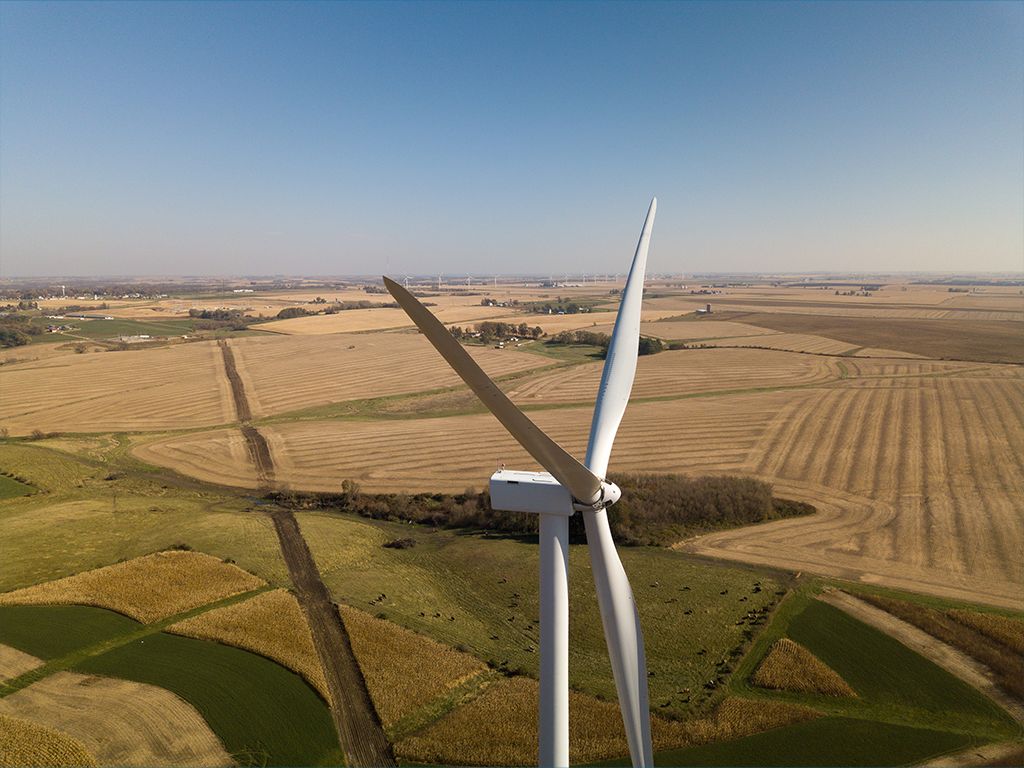
MGE generates and distributes electricity to 161,000 customers in Dane County and purchases and distributes natural gas to 173,000 customers in seven south-central and western Wisconsin counties. Keebler, who serves as MGE’s chairman, president, and CEO, prefers not to use the term buy-in when discussing customer enthusiasm for net-zero, but he knows the related goals — 80% carbon reduction by 2030 (using 2005 as the baseline), and then net-zero carbon electricity by 2050 — is important to them. Having already reduced carbon emissions 39% from 2005 levels, MGE is gaining on the 2030 goal with a combination of solar, wind, and “dispatchability” projects involving natural gas and battery technology. Reaching the 2050 goal will require some type of technological improvement that Keebler is confident will come.
“I can tell you with current technology and cost structures that we will hit our 80% carbon reduction goal by 2030,” he states. “What I don’t know is exactly the technology or exactly the cost structures that are going to be around to hit our goal for net zero by 2050. All that means is just like when we set our initial 2030 goal, which we set that back in 2015, we didn’t know exactly what the cost and technology was going to be, but we knew it was going to develop and we’re expecting the same thing between now and 2050.”
Reaching the longer-term goal will certainly include more solar and more wind, and Keebler anticipates substantial technological improvements in battery technology. Right now, most batteries have four-hour battery lives and that’s not sufficient, so MGE is testing a new type of battery with the co-owners of the Columbia Energy Center, located south of Portage, Wisconsin. “We’re testing it on the Columbia site. We call it the Energy Dome and it’s a technology that basically can create power by shifting an air process from a gas state to a liquid state, and so we think those things are going to come,” Keebler states. “We also know there are other things out there. Hydrogen technology, renewable natural gas technology, carbon capture technology, [and] people are talking about nuclear technology — that may come too. So, we need technology to improve between 2030 and 2050, and we expect that that’s going to happen.”
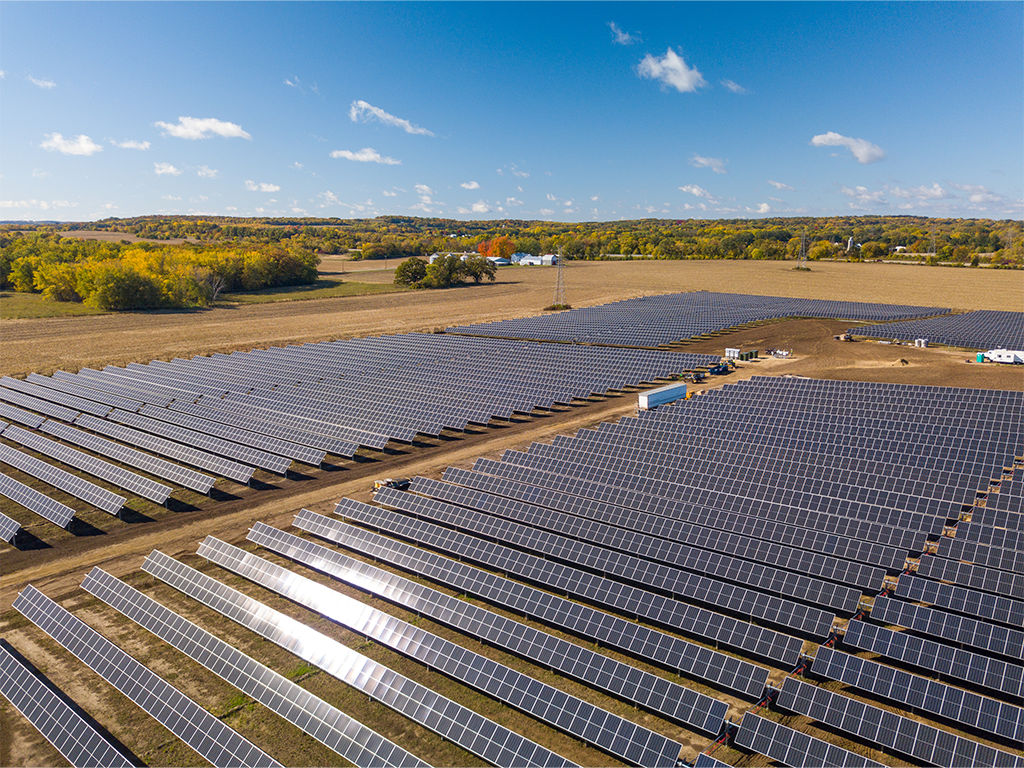
Some technological improvements have already been implemented, such as the bifacial solar panels used at MGE’s new 6-megawatt Tyto Solar installation in Fitchburg and several previous installations. Bifacial solar panels produce energy from both sides of the panel, which produces more energy without reducing the useable life of the panels. Over the course of one year, they provide a 30% increase in output from a solar facility over monofacial panels.
Add to that the continuing electrification of transportation, including public transit with the late 2024 opening of bus rapid transit; the charging network MGE is building throughout Greater Madison, including multifamily garages and pole-mounted chargers; home-based approaches such as MGE Connect for smart thermostats; and its work to achieve net-zero methane emissions from its natural gas distribution system by 2035, and it’s clear that MGE’s carbon reduction goals are being pursued on several fronts.
Meeting the 2030 goal alone will require roughly $1 billion in investment from 2016–2028, with more investment planned in 2029 and 2030. As Keebler notes, most customers feel that commitment is worthwhile in order for them to have 80% fewer carbon emissions from their electricity than they had in the baseline year of 2005. “Some of that is already included in our rates,” he explains, “and then when you think about the investment in wind and solar, those come with no fuel costs. Typically, when you’re using something that you’re dispatching, you have fuel costs associated with it, but wind and solar don’t have fuel costs. So, we get to remove those costs from our existing rate structures. I don’t want to leave anyone with the impression that it’s $1 billion net. It’s actually lower than that because of the fuel cost savings that we see.”
Safety first
Steve Lindley, president of Hooper Corp. (No. 13), has a very simple growth strategy, and it doesn’t involve mergers and acquisitions to drive growth or expand service or geographic reach. It’s about treating its 900-plus employees right.
Hooper is known for mechanical and electric power construction, HVAC, plumbing, and fire protection service — with activity split pretty evenly between the mechanical trades — HVAC, plumbing, and fire protection, and process piping — and the power side. The array of services are set up to serve the entire life cycle of a building.
As such, customer relationship building is vitally important, but in order for that to be sustained on a consistent basis, job one is creating a culture of safety. If that sounds like marketing tripe, consider the challenge of recruiting people in the trades — especially at the rate baby boomers are retiring — and consider the high level of importance Hooper must place on safety, especially with its power construction work.
The company is involved with projects from the Epic campus expansion to the West Virginia mountains to Florida’s hurricane country. While there was a distant acquisition — in 1994, Hooper acquired General Heating and Air Conditioning, which now is under the Hooper umbrella — the company focuses on organic growth, long-term partnerships with customers, and providing its field workers with the leadership and skills training, tools and equipment, and facilities (including its new DeForest campus) they need to be successful.
It sounds basic, but the strategy must be executed with more than empty promises. “If we do that right, we get really good people to work here,” he explains. “If we get really good people to work here, we do really good work, and we get more work, and then we can attract more people. So, it’s really a people-centered thing, and then of course to support that, we have to continue to reinvest in the business.”
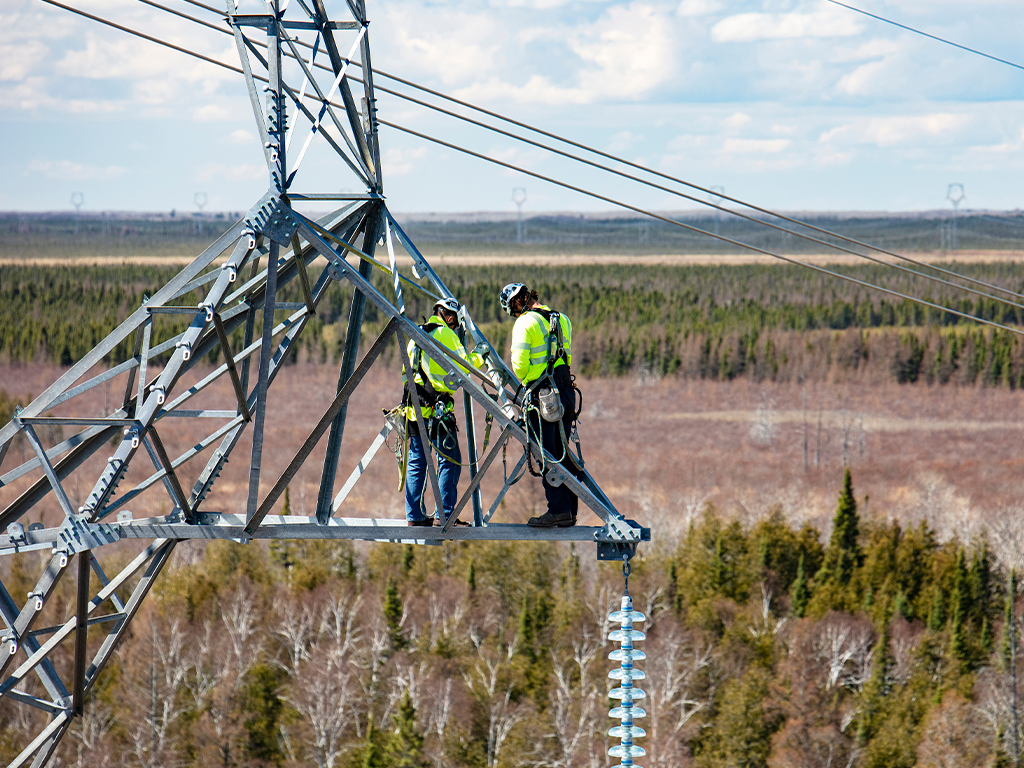
All of which results in a better performing business, which is conducted in various geographic regions. Hooper could be building transmission lines in northern Minnesota, downtown Denver, or Key West, Florida. On the mechanical side, it’s constructing another utility structure to power buildings on Epic’s Verona campus with geothermal energy.
The use of multiple trades on health care facilities like Arrowhead Pharmaceutical and UW Health’s East Clinic, or the capital improvements being undertaken by the Madison Metropolitan School District, demonstrate Hooper’s versatility. In addition, there are few local marquee projects that Hooper hasn’t worked on, and its project work includes the Fiserv Forum in Milwaukee, and the Kohl Center, the Spark/StartingBlock building, and the Mead Witter School of Music’s Hamel Music Center in Madison.
The variety of the work, the challenge associated with building in different geographic locations, and the ability to install emerging alternative energy systems add to Hooper’s attractiveness as a place to work. “There isn’t one magic bullet,” Lindley notes. “There’s a whole lot of things that go into that, and you have to be conscious of it all the time … It really boils down to whether the people you work with collectively enjoy working with each other. Do they enjoy the corporate culture? Do they like being here? Do they feel valued?”

